

1. Statement of the Concept
The Equation of Continuity expresses the principle of conservation of mass for a fluid in steady (non-compressible) flow.
It states that:
“The mass of a fluid entering a tube per unit time is equal to the mass leaving it per unit time.”
In other words, for an incompressible and non-viscous fluid flowing through a pipe of varying cross-section, the mass flow rate remains constant along the pipe.
Mathematically,
[A_1 v_1] [= A_2 v_2] [= \text{constant}]
where [A] = area of cross-section, and [v] = velocity of fluid at that section.
2. Explanation and Mathematical Derivation
Consider a fluid flowing through a pipe that has two sections of different areas [A₁] and [A₂], and the corresponding velocities [v₁] and [v₂].
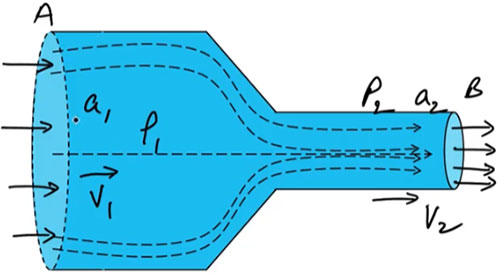
During a small time interval [Δt]:
- Volume entering through section 1: [A₁v₁Δt]
- Volume leaving through section 2: [A₂v₂Δt]
- Since fluid is incompressible,
[
A₁v₁Δt = A₂v₂Δt
]
Simplifying,
[
A₁v₁ = A₂v₂
]
This is the Equation of Continuity.
3. Dimensions and Units
| Quantity | Symbol | Dimensions | SI Unit |
|---|---|---|---|
| Area | [A] | [L²] | m² |
| Velocity | [v] | [L T⁻¹] | m/s |
| Volume rate of flow | [A v] | [L³ T⁻¹] | m³/s |
4. Key Features
- Represents mass conservation in fluid dynamics.
- Flow rate [A v] remains constant for steady flow.
- If the cross-section decreases, velocity increases (and vice versa).
- Explains why water speed increases when coming out of a narrow pipe.
- Used in Venturi meter, carburetors, blood flow, and aerodynamics.
5. Important Formulas to Remember
| Formula | Description |
|---|---|
| [A₁v₁ = A₂v₂] | Equation of Continuity |
| [ρ₁A₁v₁ = ρ₂A₂v₂] | For compressible fluids |
| [Q = A v] | Rate of flow or discharge |
6. Conceptual Questions with Solutions
1. What principle does the equation of continuity represent?
It represents the **conservation of mass** in steady fluid flow.
2. Why does velocity increase when a fluid passes through a narrow pipe?
Because the product [A v] must remain constant; as [A] decreases, [v] must increase.
3. How is continuity equation modified for compressible fluids?
It becomes [ρ₁A₁v₁ = ρ₂A₂v₂], accounting for variable density.
4. Why is the continuity equation not applicable for turbulent flow?
Because in turbulence, the flow is unsteady and mass flow rate is not uniform.
5. If area is doubled, what happens to velocity?
Velocity becomes half, since [A v = constant].
6. What happens to the flow rate if both area and velocity are doubled?
[Q = A v] becomes four times the original flow rate.
7. Why does a river flow faster at narrow regions?
Because the cross-section area decreases, so velocity increases to conserve mass flow.
8. How can we experimentally verify the continuity equation?
By measuring flow speeds at two points in a varying pipe and checking if [A₁v₁ = A₂v₂].
9. Does the equation apply to gases?
Yes, but only if density variations are negligible or accounted for.
10. What is the physical meaning of [A v]?
It represents the **volume flow rate** or **discharge** — volume of fluid passing per second.
11. Why is velocity uniform across a section assumed?
To simplify, we assume laminar flow so all streamlines move parallel and velocity is average across section.
12. How is the equation related to Bernoulli’s principle?
Both express conservation laws: continuity for mass, Bernoulli for energy.
13. What if [A₂ < A₁] and fluid is incompressible?
Then [v₂ > v₁] — the flow accelerates through the constriction.
14. Why does water jet from a tap speed up while falling?
The cross-section shrinks as velocity increases due to gravity, maintaining [A v = constant].
15. Why is the continuity equation independent of viscosity?
Because it depends only on mass conservation, not on internal friction forces.
7. FAQ / Common Misconceptions
1. Is continuity equation valid for gases?
Only if gas density is approximately constant or included in the equation [ρA v = constant].
2. Does faster flow mean higher pressure?
Not necessarily — pressure relation depends on Bernoulli’s equation, not continuity alone.
3. Can continuity hold in leaking pipes?
No, because mass is not conserved — some fluid is lost.
4. Is area always inversely proportional to velocity?
Only for steady incompressible flow; not for compressible fluids.
5. Does continuity imply constant speed?
No, it implies constant mass flow rate — speed can vary with area.
6. Why is the equation not applicable to turbulent flow?
Because velocity and flow rate fluctuate irregularly, violating steady-flow assumptions.
7. What is conserved in continuity — mass or volume?
Mass. Volume is conserved only if density is constant (incompressible fluid).
8. Can [A v] vary with height?
Not in steady flow; but if density changes with height, [ρA v] remains constant instead.
9. Why is water faster at the mouth of a hose?
Because cross-section is smaller, velocity increases to maintain [A v = constant].
10. Does the continuity equation account for energy losses?
No, it only ensures mass conservation — energy losses are covered by Bernoulli’s equation corrections.
8. Practice Questions (with Step-by-Step Solutions)
Q1. Water flows through a pipe of diameter 10 cm with speed 2 m/s. Find the speed where the diameter reduces to 5 cm.
Solution:
Using [A₁v₁ = A₂v₂]
[\dfrac{π(0.1)^2}{4} × 2] [= \dfrac{π(0.05)^2}{4} × v₂]
[v₂ = 8 m/s]
Q2. A horizontal tube tapers from 40 cm² to 10 cm². If fluid enters at 1 m/s, find exit speed.
Solution:
[A₁v₁ = A₂v₂]
[v₂ = \dfrac{A₁v₁}{A₂}] [= \dfrac{40×1}{10}] [= 4 m/s]
Q3. If velocity doubles in a narrowing section, what happens to cross-section?
Solution:
[A₂ = \dfrac{A₁v₁}{v₂}] [= \dfrac{A₁}{2}]
So cross-section halves.
Q4. Air (ρ constant) flows through a venturi tube where [A₁ = 5A₂]. If [v₁ = 2 m/s], find [v₂].
Solution:
[A₁v₁ = A₂v₂] → [v₂ = 5 × 2 = 10 m/s]
Q5. A water jet from a tap contracts as it falls. Why?
Solution:
Velocity increases due to gravity, and to maintain [A v = constant], area decreases. Hence, the stream narrows.
 Sign in with Google