


1. Concept Overview
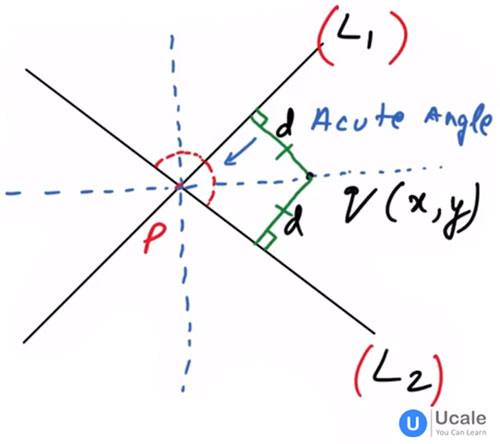
The angle bisectors of two intersecting straight lines are the lines which divide the angle between the two given lines into two equal angles.
For two non-parallel lines, there are two angle bisectors:
- One bisects the acute angle
- The other bisects the obtuse angle
2. Mathematical Explanation and Derivation
Equations of the Given Lines
Let the two lines be:
- Line 1: [a_1 x + b_1 y + c_1 = 0]
- Line 2: [a_2 x + b_2 y + c_2 = 0]
Let [(x, y)] be any point on the angle bisector.
Key Idea (Very Important Concept)
A point on the angle bisector has equal perpendicular distances from both lines.
Using the distance of a point from a line formula:
[\dfrac{|a_1 x + b_1 y + c_1|}{\sqrt{a_1^2 + b_1^2}} ][= \dfrac{|a_2 x + b_2 y + c_2|}{\sqrt{a_2^2 + b_2^2}}]
Removing Absolute Values
We obtain two equations, corresponding to the two angle bisectors:
[\dfrac{a_1 x + b_1 y + c_1}{\sqrt{a_1^2 + b_1^2}} ][= \pm\dfrac{a_2 x + b_2 y + c_2}{\sqrt{a_2^2 + b_2^2}}]
Final Standard Form
[\dfrac{a_1 x + b_1 y + c_1}{\sqrt{a_1^2 + b_1^2}} ][= \pm\dfrac{a_2 x + b_2 y + c_2}{\sqrt{a_2^2 + b_2^2}}= 0]
3. Key Features and Observations
- Angle bisectors always pass through the point of intersection
- There are two angle bisectors for any pair of intersecting lines
- The “+” sign corresponds to one bisector, “−” to the other
- Formula is independent of slopes
- Works even when lines are vertical or horizontal
4. Important Results to Remember
| Situation | Equation |
|---|---|
| General angle bisectors | [\dfrac{L_1}{\sqrt{a_1^2+b_1^2}} ][= \pm \dfrac{L_2}{\sqrt{a_2^2+b_2^2}}] |
| Lines intersect | Two bisectors |
| Lines perpendicular | Bisectors at 45° |
5. Conceptual Questions with Detailed Solutions
1. Why do angle bisectors use perpendicular distance, not slope?
Angle is a geometric concept, not dependent on coordinate orientation.
Perpendicular distance ensures rotational invariance, while slopes fail for vertical lines.
2. Why are there two angle bisectors?
Two lines form four angles: two acute and two obtuse.
Each pair of vertically opposite angles has its own bisector.
3. Why does the formula include ± sign?
The “+” and “−” arise from removing absolute values, giving two distinct bisectors.
4. Do angle bisectors depend on the scale of equations?
No.
Dividing by [\sqrt{a^2+b^2}] normalizes the equation, removing scale dependence.
5. Can angle bisectors be parallel to given lines?
Never.
Angle bisectors always intersect both lines at the same point.
6. FAQ / Common Misconceptions (Deep Exam Points)
1. Students think + gives acute bisector always.
Incorrect.
Which sign gives the acute bisector depends on the given equations.
2. Forgetting to normalize equations.
Without dividing by [\sqrt{a^2+b^2}], results become incorrect.
3. Confusing angle bisector with perpendicular bisector.
Angle bisector divides angle, not distance between points.
4. Assuming parallel lines have angle bisectors.
Parallel lines do not intersect, hence no angle is formed.
5. Ignoring absolute value logic.
Absolute value is the reason two bisectors exist.
7. Practice Questions with Step-by-Step Solutions
Question 1: Find the equations of the angle bisectors of the lines [x − y = 0] and [x + y = 0].
Step-by-Step Solution:
1. Write equations in standard form:
[x − y = 0]
[x + y = 0]
2. Identify coefficients:
For first line: [a_1 = 1, b_1 = −1, c_1 = 0]
For second line: [a_2 = 1, b_2 = 1, c_2 = 0]
3. Compute denominators:
[\sqrt{a_1^2 + b_1^2} = \sqrt{1 + 1} = \sqrt{2}]
[\sqrt{a_2^2 + b_2^2} = \sqrt{1 + 1} = \sqrt{2}]
4. Apply angle bisector formula:
[[(x − y)/\sqrt{2}] = ± [(x + y)/\sqrt{2}]]
5. Simplify:
Case 1 (+):
[x − y = x + y ⇒ y = 0]
Case 2 (−):
[x − y = −x − y ⇒ x = 0]
Answer: Angle bisectors are [y = 0] and [x = 0].
Question 2: Find the angle bisectors of [2x + y = 0] and [x − 2y = 0].
Step-by-Step Solution:
1. Standard forms:
[2x + y = 0]
[x − 2y = 0]
2. Coefficients:
[a_1 = 2, b_1 = 1]
[a_2 = 1, b_2 = −2]
3. Denominators:
[\sqrt{5}], [\sqrt{5}]
4. Formula:
[(2x + y)/\sqrt{5} ][= ± (x − 2y)/\sqrt{5}]
5. Simplify:
Case 1 (+):
[2x + y = x − 2y][ ⇒ x + 3y = 0]
Case 2 (−):
[2x + y = −x + 2y][ ⇒ 3x − y = 0]
Answer: Angle bisectors are [x + 3y = 0] and [3x − y = 0].
Question 3: Find the angle bisectors of [x = 0] and [y = 0].
Step-by-Step Solution:
1. Write in standard form:
[x = 0]
[y = 0]
2. Apply formula:
[[x/1] = ± [y/1]]
3. Simplify:
[x = y] and [x = −y]
Answer: Angle bisectors are [x − y = 0] and [x + y = 0].
Question 4: Find the angle bisectors of [3x + 4y − 10 = 0] and [4x − 3y + 5 = 0].
Step-by-Step Solution:
1. Identify coefficients:
First line: [a_1 = 3,][ b_1 = 4,][ c_1 = −10]
Second line: [a_2 = 4,][ b_2 = −3,][ c_2 = 5]
2. Denominators:
[\sqrt{3^2 + 4^2} = 5]
[\sqrt{4^2 + (−3)^2} = 5]
3. Apply formula:
[(3x + 4y − 10)/5 ][= ± (4x − 3y + 5)/5]
4. Simplify:
Case 1 (+):
[3x + 4y − 10 ][= 4x − 3y + 5 ][⇒ x − 7y + 15 = 0]
Case 2 (−):
[3x + 4y − 10 ][= −4x + 3y − 5][ ⇒ 7x + y − 5 = 0]
Answer: Angle bisectors are [x − 7y + 15 = 0] and [7x + y − 5 = 0].
Question 5: Find the angle bisectors of [x + y − 1 = 0] and [x − y + 3 = 0].
Step-by-Step Solution:
1. Denominators:
[\sqrt{2}], [\sqrt{2}]
2. Formula:
[(x + y − 1)/\sqrt{2}] [= ± (x − y + 3)/\sqrt{2}]
3. Simplify:
Case 1 (+):
[x + y − 1 = x − y + 3][ ⇒ 2y − 4 = 0][ ⇒ y = 2]
Case 2 (−):
[x + y − 1 = −x + y − 3][ ⇒ 2x + 2 = 0][ ⇒ x = −1]
Answer: Angle bisectors are [y = 2] and [x = −1].
Question 6: Find the angle bisectors of [2x − 3y + 6 = 0] and [3x + 2y − 4 = 0].
Step-by-Step Solution:
1. Denominators:
[\sqrt{13}], [\sqrt{13}]
2. Formula:
[(2x − 3y + 6)/\sqrt{13}] [= ± (3x + 2y − 4)/\sqrt{13}]
3. Simplify:
Case 1 (+):
[2x − 3y + 6 = 3x + 2y − 4][ ⇒ x + 5y − 10 = 0]
Case 2 (−):
[2x − 3y + 6 = −3x − 2y + 4][ ⇒ 5x − y + 2 = 0]
Answer: Angle bisectors are [x + 5y − 10 = 0] and [5x − y + 2 = 0].
Question 7: Find the angle bisectors of [x − 2y = 0] and [2x − y = 0].
Step-by-Step Solution:
1. Denominators:
[\sqrt{5}], [\sqrt{5}]
2. Formula:
[(x − 2y)/\sqrt{5}] [= ± (2x − y)/\sqrt{5}]
3. Simplify:
Case 1 (+):
[x − 2y = 2x − y ][⇒ x + y = 0]
Case 2 (−):
[x − 2y = −2x + y ][⇒ 3x − 3y = 0 ][⇒ x − y = 0]
Answer: Angle bisectors are [x + y = 0] and [x − y = 0].
Question 8: Find the angle bisectors of [3x − y + 1 = 0] and [x + 3y − 7 = 0].
Step-by-Step Solution:
1. Denominators:
[\sqrt{10}], [\sqrt{10}]
2. Formula:
[(3x − y + 1)/\sqrt{10} ][= ± (x + 3y − 7)/\sqrt{10}]
3. Simplify:
Case 1 (+):
[3x − y + 1 = x + 3y − 7 ][⇒ 2x − 4y + 8 = 0]
Case 2 (−):
[3x − y + 1 = −x − 3y + 7 ][⇒ 4x + 2y − 6 = 0]
Answer: Angle bisectors are [x − 2y + 4 = 0] and [2x + y − 3 = 0].
Question 9: Find the angle bisectors of [x + 2y + 4 = 0] and [2x + y − 5 = 0].
Step-by-Step Solution:
1. Denominators:
[\sqrt{5}], [\sqrt{5}]
2. Formula:
[(x + 2y + 4)/\sqrt{5} ][= ± (2x + y − 5)/\sqrt{5}]
3. Simplify:
Case 1 (+):
[x + 2y + 4 = 2x + y − 5 ][⇒ x − y − 9 = 0]
Case 2 (−):
[x + 2y + 4 = −2x − y + 5 ][⇒ 3x + 3y − 1 = 0]
Answer: Angle bisectors are [x − y − 9 = 0] and [3x + 3y − 1 = 0].
Question 10: Find the angle bisectors of [4x + 3y − 6 = 0] and [3x − 4y + 8 = 0].
Step-by-Step Solution:
1. Denominators:
[\sqrt{25}], [\sqrt{25}]
2. Formula:
[(4x + 3y − 6)/5 ][= ± (3x − 4y + 8)/5]
3. Simplify:
Case 1 (+):
[4x + 3y − 6 = 3x − 4y + 8 ][⇒ x + 7y − 14 = 0]
Case 2 (−):
[4x + 3y − 6 = −3x + 4y − 8 ][⇒ 7x − y + 2 = 0]
Answer: Angle bisectors are [x + 7y − 14 = 0] and [7x − y + 2 = 0].
 Sign in with Google