

1. Statement of the Law / Concept Overview
Michael Faraday discovered that an emf (electromotive force) is induced in a closed circuit whenever magnetic flux linked with the circuit changes.
This process is called electromagnetic induction.
Faraday’s First Law states:
Whenever magnetic flux linked with a closed coil changes, an emf is produced in the coil.
The induced emf lasts only as long as the magnetic flux is changing.
Flux can change due to:
- changing magnetic field strength,
- changing the area of the coil,
- changing the orientation (angle) of the coil,
- moving the coil in or out of a magnetic field.
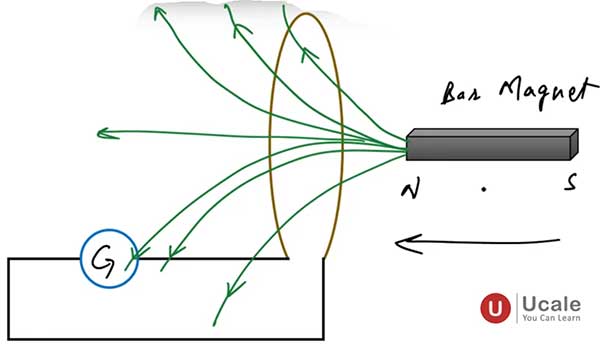
Even if there is no battery, a changing magnetic environment creates electricity.
This is the fundamental principle behind generators, transformers, induction motors, and alternators.
2. Clear Explanation and Mathematical Derivation
Magnetic flux linked with a coil of N turns:
[ \Phi = NBA\cos\theta ]
If any of the quantities B, A, or θ changes with time, the flux changes.
Experiments by Faraday show:
- When a magnet approaches a coil → flux increases → emf induced
- When magnet moves away → flux decreases → emf induced
- When magnet stops → flux constant → emf = 0
Thus emf depends only on rate of change of flux, not on motion alone.
Mathematically,
[ \text{Induced emf}] [\propto \dfrac{d\Phi}{dt} ]
The constant of proportionality becomes 1 in Faraday’s second law, but the first law only tells when emf occurs, not how much.
So, Faraday’s First Law is about presence or absence of emf, not its magnitude.
3. Dimensions and Units of Magnetic Flux
Since emf is proportional to the rate of change of flux:
- Flux unit → Weber (Wb)
- Dimensions → [ML^2T^{-2}A^{-1}]
The law itself is qualitative, so emf is not included here.
4. Key Features
- Emf is induced only when magnetic flux changes, not when it is constant.
- Emf is produced without any physical contact or battery.
- Induction works even if coil is stationary but magnet moves.
- Works even if magnet is stationary but coil moves.
- Faster changes in flux induce stronger emf.
- Principle behind electric generators and transformers.
- Induced current exists only while flux is changing.
- Explains electricity generation from mechanical motion.
5. Important Formulas to Remember
| Concept | Formula |
|---|---|
| Magnetic flux | [\Phi = BA\cos\theta] |
| Condition for induction | [\dfrac{d\Phi}{dt} \neq 0] |
| No induction condition | [\dfrac{d\Phi}{dt} = 0] |
| Flux linkage (N turns) | [\Phi_N = N\Phi] |
6. Conceptual Questions with Solutions
1. Why does constant magnetic flux not induce emf?
Because emf is induced only when flux changes. If flux stays constant, then [\dfrac{d\Phi}{dt} = 0], so no emf is produced.
2. Why does moving a magnet toward a coil induce emf?
Moving the magnet changes the magnetic field strength near the coil, changing the flux and inducing emf.
3. Why is emf induced even if the coil does not move?
Flux can change due to a moving magnet or a changing magnetic field, even if the coil is stationary.
4. Why does induced emf last only while the magnet is moving?
Because only motion causes flux to change. Once motion stops, flux becomes constant and emf becomes zero.
5. Why does changing the area of the coil affect flux?
Flux depends on area. Increasing or decreasing area changes the number of field lines passing through the coil.
6. Why does rotating a coil induce emf?
Rotation changes the angle θ between magnetic field and area vector, causing flux to change.
7. Can emf be induced without a magnet?
Yes. Changing current in a nearby coil or electromagnet can also change magnetic field and induce emf.
8. Why is emf induced more strongly when magnet is moved faster?
A faster change of flux means a higher [\dfrac{d\Phi}{dt}], producing stronger emf.
9. Why does a closed coil behave differently from an open coil?
In a closed coil, induced emf can produce current. In an open coil, emf is produced but no current flows.
10. Why does flux change even if only the angle changes?
Flux depends on cosine of the angle. Changing θ continuously changes [\Phi].
11. Why is Faraday’s first law qualitative?
Because it only states whether emf is induced—not the magnitude. Quantitative expression comes from the second law.
12. Why is induction important in power generation?
Mechanical motion of turbines changes flux in coils, producing electricity.
13. Why does a stationary magnet not induce emf?
If the magnet is stationary relative to the coil, flux does not change, so no emf is induced.
14. Why do we need a closed loop for current?
Emf can be induced in any loop, but current flows only if the circuit is closed.
15. Can induction occur in non-conducting materials?
Emf is induced in conductors. Non-conductors can experience changing fields, but no induced current flows.
7. FAQ / Common Misconceptions
1. Does emf require actual cutting of field lines?
No. Flux change—not physical cutting—causes induction.
2. Does the magnet need to be strong to induce emf?
No. Even a weak magnet induces emf if moved fast enough.
3. Does induction occur only with magnets?
No. Any changing magnetic field (even from a coil) can induce emf.
4. Does emf mean current always flows?
No. Only a closed circuit allows current flow; emf exists even in open coils.
5. Is changing flux the same as changing field?
Not necessarily. Flux can change by changing orientation or area even if field strength is constant.
6. Can a stationary coil in a stationary magnetic field produce emf?
No. Without flux change, no emf appears.
7. Does induction violate energy conservation?
No. Mechanical work done in changing the flux appears as electrical energy.
8. Is induced emf always AC?
No. It can be AC (in generators) or DC (in some motions).
9. Does flux mean magnetic field lines physically pass through the coil?
No. Flux is a mathematical representation of field linkage.
10. Does a larger coil always produce larger emf?
Not always. Only the **change** in flux determines emf.
8. Practice Questions (With Step-by-Step Solutions)
Q1. A coil is placed in a region of constant magnetic field. Will emf be induced? Why?
Solution:
Flux is constant → [\dfrac{d\Phi}{dt} = 0]
So no emf is induced.
Q2. A magnet is moved toward a coil. What happens to the flux?
Flux increases because magnetic field strength near the coil increases.
Q3. A coil of area 0.02 m² is rotated in a magnetic field. Will flux change?
Yes. Rotation changes θ → flux changes.
Q4. A coil is pushed into a magnetic field. What happens?
Flux increases as coil enters the field → emf induced.
Q5. A magnet is held stationary near a coil. No emf is observed. Why?
Because flux is constant when magnet is not moving → no induced emf.
 Sign in with Google