

1. Concept Overview
The electric field intensity on the axial line of an electric dipole is the net electric field produced by the two equal and opposite charges of the dipole at any point lying along its axis.
It is a strong field region and decreases with distance as [\dfrac{1}{r^3}] for distant points.
2. Clear Explanation and Mathematical Derivation
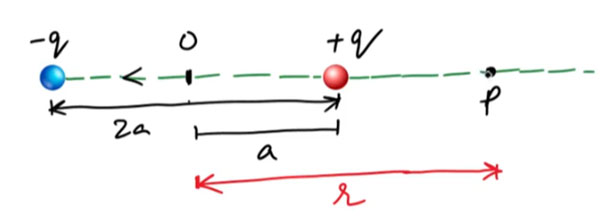
Consider a dipole consisting of:
- Charges: [+q] and [-q]
- Separation: [2a]
- Dipole moment: [\vec{p} = q(2a)\hat{l}]
Let point (P) lie on the axial line of the dipole at a distance [r] from the center.
Electric Field at P
Distance from charges to point P:
[r_+ = r – a],[\qquad] [r_- = r + a]
Electric field due to:
- Positive charge (+q) at distance [r – a]:
[E_+] [= \dfrac{1}{4\pi\varepsilon_0}\dfrac{q}{(r-a)^2}] - Negative charge (-q) at distance [r + a]:
[E_-] [= \dfrac{1}{4\pi\varepsilon_0}\dfrac{q}{(r+a)^2}]
Both fields are in the same direction (from +q to -q).
Net Electric Field on Axial Line
[E_{\text{axial}}] $= \dfrac{1}{4\pi\varepsilon_0}\left[ \dfrac{q}{(r-a)^2} – \dfrac{q}{(r+a)^2} \right]$
Simplifying:
[E_{\text{axial}}] [= \dfrac{1}{4\pi\varepsilon_0}\cdot \dfrac{4qar}{(r^2-a^2)^2}]
Substitute (p = 2aq):
[E_{\text{axial}}] [= \dfrac{1}{4\pi\varepsilon_0}\cdot \dfrac{2pr}{(r^2-a^2)^2}]
At Large Distance (r >> a)
If the observation point is far:
[E_{\text{axial}}] [\approx \dfrac{1}{4\pi\varepsilon_0}\dfrac{2p}{r^3}]
This is the commonly used form.
3. Dimensions and Units
| Quantity | Dimensions | SI Unit |
|---|---|---|
| Electric Field (E) | ([MLT^{-3}A^{-1}]) | N/C or V/m |
| Dipole Moment (p) | ([ITA]) | C·m |
4. Key Features
- Field is strongest along the axial line.
- Decreases as [\dfrac{1}{r^3}] for distant points.
- Direction of field: from +q to -q along the dipole axis.
- Both charges contribute fields in the same direction on the axial line.
- Depends on dipole moment (p).
- The axial field is twice the equatorial field in magnitude (at far distances).
- The field is non-uniform.
5. Important Formulas to Remember
| Formula | Meaning |
|---|---|
| [p = 2aq] | Dipole moment |
| [E_{\text{axial}}] $= \dfrac{1}{4\pi\varepsilon_0}\left(\dfrac{q}{(r-a)^2} – \dfrac{q}{(r+a)^2}\right)$ | Exact field on axial line |
| [E_{\text{axial}}] [= \dfrac{1}{4\pi\varepsilon_0}\cdot \dfrac{2pr}{(r^2-a^2)^2}] | Simplified exact form |
| [E_{\text{axial}}] [\approx \dfrac{1}{4\pi\varepsilon_0}\cdot\dfrac{2p}{r^3}] | Approximate (far field) |
6. Conceptual Questions with Solutions
1. Why do both charges of a dipole produce fields in the same direction on the axial line?
Because on the axial line, the electric field of +q points away from it, and that of -q points toward it — both along the same axis direction.
2. What is the effect of increasing dipole moment on the axial field?
Axial field increases because \[E_{\text{axial}} \propto p\]. Larger separation or charge → greater field.
3. Why does axial field vary as [\dfrac{1}{r^3}] for distant points?
Because the dipole consists of two opposite charges whose fields partially cancel, leaving a term proportional to the **derivative** of a point charge field, giving \[\dfrac{1}{r^3}\].
4. Why is the axial field stronger than equatorial field?
Because on the axial line, fields from both charges add; on the equatorial line, they partially cancel.
5. What happens to axial field if r = a?
The expression becomes undefined (denominator zero). Physical field is extremely large near the charges.
6. Why is the axial field directed from +q to -q?
Because electric field lines always originate from + and terminate at − charges.
7. What happens to axial field if the dipole moment becomes zero?
If \(p = 0\), dipole ceases to exist → **E = 0** along axis (except due to other charges).
8. Does doubling separation (2a) double the axial field?
No. Dipole moment becomes \[p = 2aq\], and field depends on p but also on r and a in the denominator. So effect is not linear.
9. Why does exact formula use (r − a) and (r + a)?
Because the observation point is at different distances from +q and -q.
10. Why is approximation [r >> a] used?
Because it simplifies the expression and is valid for points far away compared to dipole length.
11. Does the axial field depend on the orientation of dipole?
Yes, the direction of E depends on dipole alignment; magnitude depends on p and r.
12. Does the axial field ever become zero?
No, except at infinite distance or if \(p = 0\). Along the axis, fields from both charges are additive.
13. Why is axial field proportional to p and not q?
Because dipole behaves as a combined system of two opposite charges separated by 2a; p captures this combined effect.
14. Why is axial field non-uniform?
Because it depends strongly on the distance r from the dipole. Changing r changes E rapidly.
15. Why is axial field used to identify the strength of a dipole?
Because it directly depends on dipole moment and shows clear measurable variation with r.
7. FAQ / Common Misconceptions
1. Is axial field the same as the field of a point charge?
No. Point charge field varies as \[\dfrac{1}{r^2}\], but dipole axial field varies as \[\dfrac{1}{r^3}\] (far region).
2. Do both charges always add their fields on the axial line?
Yes, because directions align on the axial line.
3. Is axial field direction always outward?
No. It depends on the orientation of the dipole. Direction is always from +q to -q.
4. Is axial field infinite at r = 0?
No. r = 0 is the midpoint and field is finite. Infinity occurs at r = a (charge location).
5. Does the axial field depend on medium?
Yes. Replace \[\varepsilon_0\] with \[\varepsilon\] for mediums: \[ E = \dfrac{1}{4\pi\varepsilon} \cdot\dfrac{2p}{r^3} \]
6. Is axial field always twice the equatorial field?
Only for **far field**: \[ E_{\text{axial}} = 2E_{\text{equatorial}} \]
7. Does changing sign of charges affect magnitude of axial field?
No. Only directions of individual fields change; magnitude remains unchanged.
8. Is axial field maximum at r = a?
Physically yes, because you’re extremely close to a charge, but the theoretical expression diverges.
9. Does dipole field depend on angle?
On axial line, angle = 0°, so field is maximum here.
10. Do axial and equatorial fields ever become equal?
Only at infinite distance, where both approach zero.
8. Practice Questions (with Step-by-Step Solutions)
Q1.
A dipole has charges [q = 5\ \text{μC}] separated by [2a = 6\ \text{cm}].
Find the axial field at a point 20 cm from center.
[\varepsilon_0] [= 8.85\times10^{-12}\ \text{F/m}]
Solution:
- Dipole moment:
[p = q(2a)] [= 5\times10^{-6} \times 0.06] [= 3\times10^{-7}\ \text{C·m}] - Far-field approximation (r >> a):
[E] [= \dfrac{1}{4\pi\varepsilon_0}\cdot \dfrac{2p}{r^3}] - Substitute:
[E] [= 9\times10^9 \cdot\dfrac{2(3\times10^{-7})}{(0.20)^3}]
[E] [= 9\times10^9 \cdot \dfrac{6\times10^{-7}}{0.008}]
[E] [= 9\times10^9 \cdot 7.5\times10^{-5}]
[E] [= 6.75\times10^{5}\ \text{N/C}]
Answer:
[
E = 6.75\times10^{5}\ \text{N/C}
]
Q2.
For a dipole having [p = 4\times10^{-8}\ \text{C·m}], find the axial field at 10 cm.
Solution:
[E] [= \dfrac{1}{4\pi\varepsilon_0}\cdot\dfrac{2p}{r^3}]
[E] [= 9\times10^9 \cdot \dfrac{2(4\times10^{-8})}{(0.10)^3}]
[E] [= 9\times10^9 \cdot \dfrac{8\times10^{-8}}{10^{-3}}]
[E] [= 9\times10^9 \cdot 8\times10^{-5}]
[E] [= 7.2\times10^{5}\ \text{N/C}]
Answer:
[
E = 7.2\times10^{5}\ \text{N/C}
]
Q3.
A dipole has [p = 6\times10^{-9}\ \text{C·m}]. Find the ratio of axial field at distances 5 cm and 10 cm.
Solution:
[
E \propto \dfrac{1}{r^3}
]
[\dfrac{E_1}{E_2}] $= \left(\dfrac{r_2}{r_1}\right)^3$
$= \left(\dfrac{0.10}{0.05}\right)^3 = 2^3 = 8$
Answer:
[
E_{5\text{cm}} = 8E_{10\text{cm}}
]
Q4.
Find axial field at 50 cm for dipole moment [p = 1\times10^{-6}\ \text{C·m}].
Solution:
[E] [= 9\times10^9 \cdot \dfrac{2(10^{-6})}{(0.50)^3}]
[= 9\times10^9 \cdot \dfrac{2\times10^{-6}}{0.125}]
[= 9\times10^9 \cdot 1.6\times10^{-5}]
[= 1.44\times10^{5}\ \text{N/C}]
Q5.
A point is at 30 cm on axial line. Dipole moment: [p = 3\times10^{-7}\ \text{C·m}].
Find axial field.
Solution:
[E] [= 9\times10^9 \cdot \dfrac{2(3\times10^{-7})}{(0.30)^3}]
[= 9\times10^9 \cdot \dfrac{6\times10^{-7}}{0.027}]
[= 9\times10^9 \cdot 2.22\times10^{-5}]
[= 2\times10^{5}\ \text{N/C}]
 Sign in with Google