

1. Concept Overview / Statement of the Law
Fleming’s Left-Hand Rule is a simple and powerful tool used to determine the direction of force experienced by a current-carrying conductor placed in a magnetic field.
A beginner-friendly explanation:
- When a wire carries electric current, the moving charges inside it interact with the surrounding magnetic field.
- This interaction produces a magnetic force on the wire.
- But how do we know which way the wire will move?
- Fleming’s Left-Hand Rule gives the answer using just your left hand.
Statement of the Rule
“If you stretch the thumb, forefinger, and middle finger of your left hand mutually perpendicular to each other, then:
- Forefinger → direction of magnetic field (B)
- Middle finger → direction of current (I)
- Thumb → direction of the force (F) on the conductor.”**
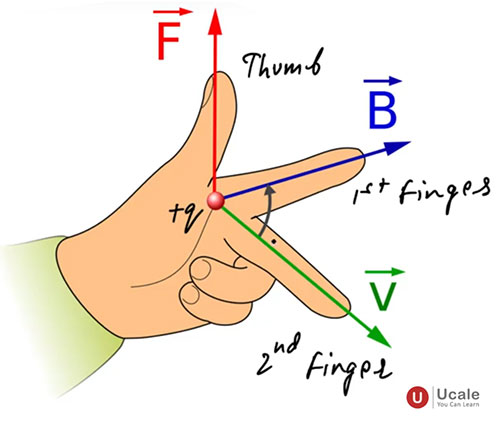
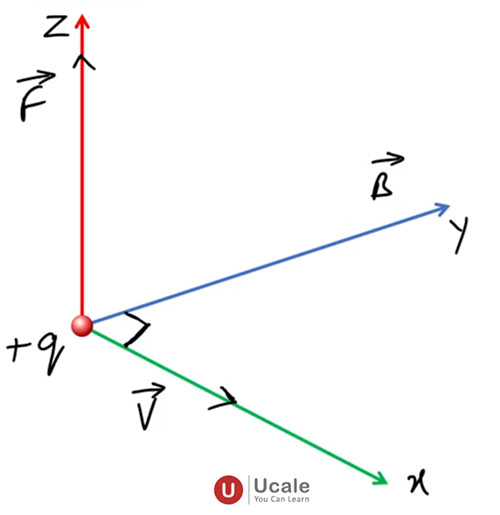
This rule helps visualize the vector cross product in the magnetic force equation:
[\vec{F}] [= I (\vec{L} \times \vec{B})]
Thus, Fleming’s Left-Hand Rule is the direction rule for magnetic force experienced by a current-carrying conductor.
2. Clear Explanation and Mathematical Derivation
Magnetic force on a current-carrying conductor
A conductor of length [\vec{L}] carrying current [I] in a magnetic field [\vec{B}] experiences force:
[\vec{F}] [= I (\vec{L} \times \vec{B})]
Magnitude:
[F = ILB\sin\theta]
- [L] = length of wire inside field
- [B] = magnetic flux density
- [\theta] = angle between current and field
Direction of force
The direction of force is given by the cross product [\vec{L} \times \vec{B}] — which is difficult to visualize directly.
This is where Fleming’s Left-Hand Rule becomes helpful:
- Middle finger (current I)
- Forefinger (magnetic field B)
- Thumb (force F)
When they are mutually perpendicular, moving one of them automatically aligns the other two.
This makes the rule extremely useful in practical applications like electric motors, moving-coil meters, and speakers.
3. Dimensions and Units
The rule itself has no units (it is a direction rule).
But the associated force uses:
Force:
Dimensions:
[F] = [M L T^{-2}]
SI unit:
- Newton (N)
Magnetic Field B:
[B] = [M A^{-1} T^{-2}]
SI unit: Tesla (T)
4. Key Features
- Determines direction of magnetic force on a current-carrying conductor.
- Uses the left hand (right hand is used for generators).
- Fingers must be mutually perpendicular (90° to each other).
- Applies only when conductor carries current in a magnetic field.
- Based on vector cross-product [\vec{F}] [= I(\vec{L} \times \vec{B})].
- Used widely in devices such as motors, loudspeakers, and galvanometers.
- Does not give magnitude of force, only direction.
- Works for both straight and curved conductors.
5. Important Formulas to Remember
| Quantity | Formula |
|---|---|
| Magnetic force on current-carrying conductor | [\vec{F}] [= I(\vec{L} \times \vec{B})] |
| Magnitude of force | [F = ILB\sin\theta] |
| Perpendicular case | [F = ILB] |
| Relation to rule | Direction of [\vec{F}] is given by Fleming’s Left-Hand Rule |
6. Conceptual Questions with Solutions (15+)
1. Why do we use the left hand for motors?
Because motors involve force on a current-carrying conductor. Left-hand rule gives the direction of force. Right-hand rule is used for generators.
2. Why must the three fingers be perpendicular?
Because the physical quantities (current, magnetic field, force) are related by the cross product which involves perpendicular directions.
3. Does this rule give magnitude of force?
No. It only gives direction. Magnitude comes from [F = ILB\sin\theta].
4. What if current is reversed?
Then the middle finger reverses direction, and the thumb (force) also reverses direction.
5. What if magnetic field direction is reversed?
Forefinger reverses, hence thumb (force) reverses too.
6. Why is there no force if the wire is parallel to the magnetic field?
Because [\theta = 0^\circ], so [F = ILB\sin 0 = 0]. No perpendicular component → no force.
7. Why is there maximum force when current is perpendicular to magnetic field?
Because [\sin\theta] is maximum at [90^\circ], giving maximum value to [F = ILB\sin\theta].
8. Why does a current-carrying conductor move in a magnetic field?
Because moving electrons interact with the magnetic field, creating Lorentz force on the wire.
9. Does the rule apply to both positive and negative charges?
For negative charge, force direction is opposite. But the rule applies to a wire where conventional current (positive) is used.
10. What decides the direction of magnetic field lines?
By convention, from North pole to South pole outside the magnet.
11. Why can’t we use the right hand for motors?
Right-hand rule corresponds to induced current in generators, not force in motors.
12. Why is Fleming’s Left-Hand Rule needed when we already have vector cross products?
Cross products are abstract; the rule gives a simple physical model using hand orientation.
13. Why does the force act on the whole conductor?
Because current spreads throughout the conductor; all moving charges experience force simultaneously.
14. Why do motors rotate using this rule?
Each side of the coil experiences opposite forces, creating a turning effect (torque) based on left-hand rule directions.
15. Why does a force appear even when the conductor is not moving?
Force depends on current and magnetic field, not on motion of the conductor itself.
16. Why is the rule not applicable to electric fields?
Electric force has no cross-product dependence; its direction follows the electric field directly.
7. FAQ / Common Misconceptions (10+)
1. Is Fleming’s Left-Hand Rule universal?
No. It applies only to force on a current-carrying conductor in a magnetic field.
2. Is this rule applicable for charges moving freely in space?
No. For free charges, we use Lorentz force and the right-hand rule.
3. Does the rule change for negative current?
No. We use conventional current direction, not electron flow.
4. Are the fingers supposed to be exactly at 90°?
Conceptually yes, but slight deviations don’t matter. The idea is mutual perpendicularity.
5. Is the thumb always force?
Yes. Forefinger is field, middle finger is current, thumb is force.
6. Does the rule tell what happens if field or current increases?
No. It only gives direction, not magnitude.
7. Can it predict rotation direction of a motor?
Yes. Apply the rule on each side of the coil to determine net torque.
8. Do magnetic fields always cause motion?
No. Only if current direction and field direction make a nonzero angle.
9. Is force always perpendicular to current?
Only when [\theta = 90^\circ]. General direction is given by the rule.
10. Is Fleming’s Left-Hand Rule a law of physics?
No. It is a **mnemonic**—a convenient way to remember directions.
8. Practice Questions (with Step-by-Step Solutions)
1. A wire of length [0.5,m] carrying current [I = 4,A] is placed perpendicular to a magnetic field [B = 0.2,T]. Find the force.
[F = ILB]
[F = 4 \times 0.5 \times 0.2 = 0.4,N]
Direction: Use Fleming’s Left-Hand Rule.
2. A current of [2,A] flows through a wire placed at [30^\circ] in a 1 Tesla field. If its length is [1,m], find force.
[F = ILB\sin\theta]
[F = 2 \times 1 \times 1 \times \dfrac{1}{2} = 1,N]
3. A conductor experiences 0 force in a magnetic field. What could be the reason?
Either:
- [\theta = 0^\circ] (parallel to field), or
- [I = 0] (no current), or
- [B = 0]
4. A wire carries current downward and magnetic field is eastward. What is force direction?
Use left hand:
- Middle finger → down
- Forefinger → east
- Thumb → north (force direction)
5. A wire moves upward due to magnetic force. If field is west, what is current direction?
- Thumb → up
- Forefinger → west
- Middle finger → south (current direction)
 Sign in with Google