

1. Statement of the Law or Concept Overview
Fleming’s Right Hand Rule is a visual mnemonic used to determine the direction of induced current in a conductor when it moves in a magnetic field.
It is used in situations involving electromagnetic induction, as described by Faraday’s Law and Lenz’s Law.
If a straight conductor moves inside a magnetic field, the direction of induced current (I) is given by orienting the thumb, forefinger, and middle finger of the right hand mutually perpendicular to each other.
2. Clear Explanation and Mathematical Derivation
According to Faraday’s Law, an induced emf develops when magnetic flux changes:
[
\mathcal{E} = -\dfrac{d\Phi}{dt}
]
For a straight conductor of length [l] moving with velocity [v] in a magnetic field of strength [B]:
[
\mathcal{E} = B l v
]
This emf causes an induced current, but its direction is determined using Fleming’s Right Hand Rule:
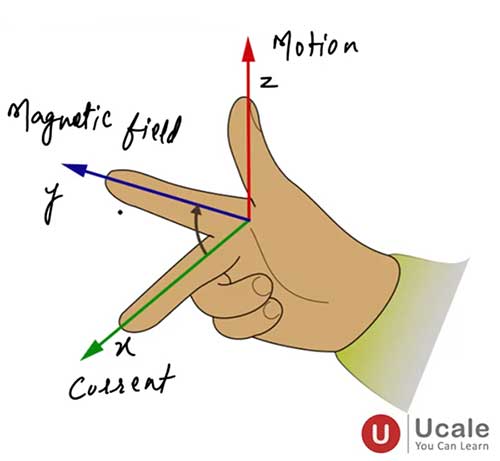
- Forefinger (index finger) → Direction of magnetic field [\vec{B}]
- Thumb → Direction of motion/velocity of the conductor [\vec{v}]
- Middle finger → Direction of induced current [I]
The rule is purely directional, not mathematical. It follows from the cross-product nature of electromagnetic induction:
[\vec{v} \times \vec{B}] [\Rightarrow \text{direction of induced current}]
3. Dimensions and Units
Fleming’s Rule itself has no dimensions, but the associated quantities are:
| Quantity | Symbol | Dimensions | SI Unit |
|---|---|---|---|
| Magnetic field | [B] | [M A^{-1} T^{-2}] | Tesla (T) |
| Velocity | [v] | [L T^{-1}] | m/s |
| Length of conductor | [l] | [L] | m |
| Induced emf | [\mathcal{E}] | [M L^{2} T^{-3} A^{-1}] | Volt (V) |
4. Key Features
- Used only for induced current (NOT force on a current-carrying conductor).
- Applicable in situations of electromagnetic induction.
- Requires knowledge of two directions (field & motion) to find the third (current).
- Works only when the three vectors are mutually perpendicular.
- Complementary to Fleming’s Left Hand Rule, which applies to motors, not generators.
5. Important Formulas to Remember
| Concept | Formula |
|---|---|
| Induced emf in a moving conductor | [\mathcal{E} = B l v] |
| Magnetic flux | [\Phi = B A] |
| Faraday’s Law | [\mathcal{E} = -\dfrac{d\Phi}{dt}] |
| Lenz’s Law (sign convention) | Current opposes flux change |
6. Conceptual Questions with Solutions
1. Why must the three fingers be mutually perpendicular in Fleming’s Right Hand Rule?
Because electromagnetic induction follows the vector cross product [\vec{v} \times \vec{B}], which is perpendicular to both velocity and magnetic field. The three directions must reflect this perpendicularity.
2. What happens if a conductor moves parallel to the magnetic field?
No emf is induced because [\vec{v} \times \vec{B}] becomes zero when the angle is [0^\circ]. Hence, no current is produced.
3. When is Fleming’s Right Hand Rule more useful than Lenz’s Law?
When you need the **direction** of induced current directly without analyzing how the flux changes. It is a quick directional tool.
4. Does the rule depend on the material of the conductor?
No. The direction of induced current depends only on motion and magnetic field orientation, not the material of the conductor.
5. Why is the right hand used instead of the left?
Because the right hand corresponds to **generator action** (induced current), while the left hand corresponds to **motor action** (force on current).
6. What happens to the direction of induced current when velocity reverses?
Reversing velocity reverses the current direction because the cross product changes sign.
7. Is induced current produced if the conductor is stationary inside the magnetic field?
No. Without motion, no flux cutting occurs, so no emf is induced.
8. Can Fleming’s Right Hand Rule be applied to AC generators?
Yes. It helps determine instantaneous current direction during each half-cycle of rotation.
9. Why can’t this rule be applied to motor action?
Motors use Fleming’s Left Hand Rule because they involve force produced by a current, not induced current due to motion.
10. What happens to the induced current if magnetic field direction reverses?
The induced current also reverses because the cross product direction flips.
7. FAQ / Common Misconceptions
1. Is Fleming’s Right Hand Rule applicable for all types of induction?
No. It applies only when a conductor **moves** in a magnetic field. For changing flux without motion, Lenz’s Law is used.
2. Does the rule give electron flow direction?
No. It gives **conventional current** direction.
3. Can this rule predict magnitude of the emf?
No. It is purely a directional rule. Magnitude must be calculated using [\mathcal{E} = B l v].
4. Is this rule the same as the Right Hand Thumb Rule?
No. Right Hand Thumb Rule is for finding magnetic field around a current-carrying wire. Fleming’s rule is for induced current.
5. Does hand orientation matter?
Yes. The thumb, forefinger, and middle finger must be mutually perpendicular for the rule to work correctly.
6. Can the rule be applied with the left hand?
No. Using the left hand gives wrong results because it corresponds to motor action, not generator action.
7. Is the rule valid in non-uniform magnetic fields?
Yes, but direction should be applied **locally** to each small segment of the conductor.
8. Why do students confuse Left and Right Hand Rules?
Because one applies to **motors** (Left) and the other to **generators** (Right). Their purposes are opposite.
9. Will reversing both magnetic field and velocity change the current direction?
No. Reversing both vectors keeps the cross product (and hence current direction) the same.
10. Does the rule apply to circular coils in generators?
Yes. Apply it to each small segment of the coil to determine the instantaneous current direction.
8. Practice Questions (with Step-by-Step Solutions)
Q1: A rod of length [0.5 \text{m}] moves perpendicular to a [0.2 \text{T}] magnetic field with speed [3 \text{m/s}]. Determine direction and magnitude of induced emf.
Solution:
- Use [\mathcal{E} = B l v]
[\mathcal{E}] [= 0.2 \times 0.5 \times 3] [= 0.3 \text{V}] - For direction:
- Forefinger → magnetic field
- Thumb → motion
- Middle finger → induced current direction (from the rule)
Q2: A conductor moves parallel to magnetic field lines. What current is induced?
Solution:
- Angle between [\vec{v}] and [\vec{B}] = [0^\circ]
- [\mathcal{E} = B l v \sin 0^\circ] [= 0]
- No induced current
Q3: If both velocity and magnetic field are reversed, what happens to induced current direction?
Solution:
- Cross product [\vec{v} \times \vec{B}] stays same because both vectors invert.
- Induced current direction remains unchanged.
Q4: A conductor moves northward in a field pointing upward. What is current direction?
Solution:
- Forefinger: Upward (field)
- Thumb: North (motion)
- Middle finger: Points toward the east → current towards the east
Q5: If velocity is doubled, what happens to emf?
Solution:
- [\mathcal{E} \propto v]
- Doubling [v] doubles [\mathcal{E}]
- Direction unchanged (rule remains same)
 Sign in with Google