

1. Concept Overview
When two long, straight, parallel conductors carry electric currents, they exert magnetic forces on each other.
This happens because:
- Each conductor carrying current generates a magnetic field around it.
- The magnetic field produced by the first conductor exerts force on the moving charges (current) in the second conductor.
- Similarly, the second conductor exerts force on the first.
The interaction leads to:
- Attraction if currents flow in the same direction
- Repulsion if currents flow in opposite directions
This is one of the most important results in electromagnetism because it forms the basis of the definition of the ampere — the SI unit of current.
The magnitude of force per unit length between two parallel long conductors separated by distance [d], carrying currents [I_1] and [I_2], is:
[\dfrac{F}{L} = \dfrac{\mu_0 I_1 I_2}{2\pi d}]
where [\mu_0] is the permeability of free space.
2. Clear Explanation and Mathematical Derivation
Consider two infinitely long, straight, parallel conductors separated by distance [d].
Let conductor 1 carry current [I_1].
This current creates magnetic field at conductor 2:
[B_1 = \dfrac{\mu_0 I_1}{2\pi d}]
Now, conductor 2 carries current [I_2] and lies in this magnetic field.
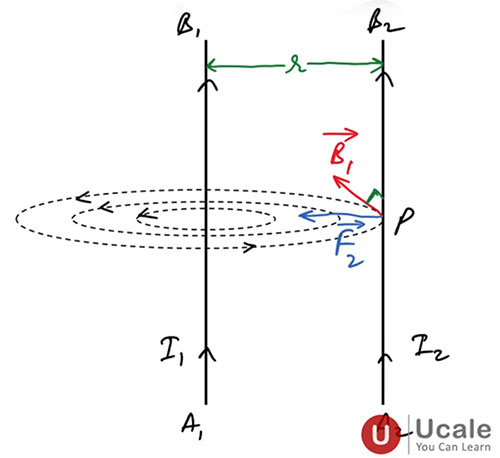
Therefore, it experiences force per unit length:
[\dfrac{F}{L} = I_2 B_1]
Substitute [B_1]:
[\dfrac{F}{L} = I_2 \dfrac{\mu_0 I_1}{2\pi d}]
Thus:
[\boxed{ \left( \dfrac{F}{L} = \dfrac{\mu_0 I_1 I_2}{2\pi d} \right) }]
Direction of Force
Apply the Right-Hand Rule:
- If currents travel in the same direction, magnetic fields cause attraction.
- If currents travel in opposite directions, magnetic fields cause repulsion.
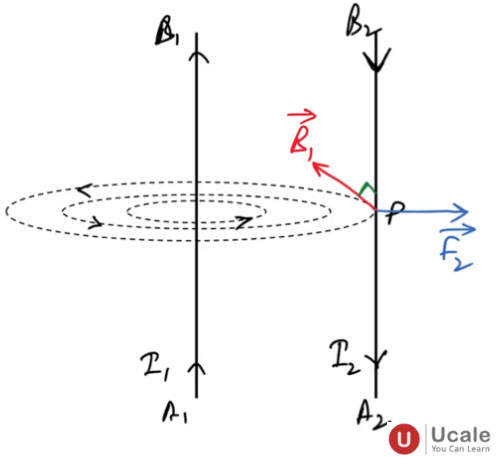
This is conceptually similar to how parallel electric currents behave like moving charges generating magnetic interactions.
3. Dimensions and Units
| Quantity | Dimensions | SI Unit |
|---|---|---|
| Force per unit length [F/L] | [MT^{-2}] | N/m |
| Permeability [\mu_0] | [MLT^{-2}A^{-2}] | T·m/A or N·A⁻² |
| Current [I] | [A] | Ampere |
| Distance [d] | [L] | Meter |
4. Key Features
- Parallel current-carrying wires always interact magnetically.
- Same direction → attraction.
- Opposite direction → repulsion.
- Interaction strength depends on product of currents.
- Force ∝ 1/d (inversely proportional to separation).
- Basis for modern definition of ampere.
- Works only for long, straight conductors.
- Direction can be predicted using right-hand rule.
5. Important Formulas to Remember
| Formula | Description |
|---|---|
| [B = \dfrac{\mu_0 I}{2\pi r}] | Magnetic field due to long straight wire |
| [F = I L B] | Force on conductor in magnetic field |
| [\left( \dfrac{F}{L} = \dfrac{\mu_0 I_1 I_2}{2\pi d} \right)] | Force per unit length between two wires |
| [F = 0] when currents are zero | No current → no magnetic force |
| [F \propto I_1 I_2] | Force increases with currents |
6. Conceptual Questions with Solutions
1. Why do two parallel conductors exert force on each other?
Because each conductor produces a magnetic field that interacts with the current in the other, creating magnetic force.
2. Why is the force attractive when currents are in the same direction?
Because magnetic fields due to currents add between the wires, producing forces that pull the wires toward each other.
3. Why is the force repulsive for opposite currents?
Opposite currents create magnetic fields that oppose each other between the wires, pushing the wires apart.
4. Why does force depend on the product [I_1 I_2]?
Because each current produces a magnetic field, and the other current interacts with that field; hence the force depends on both.
5. Why do wires very close together exert strong forces?
Because the force per unit length is inversely proportional to separation [d].
6. Why can this phenomenon be used to define the ampere?
Because force per unit length between conductors depends only on currents and known constants like [\mu_0].
7. Does the material of wire affect the force?
No. Only currents and separation matter.
8. Will force exist if only one wire carries current?
No. Force requires interaction of two magnetic fields generated by the currents.
9. Why is the magnetic field circular around a wire?
By Right-Hand Rule, field lines form concentric circles around a straight conductor.
10. Why does increasing distance reduce force?
Because magnetic field decreases with [1/d], so force weakens with bigger separation.
11. Why does direction of current matter?
Because it sets direction of magnetic field; reversing current reverses force direction.
12. Will wires at an angle exert the same force?
No. The formula applies only to parallel, long wires.
13. Why is the force always perpendicular to conductors?
Because magnetic force is always perpendicular to both direction of current and magnetic field.
14. Can two wires with equal and opposite currents have zero force at some point?
No. Opposite currents always produce repulsion regardless of current magnitude.
15. Why do we assume wires are infinitely long?
To avoid edge effects and ensure uniform magnetic field along their length.
7. FAQ / Common Misconceptions
1. Do wires attract because of electric force?
No. Electric forces between charges cancel out; attraction/repulsion is purely magnetic.
2. Do electrons from one wire move to another?
No. Each wire has its independent current; forces arise from magnetic interactions only.
3. Does thicker wire feel more force?
No. Only current magnitude matters, not wire thickness.
4. Will insulated wires still attract or repel?
Yes. Insulation does not affect magnetic interaction.
5. If currents are small, is force zero?
No. Small currents produce small force; but it is not zero.
6. If wires are very far apart, does force vanish?
It becomes very small but never exactly zero.
7. Do wires need to physically touch for force to act?
No. Magnetic fields act at a distance.
8. Does reversing both currents change direction of force?
No. If both reverse, orientation remains same → attractive remains attractive.
9. Can force be used to measure current?
Yes. Devices like current balances use this principle.
10. Does magnetic shielding eliminate force?
Only if shielding prevents interaction of their magnetic fields.
8. Practice Questions (with Step-by-Step Solutions)
1. Two parallel wires 0.2 m apart carry currents 4 A and 6 A in the same direction. Find force per meter.
Step 1: Use formula
[\dfrac{F}{L}] [= \dfrac{\mu_0 I_1 I_2}{2\pi d}]
Step 2: Substitute values
[\mu_0 = 4\pi\times10^{-7}]
[\dfrac{F}{L}] [= \dfrac{(4\pi\times10^{-7})(4)(6)}{2\pi (0.2)}]
Step 3: Simplify
= [\dfrac{96\pi\times10^{-7}}{0.4\pi}]
= [2.4\times10^{-5} \text{N/m}]
Force is attractive.
2. Two wires carry 10 A and 12 A in opposite directions, separated by 0.5 m. Find force per meter.
[\dfrac{F}{L}] [= \dfrac{\mu_0 I_1 I_2}{2\pi d}]
[\dfrac{F}{L}] [= \dfrac{(4\pi\times10^{-7})(10)(12)}{2\pi (0.5)}]
[\dfrac{F}{L}] [= 4.8\times10^{-5} \text{N/m}]
Force is repulsive.
3. Two wires 1 m apart carry equal currents of 5 A. Find force per meter.
[\dfrac{F}{L}] [= \dfrac{\mu_0 I^2}{2\pi d}]
[\dfrac{F}{L}] [= \dfrac{(4\pi\times10^{-7})(25)}{2\pi (1)}]
= [5\times10^{-6} \text{N/m}]
Attractive.
4. What happens to force if distance doubles?
Force ∝ [1/d].
If [d → 2d],
Force becomes half.
5. Two wires carry 3 A each, separated by 2 cm. Find force per meter.
[d = 0.02 \text{m}]
[\dfrac{F}{L}] [= \dfrac{(4\pi\times10^{-7})(3)(3)}{2\pi (0.02)}]
= [9\times10^{-5} \text{N/m}]
Attractive.
 Sign in with Google