

1. Concept Overview
When an electric current flows through a conductor, the moving charges (electrons) constitute an electric current.
Since moving charges experience magnetic force, a current-carrying conductor placed in a magnetic field also experiences a force.
This force:
- Depends on the amount of current flowing
- Depends on the length of the conductor inside the magnetic field
- Depends on the angle between current and magnetic field
- Is the basic working principle of electric motors, galvanometers, loudspeakers, and many electromechanical devices
The force on a straight conductor of length [L], carrying current [I], placed in magnetic field [\vec{B}] is:
[\vec{F} = I(\vec{L} \times \vec{B})]
Magnitude of the force:
[F = ILB\sin\theta]
where:
- [I] = current
- [L] = length vector along direction of current
- [\theta] = angle between current direction and magnetic field
Force direction is determined by Fleming’s Left-Hand Rule.
2. Clear Explanation and Mathematical Derivation
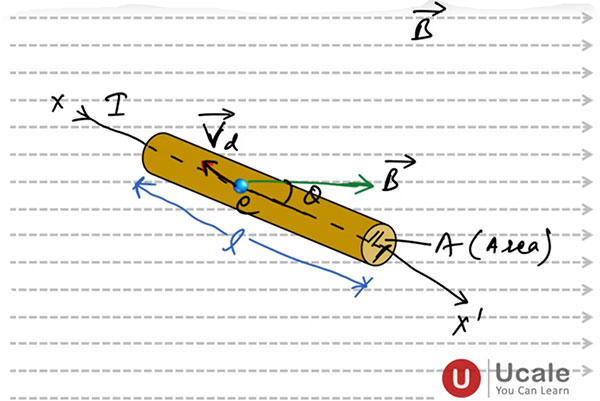
A current [I] flowing through a conductor means charge [q] passes in unit time.
If charge [q] moves with drift velocity [v_d] in magnetic field [B], it experiences magnetic force:
[
F = qv_dB\sin\theta
]
In time [t], charge flowing = [q = It].
Distance travelled by charges = [v_d t] = length of conductor = [L].
Thus:
[
F = I L B \sin\theta
]
This is the force on the entire conductor segment.
Direction of Force
- If current is perpendicular to magnetic field → maximum force.
- If current is parallel to magnetic field → zero force.
- Direction is perpendicular to both current and magnetic field.
This force causes conductors to move, giving rise to electromechanical motion.
3. Dimensions and Units
| Quantity | Dimensions | SI Unit |
|---|---|---|
| Force [F] | [MLT^{-2}] | Newton (N) |
| Magnetic Field [B] | [MT^{-2}A^{-1}] | Tesla (T) |
| Current [I] | [A] | Ampere (A) |
| Length [L] | [L] | Meter (m) |
4. Key Features
- Magnetic field exerts force on any wire carrying current.
- Force is proportional to current and wire length.
- Maximum force when conductor is perpendicular to field.
- Zero force when conductor is parallel to field.
- Force direction is given by Fleming’s Left-Hand Rule.
- Foundation for electric motors and many rotating machines.
- Demonstrates how electricity can be converted into mechanical motion.
5. Important Formulas to Remember
| Formula | Description |
|---|---|
| [F = ILB\sin\theta] | Force on straight conductor |
| [\vec{F} = I(\vec{L} \times \vec{B})] | Vector form |
| [F = 0] when [\theta = 0^\circ] | Conductor parallel to field |
| [F = ILB] | Conductor perpendicular to field |
| [F = nIlB] | Force on multi-turn coil (n turns) |
6. Conceptual Questions with Solutions
1. Why does a current-carrying conductor experience force in a magnetic field?
Because current consists of moving charges, and magnetic fields exert force on moving charges; hence the entire conductor feels a force.
2. Why is the force zero when current is parallel to magnetic field?
Because [\sin\theta = 0] when [\theta = 0^\circ], making [F = ILB\sin\theta = 0].
3. Why does force become maximum when conductor is perpendicular?
Because [\sin 90^\circ = 1], giving maximum value of [F = ILB].
4. What determines the direction of force?
Direction is given by Fleming’s Left-Hand Rule, based on mutual perpendicularity of current, magnetic field, and force.
5. Why is magnetic force a vector quantity?
Because it depends on cross product [\vec{L} \times \vec{B}], which is inherently directional.
6. Does the force depend on type of charge carrier?
No. Force depends on current direction, not on whether charges are electrons or positive ions.
7. Why does reversing current reverse force direction?
Because reversing current reverses direction of [\vec{L}], changing sign of the cross product.
8. Why does a conductor not experience torque when field is parallel?
No component of force acts perpendicular to conductor, so torque = 0.
9. Why do motors use perpendicular positioning of coils?
To achieve maximum force and hence maximum torque.
10. Can magnetic force change speed of charges in the conductor?
No; magnetic force is perpendicular to motion and only changes direction, not speed.
11. Does a thicker conductor experience more force?
Not necessarily; force depends on total current, not thickness.
12. Why does conductor feel force even though electrons move slowly?
Because drift velocity is tiny, but current (charge flow per second) is large, producing significant force.
13. Why is magnetic force independent of resistance?
Force depends on current and magnetic field, not resistance of conductor.
14. Why does a current loop experience torque?
Because opposite sides of loop experience equal and opposite forces, forming a couple.
15. Can force on conductor be used to measure magnetic field?
Yes; devices like current balances measure force to determine magnetic field strength.
7. FAQ / Common Misconceptions
1. Does magnetic field push the conductor because it contains metal?
No. Force arises due to moving charges (current), not due to material of conductor.
2. Is force always upward or downward?
No. Direction depends on current and magnetic field orientation.
3. Does the force act on electrons individually?
Yes, but we measure the combined effect on the entire wire.
4. Does higher voltage always mean higher force?
Only if it increases current, because [F \propto I].
5. Is magnetic force attractive or repulsive?
Neither. It is directional and depends on orientation of current and field.
6. Does the conductor need to be moving to feel force?
No. Charges inside the conductor are moving due to current; that is enough.
7. Can force do work on the conductor?
Yes. Unlike magnetic force on individual charges, force on conductor can move it and do work (motors).
8. Is magnetic force same everywhere?
No; it depends on magnetic field strength and orientation.
9. If current is zero, can force exist?
No. Without current, no moving charges → no magnetic force.
10. Does force depend on length submerged in magnetic field?
Yes. Only the portion inside the magnetic field experiences force.
8. Practice Questions (with Step-by-Step Solutions)
1. A wire of length 0.5 m carries current 3 A perpendicular to magnetic field 2 T. Find force.
Step 1: Use formula
[F = ILB]
Step 2: Substitute
[F = 3 × 0.5 × 2 = 3 N]
2. A 1 m wire carries 5 A at angle 30° to magnetic field of 1.5 T. Find force.
[F = ILB\sin\theta]
[F = 5 × 1 × 1.5 × \sin 30^\circ]
[F = 7.5 × 0.5 = 3.75 N]
3. A wire is parallel to magnetic field. Current = 4 A, length = 1 m, B = 2 T. Find force.
Parallel → [\sin\theta = 0]
[F = 0]
4. A conductor of length 2 m carries 6 A perpendicular to 0.4 T. Find force.
[F = ILB = 6 × 2 × 0.4 = 4.8 N]
5. A coil has 10 turns, each of length 0.3 m, carrying 2 A perpendicular to B = 1 T. Find total force.
[F = nILB]
[F = 10 × 2 × 0.3 × 1 = 6 N]
 Sign in with Google