

1. Concept Overview
When two coherent light waves from slits [A] and [B] interfere on a screen, a pattern of bright and dark fringes is formed.
- Distance between screen and slits = [D]
- Separation between two slits = [d]
- Wavelength of light = [\lambda]
The distance between two consecutive bright (or dark) fringes is known as:
[\textbf{Fringe Width } \beta] [= \dfrac{\lambda D}{d}]
Bigger wavelength ⇒ wider fringes
Screen farther away ⇒ wider fringes
Slits closer ⇒ wider fringes
2. Derivation of Fringe Width
Let O = central point on screen
Let [P] be any point on screen at distance [y] from O
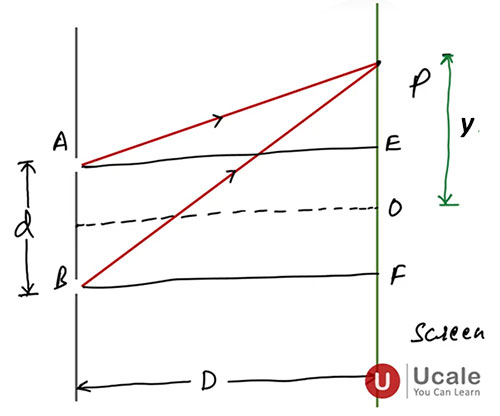
Path difference:
[
\Delta x = \dfrac{dy}{D}
]
For consecutive bright fringes:
[\Delta x] [= n\lambda] [\text{ and } (n+1)\lambda]
Difference in y-position:
[\beta] [= y_{n+1} – y_n] [= \dfrac{\lambda D}{d}]
Hence,
[\boxed{\beta = \dfrac{\lambda D}{d}}]
This is known as the Fringe Width Formula.
3. Dimensions & Units
| Quantity | Symbol | Dimension | Unit |
|---|---|---|---|
| Fringe width | [\beta] | [L] | meter (m) |
| Wavelength | [\lambda] | [L] | meter (m) |
| Screen distance | [D] | [L] | meter (m) |
| Slit separation | [d] | [L] | meter (m) |
4. Key Features
- All bright fringes are of same width
- Bright and dark fringes have equal width
- [\beta \propto \lambda]: Red light → wide fringes, Blue light → narrow fringes
- [\beta \propto D]: farther the screen → wider fringes
- [\beta \propto \dfrac{1}{d}]: closer slits → wider fringes
5. Important Formulas to Remember
| Type of Fringe | Formula |
|---|---|
| Bright fringe position | [y_n = \dfrac{n\lambda D}{d}] |
| Dark fringe position | [y_n = \dfrac{(2n+1)\lambda D}{2d}] |
| Fringe width | [\beta = \dfrac{\lambda D}{d}] |
6. Conceptual Questions with Solutions
1. What is fringe width?
It is the separation between two consecutive bright or dark fringes.
2. Why all bright fringes have equal spacing?
Because conditions for constructive interference are equally spaced in phase difference.\[\Delta x = n\lambda\]
3. If slit separation [d] is doubled, what happens to [\beta]?
[\beta \propto \dfrac{1}{d}]So it becomes half.
4. What happens to fringe width if red light is replaced by blue?
Decreases because [\lambda_{\text{blue}} < \lambda_{\text{red}}].
5. Does [\beta] depend on order number [n]?
No. It is constant for all fringes.
6. Why fringe width remains same for bright and dark fringes?
Conditions for constructive and destructive interference alternate periodically and equally.
7. Why coherent light is necessary?
Stable phase difference is required to form a regular fringe pattern.
8. What is the effect of using a lens after slits?
Pattern shifts but fringe width remains same because [\beta] depends only on [\lambda D d].
9. If light beam is replaced by sunlight, will fringes be visible?
Poorly. Sunlight is not monochromatic → white light fringes appear with colored edges.
10. Does [\beta] depend on intensity?
No. Intensity affects brightness, not spacing.
11. How does medium affect fringe width?
[\lambda = \dfrac{\lambda_0}{\mu}] [\Rightarrow \beta \downarrow\]. Fringes shrink in denser medium.
12. Why dark fringes are formed?
Destructive interference: [\Delta x] [= (2n+1)\dfrac{\lambda}{2}]
13. What happens if slits are not narrow?
Diffraction reduces interference contrast → pattern becomes unclear.
14. Which region has maximum fringe width?
Same everywhere → uniform pattern.
15. What if D is increased too much?
Pattern spreads → low visibility due to decrease in intensity.
7. FAQ / Common Misconceptions
1. Dark fringe means no light present.
Light waves exist but cancel → zero intensity.
2. Fringe width changes with order [n].
No, it is constant.
3. More intensity → larger fringe width.
False. Intensity does not affect spacing.
4. If [d] = 0, fringes become infinite.
Interference does not occur if slits overlap — coherence breaks.
5. White light has same fringe width for all colors.
Different [\lambda] ⇒ different [\beta].
6. Fringe width in glass = in air.
No. [\lambda] reduces inside glass ⇒ [\beta] becomes smaller.
7. Only bright fringes matter for fringe width.
Dark fringes have same spacing → either can be used.
8. Increasing D always helps.
After a limit intensity becomes too low to observe fringes.
9. Fringe width depends on slit width.
Only affects clarity, not width.
10. Fringes form only on central region.
Actually extend on both sides but visibility decreases outward.
8. Practice Problems (with Step-by-Step Solutions)
Q1. [\lambda = 600\text{ nm},] [D = 2\text{ m},] [d = 1\text{ mm}]
Find [\beta].
Solution:
[\beta = \dfrac{\lambda D}{d}] [= \dfrac{600 \times 10^{-9} \times 2}{1 \times 10^{-3}}] [= 1.2 \times 10^{-3}\text{ m}] [= \boxed{1.2\text{ mm}}]
Q2. Fringe width observed is [\beta = 0.5\text{ mm}], [\lambda = 500\text{ nm}], [D = 1\text{ m}].
Find slit separation.
[d = \dfrac{\lambda D}{\beta}] [= \dfrac{500\times10^{-9}\times1}{0.5\times10^{-3}}] [= \boxed{1\times10^{-3}\text{ m} = 1\text{ mm}}]
Q3. Red light [(\lambda = 700\text{ nm})] → [\beta = 0.7\text{ mm}].
Find [\beta] for blue light [(\lambda = 475\text{ nm})].
[\beta \propto \lambda] [\Rightarrow \beta_{blue} = \dfrac{475}{700} \times 0.7] [= \boxed{0.475\text{ mm}}]
Q4. What happens to [\beta] if [D] = 0.5 m → 1.5 m?
[\beta \propto D] [\Rightarrow \text{new }\beta] [= 3\text{ times}]
Q5. [\lambda = 550\text{ nm},] [d=0.5\text{ mm},] [\beta=2.2\text{ mm}]
Find distance (D).
[D = \dfrac{\beta d}{\lambda}] [= \dfrac{2.2\times10^{-3}\times0.5\times10^{-3}}{550\times10^{-9}}] [= \boxed{2\text{ m}}]
 Sign in with Google