

1. Concept Overview / Statement of the Law
Gauss’s Law is one of the four fundamental Maxwell’s equations. It connects electric charges to the electric field they produce.
Understanding
Every electric charge produces electric field lines.
If we imagine a closed surface (a balloon, sphere, cube, etc.) around charges, some field lines pass through the surface.
Gauss’s Law tells us:
The total electric flux passing through any closed surface is equal to the net charge enclosed by that surface divided by the permittivity of free space.
Mathematically,
[\oint \vec{E} \cdot d\vec{A}] [= \dfrac{Q_{\text{enclosed}}}{\varepsilon_0}]
Here:
- [\oint] means integral over a closed surface
- [\vec{E}] is electric field
- [d\vec{A}] is a small area element on the surface
- [Q_{\text{enclosed}}] is total charge inside the surface
- [\varepsilon_0] is permittivity of free space
Gauss’s Law does not require the surface to be spherical or regular. It works for any shape.
2. Explanation and Derivation
Electric Flux
Electric flux is:
[\phi = \vec{E} \cdot d\vec{A}] [= EA\cos\theta]
For a closed surface, the total flux is:
[
\oint \vec{E} \cdot d\vec{A}
]
Derivation for a Point Charge at the Center of a Sphere
Let a point charge [+q] be at the center of a sphere of radius [r].
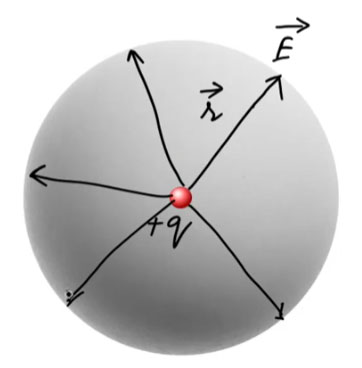
Field at every point:
[
E = \dfrac{1}{4\pi\varepsilon_0} \dfrac{q}{r^2}
]
Area of sphere:
[
A = 4\pi r^2
]
Total flux:
[\oint \vec{E} \cdot d\vec{A}] [= E \cdot A] [= \dfrac{1}{4\pi\varepsilon_0}\dfrac{q}{r^2}(4\pi r^2)] [= \dfrac{q}{\varepsilon_0}]
Thus,
[
\boxed{\oint \vec{E} \cdot d\vec{A} = \dfrac{Q}{\varepsilon_0}}
]
This result remains true for any closed surface, even if not spherical.
3. Dimensions and Units
Dimensions
Electric flux:
[\phi] = [E][A] = \left( \dfrac{MLT^{-3}A^{-1}}{} \right) [L^2] = [ML^3T^{-3}A^{-1}]
Gauss’s Law:
[\oint \vec{E} \cdot d\vec{A} = \dfrac{Q}{\varepsilon_0}]
Unit of electric flux = Newton metre² per coulomb
([N m^2/C])
4. Key Features
- Valid for any closed surface → spherical, cylindrical, irregular.
- Depends only on charge enclosed, not on charge outside.
- Extremely useful for computing electric fields of symmetrical charge distributions:
- Spherical symmetry
- Cylindrical symmetry
- Planar symmetry
- Reduces complex integrals to simple algebra.
- Works in electrostatics only (charges at rest).
5. Important Formulas to Remember
| S.No. | Formula | Meaning |
|---|---|---|
| 1 | [\oint \vec{E} \cdot d\vec{A}] [= \dfrac{Q_{\text{enclosed}}}{\varepsilon_0}] | Gauss’s Law |
| 2 | [\vec{E}] [= \dfrac{1}{\varepsilon_0} \dfrac{Q_{\text{enclosed}}}{A}] | If field is constant over surface |
| 3 | [\phi = EA\cos\theta] | Electric flux |
| 4 | [A_{\text{sphere}}] [= 4\pi r^2] | Useful for point charges |
| 5 | [\varepsilon_0] [= 8.85 \times 10^{-12} C^2N^{-1}m^{-2}] | Permittivity of free space |
6. Conceptual Questions with Solutions
1. Does Gauss’s Law depend on the shape of the surface?
No. Gauss’s Law depends only on the **net charge enclosed**, not on the shape of the Gaussian surface.
2. Does charge outside a closed surface contribute to flux?
No. Charges outside create field lines that **enter and leave**, giving **net zero flux**.
3. Can the electric field at the surface be zero while flux is non-zero?
No. If flux is non-zero, the field cannot be zero everywhere on the surface.
4. Can flux be non-zero even if no charge is enclosed?
Yes, flux through **parts of the surface** may be non-zero, but **total flux is zero**.
5. What happens to flux if the Gaussian surface is made larger?
Flux remains the same because it depends only on the enclosed charge.
6. Do electric field lines always start/end on charges?
Yes. Field lines originate on positive charges and terminate on negative charges.
7. If a charge is placed exactly on the surface, is it enclosed?
By convention, such a charge is treated as **half enclosed**, but in most problems it is avoided.
8. Why is Gauss’s Law useful only in symmetric cases?
Because otherwise evaluating the integral becomes extremely difficult.
9. What if the Gaussian surface intersects the charge?
Mathematically undefined. Gaussian surfaces must lie in **charge-free regions**.
10. Can electric flux be negative?
Yes. Negative flux indicates the field is directed **inward**.
11. If the electric field is tangent to the surface, what is flux?
Zero, because [\theta = 90^\circ] → [\phi = EA\cos 90^\circ = 0].
12. Can Gauss’s Law be used to find electric potential?
Indirectly. It gives the field first, then integrate: [V = -\int \vec{E}\cdot d\vec{l}].
13. Can two charges inside a Gaussian surface produce zero flux?
Yes, if the **net charge enclosed is zero**.
14. Does Gauss’s Law apply inside conductors?
Inside a conductor, [\vec{E}=0], so flux through any closed surface inside is zero → enclosed charge must also be zero.
15. Does flux depend on the medium?
Yes. In medium, replace [\varepsilon_0] by [\varepsilon].
7. FAQ / Common Misconceptions
1. Is Gauss’s Law valid only for symmetric surfaces?
No. It is **always valid**, but only useful for calculating fields in symmetric cases.
2. Do field lines always cross a Gaussian surface perpendicularly?
No. Only in symmetric cases. Gauss’s Law does not assume this.
3. More field lines crossing means more charge?
Only the **net number** matters. Lines entering and leaving cancel.
4. Does zero flux mean zero electric field?
No. Zero flux means equal inward and outward flux, not zero field.
5. Does flux measure number of field lines?
Conceptually yes, but mathematically it’s the **dot product** [\vec{E}\cdot d\vec{A}].
6. Does a Gaussian surface need to be real?
No. It is an imaginary surface.
7. If flux is constant, is field constant?
No. Flux depends on **average** behavior, not local field values.
8. Gauss’s Law cannot be applied if charges move?
Correct. It applies only to **electrostatics** (charges at rest).
9. A larger surface means larger flux?
False. Flux depends only on **enclosed charge**.
10. Does Gauss’s Law give direction of electric field?
Not directly. It gives magnitude; direction comes from symmetry.
8. Practice Questions (With Step-By-Step Solutions)
Q1. A point charge of [+5 μC] is enclosed in a spherical surface. Find the electric flux.
Step 1: Use Gauss’s Law:
[
\phi = \dfrac{Q}{\varepsilon_0}
]
Step 2: Insert values:
[
\phi = \dfrac{5 \times 10^{-6}}{8.85 \times 10^{-12}}
]
[
\phi = 5.65 \times 10^5 , N,m^2/C
]
Q2. A closed surface encloses +2C and –5C charges. Find net flux.
[Q_{\text{net}}] [= 2 – 5] [= -3C]
[
\phi = \dfrac{-3}{\varepsilon_0}
]
[
\phi = -3.39 \times 10^{11}Nm^2/C
]
Q3. A cube encloses no charge. What is the net flux?
[\phi = \dfrac{0}{\varepsilon_0}] [= 0]
Q4. A point charge of [+q] is placed outside a closed box. What is the flux through the box?
[
\phi = 0
]
Because charge outside does not contribute to net flux.
Q5. A Gaussian surface encloses charge of magnitude [40,nC]. Find flux.
[
\phi = \dfrac{40 \times 10^{-9}}{8.85 \times 10^{-12}}
]
[
\phi = 4.52 \times 10^3 Nm^2/C
]
 Sign in with Google