

1. Statement of the Law / Concept Overview
Gauss’s law in magnetism states that:
“The net magnetic flux through any closed surface is always zero.”
In mathematical form:
[\phi_B] [= \displaystyle \oint \vec{B}\cdot d\vec{S} = 0]
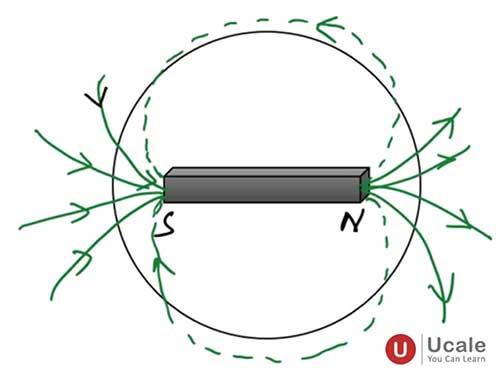
This law essentially says that magnetic field lines never begin or end at any point—they always form closed continuous loops.
Thus:
- Magnetic monopoles do not exist.
- Every magnet has two poles—a north and a south—always in pairs.
- Magnetic field lines emerge from the north pole and enter the south pole externally, but inside the magnet, they go from south to north, forming a continuous cycle.
For beginners, the simplest way to understand this law is:
- In electrostatics, Gauss’s law relates flux to charge enclosed.
- In magnetism, there is no magnetic charge (monopole).
- So the net flux through any closed surface must always be zero.
2. Clear Explanation and Mathematical Derivation
Understanding Magnetic Flux
The magnetic flux through a small surface element (d\vec{S}) is:
[
d\phi_B = \vec{B}\cdot d\vec{S}
]
Total flux through a closed surface:
[\phi_B] [= \displaystyle \oint \vec{B}\cdot d\vec{S}]
Why is Net Flux Zero?
Consider a closed Gaussian surface placed around:
(a) A bar magnet
Magnetic field lines:
- Emerge from the north pole → positive flux outward
- Enter the south pole → negative flux inward
But the same number of lines that leave the magnet re-enter it, giving net flux:
[\phi_B] [= \phi_{\text{out}} + \phi_{\text{in}} = 0]
(b) A magnetic dipole
A dipole produces a closed pattern of magnetic field lines.
For any closed surface, lines exiting equal lines entering.
(c) A current-carrying conductor
Even around a conductor, magnetic field lines are circular loops.
A closed surface cuts the loop equally entering and leaving → flux = 0.
3. Dimensions and Units
Magnetic Flux ([\phi_B])
- SI Unit: Weber (Wb)
- Dimensions: ([M L^2 T^{-2} A^{-1}])
Magnetic Field ([\vec{B}])
- SI Unit: Tesla (T)
4. Key Features
- Magnetic flux through a closed surface is always zero.
- Shows impossibility of isolated north or south poles.
- Magnetic field lines form closed loops.
- Magnetic flux is independent of the shape of the Gaussian surface.
- Analogous to Gauss’s law in electrostatics, but charge term is missing.
- Supports Maxwell’s equation:
[
\nabla \cdot \vec{B} = 0
]
5. Important Formulas to Remember
| Concept | Formula |
|---|---|
| Magnetic flux | ([\phi_B] [= \displaystyle \oint \vec{B} \cdot d\vec{S}]) |
| Gauss’s law in magnetism | ([\displaystyle \oint \vec{B}\cdot d\vec{S} = 0]) |
| Differential form | ([\nabla \cdot \vec{B} = 0]) |
| Magnetic flux through open surface | ([\phi_B = \displaystyle \int \vec{B}\cdot d\vec{S}]) |
6. Conceptual Questions with Solutions
1. Why does Gauss’s law in magnetism say flux is zero?
Because magnetic field lines form closed loops—every line that leaves a surface re-enters it, giving net flux zero.
2. What would it imply if flux through a closed surface were non-zero?
It would imply the existence of magnetic monopoles, which have never been observed.
3. Do magnetic field lines begin or end at magnetic poles?
No. They only appear to. In reality, the lines continue through the magnet, forming closed loops.
4. Is Gauss’s law violated inside a magnet?
No. Even inside a magnet, field lines loop back from south to north—flux still cancels.
5. Does Gauss’s law depend on the shape of the surface?
No. For any closed surface, flux is zero regardless of shape or orientation.
6. Is magnetic flux through an open surface zero?
No. Gauss’s law applies only to closed surfaces. Open surfaces can have non-zero flux.
7. How is Gauss’s law in magnetism different from Gauss’s law in electrostatics?
In electrostatics, flux equals charge enclosed. In magnetism, no magnetic charge exists, so net flux is zero.
8. What does the equation [∇·B = 0] physically mean?
It means magnetic field lines have no divergence—they never originate or terminate anywhere.
9. Can a current-carrying wire enclose non-zero flux?
No. Field lines around the wire are circular and closed, giving net zero flux through a closed surface.
10. What happens if we place a Gaussian surface around only the north pole of a magnet?
Impossible—north and south poles cannot be isolated. The surface always encloses whole magnetization loops, giving zero flux.
11. Does the thickness of the Gaussian surface matter?
No. Flux depends only on the net number of lines entering and leaving.
12. Can magnetic flux be negative?
Yes. But net flux (sum of positive and negative) through a closed surface is zero.
13. Why are magnetic field lines continuous?
Because magnetic dipoles cannot be broken into isolated poles—fields must loop back.
14. What would happen to Maxwell’s equations if monopoles existed?
The equation would become \([\nabla\cdot\vec{B} = \rho_m]\), where [\rho_m] is magnetic charge density.
15. What is the flux through a cube placed in a uniform magnetic field?
Zero. Though some surfaces have positive flux and others negative, total flux through the closed cube is zero.
7. FAQ / Common Misconceptions
1. “Field lines start at north pole and end at south pole.”
They only appear to do that externally. Inside the magnet, lines go from south to north, forming closed loops.
2. “Flux is always zero through any surface.”
Only through closed surfaces. Open surfaces can have non-zero flux.
3. “A magnet has more field lines at the north pole than the south pole.”
No. The number of lines is always equal for both poles.
4. “Gauss’s law forbids magnetic field variation.”
No. It only forbids divergence (beginning or ending); curl and variations are allowed.
5. “Gauss’s law means magnetic fields cannot pass through a surface.”
No. Fields pass freely. Positive flux is balanced by negative flux.
6. “Net flux zero means field is zero everywhere.”
No. Field can be strong; only total flux through closed surface is zero.
7. “Isolated magnetic poles can be created by cutting a magnet.”
No. Cutting gives two smaller dipoles, each with N and S poles.
8. “Flux depends on shape of Gaussian surface.”
No. For closed surfaces, net flux is always zero.
9. “Gauss’s law in magnetism proves magnets are permanent.”
No. It only describes field behavior, not magnetization permanence.
10. “Flux zero means no magnetic field exists.”
No. Magnetic field may exist; only net flux is zero.
8. Practice Questions (with Step-by-Step Solutions)
1. Find the flux through a spherical surface placed around a bar magnet.
Solution:
Magnetic flux through a closed surface is zero:
[\displaystyle \oint \vec{B}\cdot d\vec{S} = 0]
2. A uniform magnetic field of 0.5 T passes through a closed cube. What is net flux?
Solution:
For any closed surface:
[
\phi_B = 0
]
3. Through one face of a cube, flux is ([+3,\text{Wb}]). Through another face, flux is ([-3,\text{Wb}]). What is flux through the remaining 4 faces?
Solution:
Total flux through closed surface = 0
[3 + (-3) + \phi_{\text{remaining}}] [= 0]
[
\phi_{\text{remaining}} = 0
]
4. A magnetic field passes through a tetrahedral surface. Is flux zero?
Solution:
If tetrahedron is closed,
[
\phi_B = 0
]
If one face removed (open surface), flux is not zero.
5. Can you calculate the magnetic charge enclosed by a closed surface?
Solution:
Magnetic charge does not exist.
[
\phi_B = 0
]
Hence enclosed magnetic charge = 0.
 Sign in with Google