

1. Concept Overview
Every mass in the universe exerts a gravitational pull on every other mass.
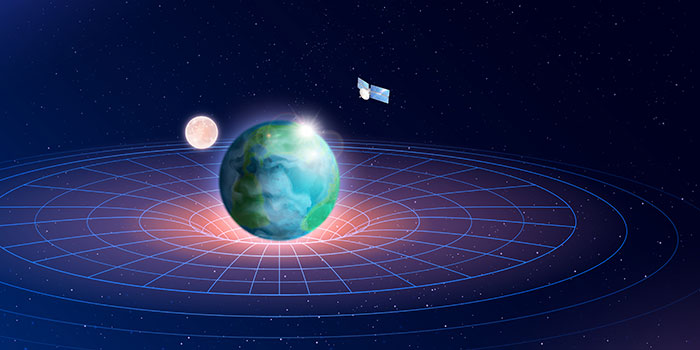
To describe the region around a mass where its gravitational influence is felt, we define a gravitational field.
Definition:
The gravitational field is the region surrounding a body within which another body experiences a gravitational force of attraction.
2. Explanation and Mathematical Derivation
Let a body of mass [M] be placed at a point in space.
It creates a gravitational field around it.
If a small test mass [m] is placed at a point in this field, it experiences a force [F] due to [M].
According to Newton’s Law of Gravitation,
[F = G \dfrac{M m}{r^2}]
where
- [G] = Universal Gravitational Constant
- [r] = Distance between the masses
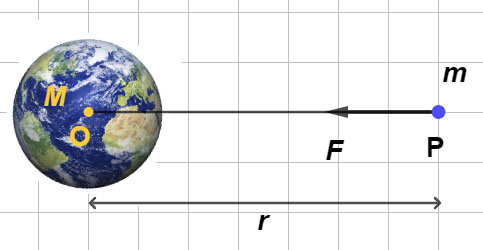
The gravitational field intensity (or gravitational field strength) at that point is defined as the force experienced per unit mass placed at that point.
[
E = \dfrac{F}{m}
]
Substituting [F = G \dfrac{M m}{r^2}], we get:
[
E = \dfrac{G M}{r^2}
]
Thus, the intensity of the gravitational field at a point due to a mass [M] is inversely proportional to the square of the distance from the mass.
Direction:
The direction of the gravitational field intensity is towards the mass that creates the field (i.e., always attractive).
3. Dimensions and Units
Dimensions of E:
[E] = [F][M^{-1}] = [M^0 L^1 T^{-2}]
SI Unit: [N kg^{-1}]
CGS Unit: [dyne g^{-1}]
4. Key Features
- The gravitational field is a vector field — it has both magnitude and direction.
- Its direction is towards the mass producing it.
- It decreases with the square of the distance from the mass.
- The field strength is independent of the test mass.
- The field is superposable — i.e., fields from multiple masses can be vectorially added.
- The lines of force for a gravitational field are radially inward for an isolated mass.
- The field is always attractive, never repulsive.
5. Important Formulas to Remember
| Quantity | Symbol | Formula | Unit |
|---|---|---|---|
| Gravitational Field Intensity | [E] | [E = \dfrac{G M}{r^2}] | [N kg^{-1}] |
| Force on Mass [m] | [F] | [F = E m = G \dfrac{M m}{r^2}] | [N] |
| Relation between [E] and [g] (on Earth) | [E = g] | — | [N kg^{-1}] |
6. Conceptual Questions with Solutions
1. What is the gravitational field at a point?
It is the region around a mass where another mass experiences a gravitational force. Mathematically, [E = \dfrac{F}{m}].
2. Why is the gravitational field a vector quantity?
Because it has both magnitude ([E = \dfrac{G M}{r^2}]) and direction (toward the mass creating the field).
3. Does the test mass affect the field intensity?
No. [E = \dfrac{F}{m}] is independent of [m]. The test mass only helps measure the field.
4. What happens to the gravitational field as distance increases?
It decreases with the square of distance: [E \propto \dfrac{1}{r^2}].
5. In what direction does the gravitational field act?
Always toward the center of the attracting mass (inward direction).
6. What is the gravitational field at infinity?
At infinity, [E = 0], as [r \to \infty].
7. Is the gravitational field always attractive?
Yes, gravity only attracts — there is no repulsive gravitational field.
8. How is gravitational field related to acceleration due to gravity?
At Earth’s surface, [E = g].
9. What does the negative sign in field vector mean?
It indicates the field direction is toward the source mass.
10. What are gravitational lines of force?
They are imaginary lines showing the direction of gravitational field — radially inward towards the mass.
11. Can gravitational field lines intersect?
No. If they intersected, a point would have two directions of force, which is impossible.
12. What is the relation between gravitational potential and field intensity?
[E = -\dfrac{dV}{dr}], where [V] is gravitational potential. (Refer to “Gravitational Potential” topic.)
13. How does the field vary inside a uniform spherical shell?
Inside a uniform shell, [E = 0]. Outside, [E = \dfrac{G M}{r^2}].
14. What is the difference between field strength and force?
Field strength is per unit mass quantity, while force depends on the mass of the body.
15. How is superposition applied in gravitational fields?
The resultant field is the vector sum of all individual fields from different masses.
7. FAQ / Common Misconceptions
1. The gravitational field exists only near large bodies like Earth.
❌ False. Every mass, no matter how small, creates a gravitational field.
2. Gravitational field can be repulsive.
❌ No, it is always attractive.
3. Gravitational field depends on the test mass.
❌ Incorrect. It depends only on the source mass and distance.
4. The gravitational field is scalar.
❌ It’s a vector quantity.
5. The direction of gravitational field is outward.
❌ It is always inward, toward the source.
6. Inside a hollow spherical shell, field is not zero.
❌ Inside a uniform shell, [E = 0].
7. Gravitational field and gravitational potential are the same.
❌ No. Field is the rate of change of potential: [E = -\dfrac{dV}{dr}].
8. Field lines can cross each other.
❌ They never cross.
9. The field intensity is maximum at the center of Earth.
❌ No. It is zero at the center and maximum at the surface.
10. The field intensity due to Earth is different for different objects.
❌ No. It is the same for all objects (neglecting air resistance).
8. Practice Questions (With Step-by-Step Solutions)
Q1. Find the gravitational field intensity at a point 4000 km from Earth’s center.
[ M = 6 \times 10^{24}kg,; G = 6.67 \times 10^{-11}Nm^2/kg^2 ]
Solution:
[E = \dfrac{G M}{r^2}] [= \dfrac{6.67 \times 10^{-11} \times 6 \times 10^{24}}{(4 \times 10^6)^2}] [= 25.0N/kg]
Answer: [E = 25.0N/kg]
Q2. At what distance from a mass of [10^4kg] will the gravitational field be [6.67 \times 10^{-6}N/kg]?
Solution:
[E = \dfrac{G M}{r^2} \Rightarrow r] [= \sqrt{\dfrac{G M}{E}}] [= \sqrt{\dfrac{6.67 \times 10^{-11} \times 10^4}{6.67 \times 10^{-6}}}] [= 1m]
Answer: [r = 1m]
Q3. If the field at a point is [9.8N/kg], what is the force on a body of 2 kg placed there?
Solution:
[F = E \times m = 9.8 \times 2 = 19.6N]
Answer: [F = 19.6N]
Q4. The gravitational field due to two equal masses placed 2 m apart is zero at the midpoint. Why?
Solution:
The fields due to both masses are equal in magnitude but opposite in direction, hence they cancel out.
Q5. Compare the field intensity at distances [r] and [2r] from a mass [M].
Solution:
[E_1 = \dfrac{G M}{r^2} \quad E_2] [= \dfrac{G M}{(2r)^2}] [= \dfrac{E_1}{4}]
Answer: Field intensity becomes one-fourth when distance is doubled.
 Sign in with Google