

1. Concept Overview / Statement of the Effect
The Hall Effect is the production of a transverse (sideways) potential difference across a current-carrying conductor when it is placed in a magnetic field perpendicular to the direction of current.
This potential difference is called the Hall Voltage.
Why does this happen?
When charges (electrons or holes) move through a conductor, and a magnetic field is applied perpendicular to their motion, they experience a sideways magnetic force.
This force pushes the charges to one side of the conductor, making that side negatively charged and the other side positively charged.
Because of this, a potential difference develops across the conductor — this is the Hall Voltage.
At equilibrium, this sideways force is balanced by an electric force (due to accumulation of charges).
This allows us to measure the type of charge carriers, their density, and their drift velocity.
2. Clear Explanation and Mathematical Derivation
Consider a current-carrying conductor:
- Current = [I]
- Thickness (or width) = [t]
- Magnetic field (perpendicular to current) = [B]
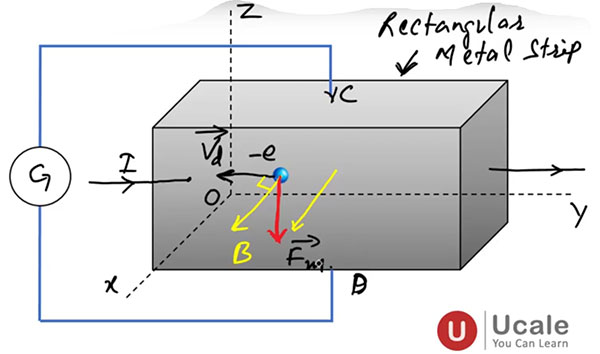
Charge carriers move with drift velocity [v_d] and experience magnetic force:
[F_B = q v_d B]
This force pushes carriers sideways, creating an electric field called the Hall field [E_H].
At equilibrium:
[ q E_H = q v_d B ]
[ E_H = v_d B ]
The Hall voltage is:
[V_H = E_H t = v_d B t ]
But drift velocity:
[v_d = \dfrac{I}{n A q}]
Where:
- [n] = charge carrier density
- [A] = cross-sectional area = [w t] (width × thickness)
Substitute:
[V_H = \dfrac{I B}{n q t}]
Define the Hall coefficient:
[R_H = \dfrac{1}{n q}]
Finally:
[V_H = R_H \dfrac{I B}{t}]
Sign of [R_H] indicates whether conduction is due to electrons (negative) or holes (positive).
3. Dimensions and Units
| Quantity | Expression | Dimensions | SI Unit |
|---|---|---|---|
| Hall Voltage | [V_H] | [ML^2T^{-3}A^{-1}] | Volt (V) |
| Hall Field | [E_H] | [MLT^{-3}A^{-1}] | V/m |
| Hall Coefficient | [R_H = \dfrac{1}{nq}] | [m^3 C^{-1}] | m³/C |
| Carrier Density | [n] | [L^{-3}] | m⁻³ |
4. Key Features
- Hall Effect occurs only when current and magnetic field are perpendicular.
- Helps determine type of charge carrier (electrons or holes).
- Used to calculate carrier density in semiconductors.
- Direction of Hall voltage reverses when current or magnetic field direction reverses.
- Useful in measuring magnetic fields using Hall sensors.
5. Important Formulas to Remember
| Purpose | Formula |
|---|---|
| Hall electric field | [E_H = v_d B] |
| Drift velocity | [v_d = \dfrac{I}{n A q}] |
| Hall voltage | [V_H = R_H \dfrac{I B}{t}] |
| Hall coefficient | [R_H = \dfrac{1}{n q}] |
| Carrier density | [n = \dfrac{1}{q R_H}] |
6. Conceptual Questions with Solutions
1. Why does a Hall voltage develop in a conductor?
Because moving charges in a magnetic field experience a sideways magnetic force [F_B = q v_d B]. This pushes charges to one side, creating a voltage difference.
2. Why is the Hall voltage zero when the magnetic field is zero?
Because Hall voltage is generated only due to magnetic force. Without magnetic field, no sideways force acts on the charges.
3. Why can the Hall Effect determine the nature of charge carriers?
The direction of Hall voltage depends on whether electrons or holes are moving. This polarity reveals the sign of charge carriers.
4. Why is the Hall coefficient negative in metals?
Because electrons (negative charge carriers) dominate in metals.
5. Why does Hall voltage increase when current increases?
Because [V_H \propto I]. Higher current means higher drift velocity, giving greater charge separation.
6. Why is Hall voltage inversely proportional to thickness?
Because [V_H = R_H \dfrac{I B}{t}]. Thicker conductors reduce the electric field required to balance the magnetic force.
7. Why does Hall voltage increase with magnetic field?
Because a stronger magnetic field pushes charges more forcefully, increasing transverse voltage.
8. Why is Hall effect extremely small in metals?
Because carrier density [n] is extremely high, so [R_H = \dfrac{1}{nq}] is very small.
9. Why is Hall effect large in semiconductors?
Because semiconductors have lower carrier density, making [R_H] larger and Hall voltage noticeable.
10. What happens to the Hall voltage if direction of current is reversed?
The Hall voltage reverses its polarity since charge flow direction changes.
11. What happens if magnetic field direction is reversed?
The Hall voltage reverses its polarity because magnetic force reverses direction.
12. Why is Hall Effect useful to find drift velocity?
Because [E_H = v_d B], and [E_H = \dfrac{V_H}{t}]. Measuring [V_H] gives [v_d].
13. Can Hall effect occur if current and magnetic field are parallel?
No. Magnetic force is zero when velocity and magnetic field are parallel: [F = qvB\sin 0 = 0].
14. Why does Hall voltage saturate at very high magnetic fields?
Because at high fields, charge accumulation cannot increase indefinitely and reaches equilibrium limits.
15. Why can Hall effect measure magnetic fields?
Because [V_H \propto B]. By measuring Hall voltage, magnetic field strength can be calculated.
7. FAQ / Common Misconceptions
1. Is Hall effect present only in semiconductors?
No. It occurs in all conductors, but is most significant in semiconductors due to lower carrier density.
2. Does Hall effect require electrons to physically move to the side?
Yes. Electrons accumulate on one side due to magnetic force, creating the Hall field.
3. Is the Hall voltage always positive?
No. Its sign depends on the charge carrier type.
4. Does reversing current change the magnitude of Hall voltage?
No, only its direction changes.
5. Is Hall voltage the same across materials?
No. It depends on charge carrier density and type.
6. Is the Hall coefficient a constant for all temperatures?
No. Carrier density changes with temperature, especially in semiconductors.
7. Can a material have zero Hall coefficient?
Yes. In some materials, electrons and holes contribute equally, cancelling out effect.
8. Is magnetic field necessary for Hall effect?
Yes. Without magnetic field, no sideways force acts on carriers.
9. Is Hall effect same as Lorentz force?
No. Hall effect is a consequence of the Lorentz magnetic force acting on charges.
10. Can Hall effect be used for current sensing?
Yes. Many modern current sensors (like Hall ICs) use this principle.
8. Practice Questions (With Step-by-Step Solutions)
1. A conductor of thickness 2 mm carries a current of 3 A. It is placed in a magnetic field of 0.5 T. If Hall coefficient is [4 \times 10^{-4}] m³/C, find the Hall voltage.
Solution:
Thickness: [t = 2 \times 10^{-3}] m
Formula:
[V_H = R_H \dfrac{I B}{t}]
[V_H] [= 4 \times 10^{-4} \dfrac{3 \times 0.5}{2\times10^{-3}}]
[V_H = 0.3\ \text{V}]
2. A semiconductor has Hall coefficient [R_H = 5 \times 10^{-3}] m³/C. If current is 2 A, magnetic field 0.2 T, and thickness 1 mm, find Hall voltage.
[V_H = R_H \dfrac{I B}{t}]
[V_H] [= 5\times10^{-3} \dfrac{2 \times 0.2}{1\times10^{-3}}]
[V_H = 2\ \text{V}]
3. A conductor carries current 5 A and shows Hall voltage 4 mV in 0.1 T magnetic field. If thickness is 1 cm, find Hall coefficient.
[V_H = R_H \dfrac{I B}{t}]
[R_H = \dfrac{V_H t}{I B}]
[R_H] [= \dfrac{4\times10^{-3} \times 1\times10^{-2}}{5 \times 0.1}]
[R_H = 8 \times 10^{-6}\ \text{m}^3\text{/C}]
4. A metal has [n = 8\times10^{28}] m⁻³. Find its Hall coefficient.
[R_H = \dfrac{1}{n q}]
[q = 1.6\times10^{-19}]
[R_H] [= \dfrac{1}{8\times10^{28} \times 1.6\times10^{-19}}]
[R_H = 7.8 \times 10^{-12}\ \text{m}^3\text{/C}]
5. A current of 10 A flows through a slab 5 mm thick. If measured Hall voltage is 1 mV in a 0.2 T magnetic field, find carrier density.
[V_H = R_H \dfrac{I B}{t}]
[R_H = \dfrac{V_H t}{I B}]
[R_H] [= \dfrac{1\times10^{-3} \times 5\times10^{-3}}{10 \times 0.2}]
[R_H = 2.5 \times 10^{-6}]
[n = \dfrac{1}{q R_H}]
[n] [= \dfrac{1}{1.6\times10^{-19} \times 2.5\times10^{-6}}]
[n] [\approx 2.5\times10^{24}\ \text{m}^{-3}]
 Sign in with Google