

1. Concept Overview
When a satellite revolves around the Earth in a circular orbit, its orbital radius ([r]) is the distance from the center of the Earth to the satellite.
The height of the satellite above the Earth’s surface ([h]) is given by:
[
h = r – R
]
where:
- ([r]) = orbital radius of the satellite
- ([R]) = radius of the Earth
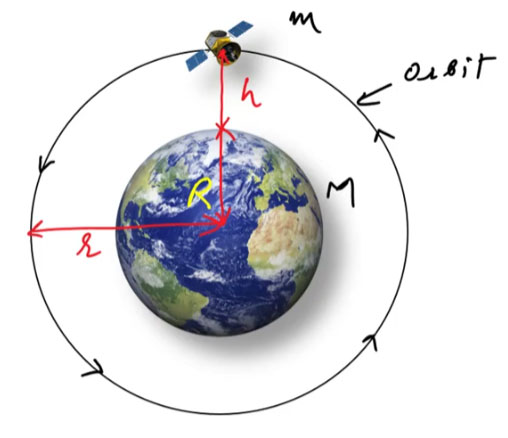
This concept helps determine how high a satellite orbits depending on its time period or velocity.
2. Explanation and Derivation
We know from the Newton’s Law of Gravitation that the gravitational force provides the necessary centripetal force for the circular motion of a satellite:
[
\dfrac{G M m}{r^2} = \dfrac{m v^2}{r}
]
Simplifying, we get:
[
v^2 = \dfrac{G M}{r}
]
Also, the time period of revolution (T) is given by:
[
v = \dfrac{2 \pi r}{T}
]
Substitute the value of ([v]):
[\left(\dfrac{2 \pi r}{T}\right)^2] [= \dfrac{G M}{r}]
[
T^2 = \dfrac{4 \pi^2 r^3}{G M}
]
Now, to find the height of the satellite (h) above Earth’s surface, replace ([r]) by ([R + h]):
[
T^2 = \dfrac{4 \pi^2 (R + h)^3}{G M}
]
Rearranging for height ([h]):
$h = \left[\left(\dfrac{G M T^2}{4 \pi^2}\right)^{\dfrac{1}{3}}\right] – R$
This gives the height of the satellite in terms of its time period.
3. Dimensions and Units
| Quantity | Symbol | Dimensions | SI Unit |
|---|---|---|---|
| Gravitational constant | [G] | [M⁻¹ L³ T⁻²] | [N·m²·kg⁻²] |
| Mass of Earth | [M] | [M] | [kg] |
| Radius of Earth | [R] | [L] | [m] |
| Time period | [T] | [T] | [s] |
| Height | [h] | [L] | [m] |
4. Key Features
- The height of a satellite depends only on its time period.
- For a geostationary satellite, ([T = 24 \text{ hours}]).
- Higher time period ⇒ greater orbital radius ⇒ greater height.
- The gravitational acceleration decreases with altitude.
- The equation is derived assuming circular orbits.
5. Important Formulas to Remember
| Formula | Description |
|---|---|
| [h = r – R] | Height of satellite above Earth’s surface |
| [v^2 = \dfrac{G M}{r}] | Orbital velocity relation |
| [T = \dfrac{2 \pi r}{v}] | Time period relation |
| [T^2 = \dfrac{4 \pi^2 r^3}{G M}] | Kepler’s third law (circular orbit) |
| $h = \left[\left(\dfrac{G M T^2}{4 \pi^2}\right)^{1/3}\right] – R$ | Height in terms of time period |
6. Conceptual Questions with Solutions
1. What is the relationship between the height of a satellite and its time period?
The height increases with the cube root of the square of the time period, as given by [h = \left[\left(\dfrac{G M T^2}{4 \pi^2}\right)^{1/3}\right] – R].
2. What happens to the height if the time period doubles?
If [T] doubles, height [h] increases by a factor of [2^{2/3}] approximately 1.59 times.
3. Why do geostationary satellites have a fixed height?
Because they must complete one revolution in 24 hours, and this unique time period fixes the height at approximately 36,000 km above Earth’s surface.
4. What happens if a satellite is launched below the required height?
It will experience higher gravitational pull and will not maintain a stable orbit.
5. Is height of the satellite the same as orbital radius?
No. Orbital radius [r] = [R + h], where [R] is Earth’s radius and [h] is the height above Earth’s surface.
6. Does gravitational acceleration affect satellite height?
Yes, gravitational acceleration decreases with height, affecting orbital speed and stability.
7. What is the orbital height of a geostationary satellite?
Approximately [3.6 × 10^7 \text{ m}] or 36,000 km above Earth’s surface.
8. How does Earth’s mass influence satellite height?
A greater planetary mass increases gravitational attraction, which for the same period, reduces the orbital height.
9. Is this formula valid for elliptical orbits?
No, the derivation assumes circular orbits; elliptical motion requires Kepler’s laws.
10. What is the difference between altitude and height in this context?
Both refer to the same physical quantity — the distance of the satellite above Earth’s surface.
7. FAQ / Common Misconceptions
1. Do higher satellites move faster?
No. Higher satellites move slower because gravitational attraction weakens with distance.
2. Is the satellite height the same for all orbits?
No. It varies depending on the purpose — low, medium, or geostationary orbits.
3. Can a satellite orbit at any random height?
No. Each height corresponds to a specific time period that must balance gravitational and centripetal forces.
4. Does greater height mean stronger gravity?
No. Gravity decreases with the square of the distance from Earth’s center.
5. Are all geostationary satellites at the same height?
Yes, they all orbit at roughly 36,000 km to maintain a 24-hour period.
6. Does the satellite’s mass affect its height?
No. The orbital height depends only on the time period, not on the satellite’s mass.
7. Can a satellite orbit inside the atmosphere?
No. Atmospheric drag would slow it down and cause it to fall back to Earth.
8. Is the height of the satellite the same as altitude used in aviation?
Conceptually similar, but altitude in aviation is measured from mean sea level, while height here is from Earth’s surface.
9. Does satellite height affect communication delay?
Yes. Greater height increases signal travel time, causing more delay.
10. Why are low-Earth orbit satellites preferred for imaging?
Because they are closer to Earth and provide higher-resolution images.
8. Practice Questions (With Step-by-Step Solutions)
Q1. Find the height of a satellite revolving around the Earth with a time period of 24 hours.
(Given: [G = 6.67 × 10^{-11} N·m²·kg^{-2}], [M = 6 × 10^{24} kg], [R = 6.4 × 10^6 m])
Solution:
[
T = 24 × 60 × 60 = 86400 \text{ s}
]
$h = \left[\left(\dfrac{G M T^2}{4 \pi^2}\right)^{1/3}\right] – R$
$h$ $= \left[\left(\dfrac{6.67 × 10^{-11} × 6 × 10^{24} × (86400)^2}{4 \pi^2}\right)^{1/3}\right]$ $- 6.4 × 10^6$
[
h ≈ 3.6 × 10^7 \text{ m}
]
Q2. A satellite revolves around Earth in 6 hours. Calculate its height.
Using the same formula, [T = 6 × 3600 = 21600 s].
$h$ $= \left[\left(\dfrac{6.67 × 10^{-11} × 6 × 10^{24} × (21600)^2}{4 \pi^2}\right)^{1/3}\right]$ – $6.4 × 10^6$
[
h ≈ 1.6 × 10^7 \text{ m}
]
Q3. Show that height of geostationary satellite is independent of its mass.
Since mass [m] does not appear in the derived equation for [h], it does not affect height.
Q4. Find the orbital radius of a satellite revolving in 90 minutes.
[T = 5400 \text{ s},] [\quad r = \left(\dfrac{G M T^2}{4 \pi^2}\right)^{1/3}]
Q5. If the time period of a satellite is 8 hours, calculate its height.
[
T = 28800 \text{ s}
]
$h$ $= \left[\left(\dfrac{G M T^2}{4 \pi^2}\right)^{1/3}\right] – R$
[
h ≈ 2.02 × 10^7 \text{ m}
]
 Sign in with Google