

1. Concept Overview
To understand how light travels, bends, or spreads, we need a simple idea called Huygens’ Principle.
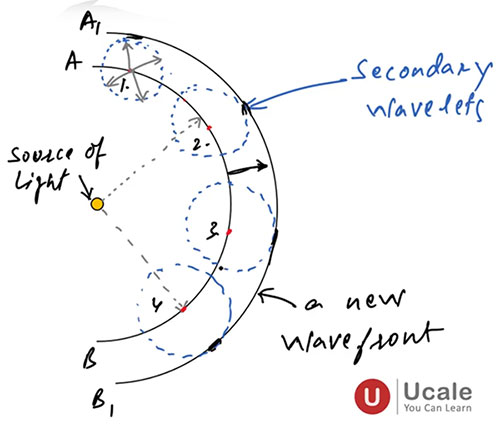
It tells us that every point on a wave front acts like a new source of tiny waves, called secondary wavelets.
These tiny wavelets spread out in all directions.
The surface that touches all these new wavelets becomes the new wave front.
So, light doesn’t just “move forward.”
It rebuilds itself step-by-step, creating new wave fronts at every moment.
Why is this useful?
Because this idea helps explain:
- Reflection
- Refraction
- Diffraction
- Interference
— phenomena that cannot be explained by simple ray diagrams.
2. Statement and Explanation of Huygens’ Principle
Statement
Every point on a given wave front acts as a source of secondary spherical wavelets.
The common tangent (envelope) to all these wavelets at a later time gives the new wave front.
Explanation
- Start with an existing wave front (like a surface representing constant phase).
- Consider any point on this wave front.
- That point emits a secondary wavelet—a tiny spherical wave.
- Do this for every point → a family of spherical wavelets.
- Draw a tangent surface touching the outer edges of these wavelets.
- This tangent surface becomes the next wave front.
By repeating this process, the wave travels forward.
Why do wavelets only form a forward envelope?
In real light, the backward envelope is not observed because the amplitude of backward wavelets cancels due to interference.
This correction was later added by Fresnel, refining the original principle.
3. Dimensions and Units
Huygens’ Principle is a concept, not a measurable physical quantity.
- Dimensions: None
- Units: None
4. Key Features
- Every point on a wave front behaves like a source of wavelets.
- New wave fronts are formed by touching the outer boundary of these wavelets.
- Works for all types of waves (light, sound, water waves).
- Explains reflection, refraction, and diffraction.
- Light rays can be drawn perpendicular to wave fronts.
- Can convert spherical wave fronts into plane wave fronts (and vice versa).
- Provides a geometric method to track the wave propagation.
5. Important Concepts / Formulas (Table)
| Concept / Formula | Description |
|---|---|
| Secondary wavelets | Tiny spherical waves emitted from each point on wave front |
| New wave front | Common tangent to secondary wavelets |
| Direction of propagation | Perpendicular to wave front |
| Reflection through Huygens | Angle of incidence = angle of reflection (derived using wavelets) |
| Refraction through Huygens | Snell’s law [\dfrac{\sin i}{\sin r}] [= \dfrac{v_1}{v_2} ] |
6. Conceptual Questions with Solutions
1. Why do secondary wavelets form the basis of wave propagation?
Because wave propagation requires that the disturbance at one point influences the next. Secondary wavelets represent this “forward influence” of every point on the wave front.
2. Why is the new wave front the envelope of all secondary wavelets?
Because the common tangent surface touches all wavelets at the earliest possible moment, representing the farthest advance of the wave at that time.
3. Why does Huygens’ principle work for light?
Because light behaves like a wave. Wherever waves propagate, wave fronts and secondary wavelets naturally arise.
4. Why is the backward envelope not used?
Backward wavelets interfere destructively due to Fresnel’s correction, so only the forward envelope represents the real wave front.
5. Can Huygens’ principle explain reflection?
Yes. The wavelets from the reflecting surface form a new wave front such that angle of incidence equals angle of reflection.
6. Can it explain refraction?
Yes. Due to different speeds in two media, secondary wavelets grow with different radii, leading to Snell’s law.
7. Why is Huygens’ principle helpful in diffraction?
Because it shows how wavelets spread into regions where rays cannot go, explaining bending around obstacles.
8. Why are wavelets spherical?
Because disturbance from a point spreads equally in all directions unless prevented by geometry.
9. Why is the principle geometrical rather than mathematical?
Because it uses shapes (wave fronts and wavelets) to construct propagation; no direct equations are necessary.
10. What happens to wavelets in a denser medium?
Their radius grows more slowly because speed is smaller, giving a refracted wave front.
11. Why are rays always perpendicular to wave fronts?
Because rays show direction of propagation, which is normal to the surface of constant phase.
12. Does Huygens’ principle support both longitudinal and transverse waves?
Yes, because both involve wave fronts and phase.
13. Does Huygens’ principle predict speed of light?
No. It only shows direction of propagation; speed must be known from experiments.
14. Why can Huygens’ principle not explain polarization?
Because Huygens assumed light to be a scalar wave, unaware that it was transverse.
15. Why does the radius of wavelets determine the direction of the refracted ray?
Because the envelope drawn around unequal wavelets creates a tilted wave front, whose normal gives refracted direction.
7. FAQ / Common Misconceptions
1. Misconception: Huygens’ principle is only for optics.
No. It applies to all waves—sound, water, etc.
2. Misconception: Wavelets travel faster than the original wave.
False. They travel with the SAME speed as the parent wave in that medium.
3. Misconception: Only a few points emit wavelets.
Incorrect. **Every** point on the wave front emits wavelets.
4. Misconception: The backward wave front is real.
It is not observed because it interferes destructively.
5. Misconception: Rays are fundamental; wave fronts are secondary.
Actually, rays are normals **derived** from wave fronts.
6. Misconception: Huygens’ principle contradicts Snell’s law.
False. It actually **derives** Snell’s law.
7. Misconception: Diffraction needs special wave fronts.
Diffraction naturally arises from ordinary secondary wavelets.
8. Misconception: Wavelets must be identical in all media.
Their radius depends on wave speed; thus they differ across media.
9. Misconception: Light cannot bend.
Light bends due to wavefront reconstruction in diffraction and refraction.
10. Misconception: Huygens’ principle works only for monochromatic waves.
No. Any continuous wave (even polychromatic) forms wave fronts.
8. Practice Questions (with Step-by-Step Solutions)
1. Use Huygens’ principle to justify why light travels in straight lines in homogeneous media.
Solution:
In a uniform medium, all secondary wavelets have equal radii.
The tangent surface is a plane parallel to the previous one → propagation is straight.
2. Show using Huygens’ principle why a spherical wave front remains spherical.
Solution:
Every point on the spherical wave front emits spherical wavelets with equal radii.
The envelope of these wavelets is another sphere, just enlarged.
3. Using Huygens’ principle, explain why a ray bends toward the normal when light enters a denser medium.
Solution:
Speed decreases → wavelets in denser medium have smaller radii.
The envelope tilts toward the normal.
Thus, the ray (normal to envelope) bends toward the normal.
4. Derive Snell’s law using Huygens’ construction.
Solution:
From geometry of wave fronts:
[ \dfrac{\sin i}{\sin r}] [= \dfrac{v_1}{v_2} ]
This becomes Snell’s law.
5. Why does diffraction occur according to Huygens’ principle?
Solution:
At an obstacle edge, the edge point acts as a secondary source.
Wavelets spread into the shadow region → bending = diffraction.
 Sign in with Google