

1. Statement of the Principle
A hydraulic lift works on the principle of Pascal’s Law, which states that when pressure is applied to a confined fluid, it is transmitted equally and undiminished in all directions throughout the fluid.
2. Explanation and Mathematical Derivation
Consider a hydraulic lift consisting of two pistons — a narrow piston (A₁) and a broad piston (A₂) — connected by a tube filled with an incompressible liquid.
Let:
- Force applied on the small piston = [F₁]
- Area of the small piston = [A₁]
- Force on the large piston = [F₂]
- Area of the large piston = [A₂]
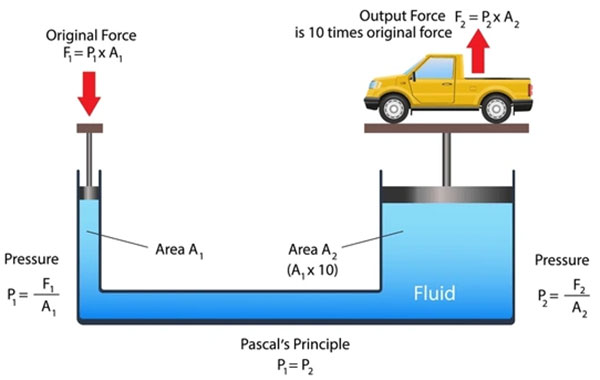
According to Pascal’s Law, the pressure is transmitted equally:
[
\dfrac{F₁}{A₁} = \dfrac{F₂}{A₂}
]
Therefore,
[
F₂ = F₁ \times \dfrac{A₂}{A₁}
]
Hence, the mechanical advantage (M.A.) is:
[
M.A. = \dfrac{F₂}{F₁} = \dfrac{A₂}{A₁}
]
Thus, a small force applied on a smaller piston can lift a large weight on the bigger piston — forming the basis of a hydraulic lift, hydraulic brakes, and hydraulic presses.
3. Dimensions and Units
| Quantity | Symbol | Formula | Dimensions | SI Unit |
|---|---|---|---|---|
| Pressure | P | [\dfrac{F}{A}] | [M L⁻¹ T⁻²] | Pascal (Pa) |
| Force | F | — | [M L T⁻²] | Newton (N) |
| Area | A | — | [L²] | m² |
4. Key Features
- Works on Pascal’s Law.
- Incompressible fluid is used (usually oil).
- Produces large output force with a small input force.
- Used in hydraulic jacks, car lifts, brakes, presses, etc.
- The lift efficiency depends on friction and fluid leakage.
5. Important Formulas to Remember
| Formula | Description |
|---|---|
| [\dfrac{F₁}{A₁} = \dfrac{F₂}{A₂}] | Pressure transmitted equally |
| [F₂ = F₁ \times \dfrac{A₂}{A₁}] | Force relationship |
| [M.A. = \dfrac{A₂}{A₁}] | Mechanical advantage |
| [P = \rho g h] | Pressure at depth (if height difference exists) |
6. Conceptual Questions with Solutions
1. What physical principle is used in a hydraulic lift?
It is based on Pascal’s Law — pressure applied to a confined liquid is transmitted equally in all directions.
2. Why is an incompressible liquid necessary?
Because only incompressible fluids can transmit pressure uniformly without loss.
3. What happens if air enters the hydraulic fluid?
The lift becomes inefficient because air compresses, preventing equal pressure transmission.
4. If [A₂ = 10A₁], how much weight can be lifted using 100 N force?
[F₂ = F₁ \times \dfrac{A₂}{A₁} = 100 \times 10 = 1000 N]
5. What is the mechanical advantage in a hydraulic lift?
The ratio of areas of the two pistons, [M.A. = \dfrac{A₂}{A₁}].
6. Can Pascal’s law work in gases?
Not effectively — gases are compressible, so pressure transmission isn’t uniform.
7. Why is oil used instead of water?
Oil is less compressible and prevents rusting of metal parts.
8. How does friction affect the hydraulic lift?
Friction in the pistons and valves reduces efficiency and force output.
9. What ensures equilibrium in a hydraulic lift?
Equal transmitted pressure and balanced forces on both pistons.
10. If the small piston moves down by 0.1 m, how far does the large piston move?
[A₁x₁ = A₂x₂], hence [x₂ = \dfrac{A₁}{A₂}x₁].
11. How is energy conserved in a hydraulic lift?
Input work = Output work → [F₁x₁ = F₂x₂].
12. What happens if A₁ and A₂ are equal?
No mechanical advantage — [F₁ = F₂].
13. Does height difference affect pressure?
Yes, [P = \rho g h] adds to transmitted pressure when height differs.
14. Why can hydraulic systems lift heavy vehicles?
Because the large piston area multiplies the input force many times.
15. What is the advantage of a larger A₂/A₁ ratio?
Greater load can be lifted with smaller effort, increasing mechanical advantage.
7. FAQ / Common Misconceptions
1. Is hydraulic lift violating energy conservation?
No. Work done remains equal on both sides; force increases, but distance decreases.
2. Does a hydraulic lift multiply force or energy?
It multiplies force, not energy.
3. Is Pascal’s law valid for compressible fluids?
No, it holds accurately only for incompressible fluids.
4. Is pressure transmitted only vertically?
No, it’s transmitted equally in all directions.
5. Is the lift efficiency always 100%?
No, due to friction and leakage, efficiency < 100%.
6. Can a small piston lift an unlimited load?
No, limited by material strength and system pressure capacity.
7. Does piston size affect pressure transmission?
No, pressure is the same on both pistons; only force differs.
8. Is mechanical advantage the same as efficiency?
No. M.A. is geometric; efficiency includes energy losses.
9. Can gas leakage occur in hydraulic systems?
No, liquid systems are sealed to prevent pressure loss.
10. Why do real systems need periodic maintenance?
To prevent leakage, contamination, and frictional wear.
8. Practice Questions (with Step-by-Step Solutions)
Q1. A hydraulic lift has [A₁ = 0.02 m²] and [A₂ = 0.8 m²]. Find the force needed on the smaller piston to lift a car weighing [16,000 N].
Solution:
[\dfrac{F₁}{A₁} = \dfrac{F₂}{A₂}]
[F₁ = F₂ \times \dfrac{A₁}{A₂}] [= 16000 \times \dfrac{0.02}{0.8}] [= 400 N]
Q2. If a 100 N force moves the small piston down by 0.5 m, find the distance moved by the large piston if [A₂/A₁ = 20].
Solution:
[Work input] [= Work output]
[\Rightarrow F₁x₁ = F₂x₂]
[\Rightarrow 100 \times 0.5] [= 2000 \times x₂]
[\Rightarrow x₂ = 0.025 \text{ m}]
Q3. Calculate mechanical advantage if [A₂ = 25A₁].
Solution:
[M.A. = \dfrac{A₂}{A₁} = 25]
Q4. If a pressure of [2×10⁵ Pa] is applied on the small piston, find the output force on the large piston of area [0.5 m²].
Solution:
[F₂] = P \times A₂] [= 2 \times 10⁵ \times 0.5] [= 1 \times 10⁵ N]
Q5. A hydraulic lift uses oil of density [800 kg/m³]. If height difference between pistons is 0.5 m, find additional pressure due to gravity.
Solution:
[P] [= \rho g h] [= 800 \times 9.8 \times 0.5] [= 3920 \text{ Pa}]
 Sign in with Google