

1. Concept Overview
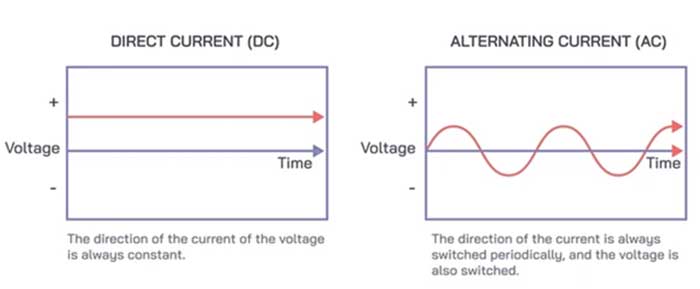
An Alternating Current (AC) is an electric current whose magnitude and direction change periodically with time. Unlike Direct Current (DC), which flows in one direction, AC reverses its direction many times per second.
Most of the electricity supplied to homes, industries, and power stations is AC, because it is easy to generate, transmit over long distances, and transform to different voltage levels.
2. Clear Explanation (with Mathematical Form)
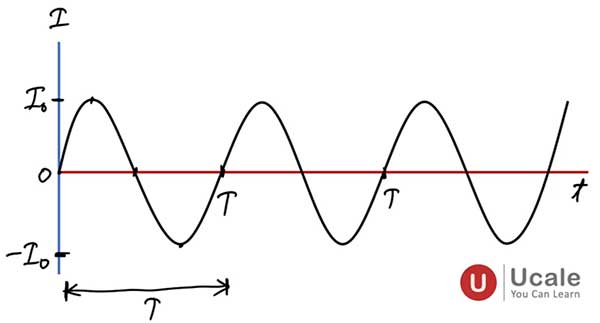
An AC voltage or current is typically expressed as a sinusoidal function:
- Instantaneous emf:
[
e(t) = E_0 \sin(\omega t)
] - Instantaneous current:
[
i(t) = I_0 \sin(\omega t)
]
Where:
- ([E_0]) = Peak (maximum) voltage
- ([I_0]) = Peak (maximum) current
- ([\omega]) = Angular frequency
- ([t]) = Time
The waveform alternates between positive and negative values.
Frequency and Time Period
- Frequency:
[
f = \dfrac{\omega}{2\pi}
] - Time Period: [
T = \dfrac{1}{f}
]
In India, the AC power supply has:
[
f = 50\ \text{Hz}
]
So,
[
T = \dfrac{1}{50}\ \text{s} = 0.02\ \text{s}
]
3. Dimensions and Units
| Quantity | Expression | Dimensions | SI Unit |
|---|---|---|---|
| Voltage (AC) | ( e(t) ) | ([ML^2T^{-3}A^{-1}]) | Volt (V) |
| Current (AC) | ( i(t) ) | ([A]) | Ampere (A) |
| Angular Frequency | ( \omega ) | ([T^{-1}]) | rad/s |
| Frequency | ( f ) | ([T^{-1}]) | Hz |
| Time Period | ( T ) | ([T]) | second |
4. Key Features of AC
- The direction of current reverses periodically.
- AC can be generated easily using alternators.
- AC can be stepped up or stepped down efficiently using transformers.
- AC has lower transmission loss compared to DC.
- AC can be represented mathematically using sinusoidal functions.
- The value of AC keeps changing; hence the concept of effective (RMS) values is used.
- AC is more suitable for long-distance power transmission.
5. Important Formulas to Remember
| Concept | Formula |
|---|---|
| Instantaneous voltage | ([e(t) = E_0 \sin(\omega t)]) |
| Instantaneous current | ([i(t) = I_0 \sin(\omega t)]) |
| Angular frequency | ([\omega = 2\pi f]) |
| Frequency | ([f = \dfrac{\omega}{2\pi}]) |
| Time period | ([T = \dfrac{1}{f}]) |
6. Conceptual Questions with Solutions
1. Why does AC reverse its direction periodically?
Because AC is produced by rotating a coil in a magnetic field. The direction of induced emf changes every half rotation (due to Fleming’s right-hand rule), causing current direction to reverse periodically.
2. Why is AC preferred over DC for power transmission?
Because AC voltage can be stepped up or down easily using transformers, reducing power loss \([I^2R]\) during transmission.
3. Why is AC represented by a sine function?
Because the rotating coil generates emf proportional to the sine of the angle between the coil and magnetic field, naturally giving a sinusoidal waveform.
4. Why do we define RMS values for AC?
Because the instantaneous values keep changing; RMS gives an equivalent steady DC value that produces the same heating effect.
5. Does AC have a fixed direction?
No. It reverses direction periodically due to sinusoidal nature.
6. Why is household voltage marked as 230 V when AC keeps changing?
Because 230 V is the **RMS value**, not the peak value. Actual peak voltage is higher.
7. Why is AC safer to transform?
Transformers work on the principle of mutual induction, which requires varying current—fulfilled naturally by AC.
8. What determines the frequency of AC?
The rotational speed of the alternator.
9. Why does AC cause less transmission loss?
High-voltage AC transmission reduces current, and thus power loss \([P = I^2R]\).
10. Why are AC motors more widely used?
They are simpler, cheaper, and require no brushes or commutators.
11. Can AC be converted to DC?
Yes, using rectifiers.
12. Why does AC frequency matter?
Because the performance of motors, transformers, and electronic devices depends on frequency.
13. Why do we use sinusoidal AC instead of triangular or square AC?
Sinusoidal waveforms experience least distortion during transmission and are naturally produced by rotating machines.
14. Why does AC not require a commutator like DC?
Because direction reversal is naturally achieved through rotation, not by switching.
15. Why do we say AC has “zero average value” over a cycle?
Because positive and negative halves of the sine wave neutralize each other, giving zero average current/voltage.
7. FAQ / Common Misconceptions
1. Is AC always sinusoidal?
No. AC can be square, triangular, or any periodic waveform. But power supply AC is sinusoidal.
2. Does AC mean high voltage?
No. AC simply means alternating direction; voltage level can be low or high.
3. Does AC waste more power than DC?
No. AC is more efficient for long-distance transmission due to transformer compatibility.
4. Is RMS value the same as average value?
No. RMS is based on heating effect. Average of a sine wave over a full cycle is zero.
5. Is peak value more important than RMS?
RMS is more important for practical use (like household electricity).
6. Does AC frequency vary in homes?
No. It is fixed at 50 Hz (India) or 60 Hz (US).
7. Do transformers work with DC?
No. DC does not change with time, so no induction occurs.
8. Is AC dangerous only at high voltages?
AC at even moderate voltage can be dangerous due to its varying nature.
9. Does AC flow at the speed of electrons?
No. AC propagation is the movement of the electric field, not electrons. The field propagates extremely fast.
10. Is 230 V the peak voltage?
No. It’s the RMS value. Peak voltage: \[ E_0 = \sqrt{2} \times 230 = 325.3\ \text{V} \]
8. Practice Questions (with Step-by-Step Solutions)
1. The mains AC supply has a frequency of 50 Hz. What is its time period?
Solution:
[T = \dfrac{1}{f}] [= \dfrac{1}{50}] [= 0.02\ \text{s}]
2. If an alternating emf is given by ([e = 200 \sin(100\pi t)]), find its peak voltage and frequency.
Solution:
- Peak voltage: ([E_0 = 200\ \text{V}])
- Angular frequency: ([\omega = 100\pi])
[f = \dfrac{\omega}{2\pi}] [= \dfrac{100\pi}{2\pi}] [= 50\ \text{Hz}]
3. A sinusoidal AC has an RMS value of 10 A. Find its peak current.
Solution:
[I_0 = \sqrt{2} I_{\text{rms}}] [= \sqrt{2} \times 10] [= 14.14\ \text{A}]
4. A generator produces AC of frequency 60 Hz. How many times does the current reverse direction per second?
Solution:
Each cycle = 2 reversals
[\text{Reversals per second}] [= 2f = 120]
5. If the instantaneous current is ([i = 5 \sin(200 t)]), find the time when current is zero.
Solution:
[i = 0] [\Rightarrow \sin(200 t) = 0]
[200 t = n\pi] [\Rightarrow t = \dfrac{n\pi}{200}]
where (n = 0, 1, 2, \ldots)
 Sign in with Google