

1. Statement of the Laws
Johannes Kepler, using Tycho Brahe’s observations, formulated three fundamental laws that describe the motion of planets around the Sun. These are known as Kepler’s Laws of Planetary Motion.
- First Law (Law of Orbits):
Every planet moves in an elliptical orbit with the Sun at one of the foci. - Second Law (Law of Areas):
The line joining a planet and the Sun sweeps out equal areas in equal intervals of time. - Third Law (Law of Periods):
The square of the time period of revolution of a planet around the Sun is directly proportional to the cube of the semi-major axis of its orbit.
[T^2 \propto r^3] [\quad \text{or}] [\quad] $\left[\dfrac{T_1^2}{T_2^2} = \dfrac{r_1^3}{r_2^3}\right]$
2. Explanation and Mathematical Derivation
Kepler’s First Law — Law of Orbits
The orbit of each planet is an ellipse defined by:
$\left[\dfrac{x^2}{a^2} + \dfrac{y^2}{b^2} = 1\right]$
where:
- [a] = semi-major axis
- [b] = semi-minor axis
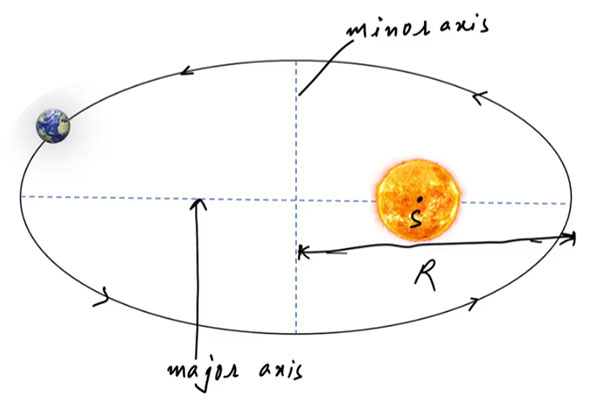
The Sun lies at one focus of this ellipse.
This means the distance between the planet and the Sun changes continuously during its revolution.
Kepler’s Second Law — Law of Areas
If [r] is the distance between the Sun and planet and [\theta] is the angle swept at the center in time [dt],
then the area swept in time [dt] is:
[dA = \dfrac{1}{2} r^2 d\theta]
Rate of sweeping area:
[\dfrac{dA}{dt}] [= \dfrac{1}{2} r^2 \dfrac{d\theta}{dt}]
But angular momentum of the planet is:
[L = m r^2 \dfrac{d\theta}{dt}]
Hence,
[\dfrac{dA}{dt}] [= \dfrac{L}{2m}] [= \text{constant}]
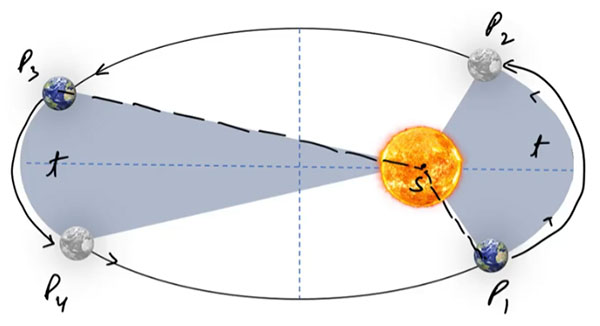
Thus, the planet sweeps equal areas in equal times → Angular momentum is conserved, showing that the gravitational force is central (acts along the radius vector).
Kepler’s Third Law — Law of Periods
For a planet of mass [m] revolving around the Sun (mass [M]) in a circular orbit of radius [r] and period [T]:
Gravitational force provides centripetal force:
[\dfrac{G M m}{r^2} = \dfrac{m v^2}{r}]
or,
[v^2 = \dfrac{G M}{r}]
Time period of revolution:
[T = \dfrac{2\pi r}{v}] [= 2\pi \sqrt{\dfrac{r^3}{G M}}]
Squaring both sides:
[T^2 = \dfrac{4\pi^2}{G M} r^3]
Hence,
[T^2 \propto r^3]
This holds true for all planets revolving around the Sun.
3. Dimensions and Units
| Quantity | Symbol | Dimensions | SI Unit |
|---|---|---|---|
| Time Period | [T] | [T] | [s] |
| Radius / Semi-major Axis | [r] | [L] | [m] |
| Gravitational Constant | [G] | [M⁻¹L³T⁻²] | [N·m²/kg²] |
4. Key Features
- Planets follow elliptical paths, not perfect circles.
- The Sun lies at one focus, not at the center.
- The velocity of a planet is maximum at perihelion and minimum at aphelion.
- The second law is a direct consequence of conservation of angular momentum.
- The third law links orbital size and period, revealing that outer planets move slower.
- The laws are valid for any object under gravitational attraction (e.g., satellites around Earth).
5. Important Formulas to Remember
| Formula | Description |
|---|---|
| [dA/dt = \dfrac{L}{2m}] | Constant areal velocity (Second Law) |
| [v^2 = \dfrac{G M}{r}] | Orbital speed relation |
| [T = 2\pi \sqrt{\dfrac{r^3}{G M}}] | Time period of revolution |
| [T^2 = \dfrac{4\pi^2}{G M} r^3] | Kepler’s Third Law |
| [T^2 \propto r^3] | General proportionality form |
6. Conceptual Questions with Solutions
1. State Kepler’s First Law.
Every planet moves in an elliptical orbit with the Sun at one of its foci.
2. What physical principle underlies Kepler’s Second Law?
It is a consequence of **conservation of angular momentum**.
3. When does a planet move fastest in its orbit?
At **perihelion**, where it is closest to the Sun.
4. When is the planet’s speed minimum?
At **aphelion**, where it is farthest from the Sun.
5. What is common among all planets according to Kepler’s Third Law?
The ratio [T^2 / r^3] is the same for all planets orbiting the same central body.
6. How does Kepler’s Second Law prove that the gravitational force is central?
Because areal velocity remains constant only when torque about the center is zero — implying force acts along the radius vector.
7. Derive Kepler’s Third Law for circular orbits.
From [G M m / r^2 = m v^2 / r] and [T = 2\pi r / v], we get [T^2 = (4\pi^2 / G M) r^3].
8. What happens to the orbital period if the radius doubles?
From [T^2 \propto r^3], [T \propto r^{3/2}]. If [r_2 = 2r_1], [T_2 = 2^{3/2} T_1 = 2.83 T_1].
9. Why is Earth’s orbital speed not constant?
Because its orbit is elliptical; speed increases near the Sun and decreases away.
10. How are Kepler’s laws related to Newton’s laws?
Newton’s law of gravitation provides the **theoretical basis** for Kepler’s empirical laws.
11. What is the shape of a satellite’s orbit if its speed equals orbital velocity?
Circular orbit.
12. How do artificial satellites obey Kepler’s Third Law?
They also satisfy [T^2 \propto r^3], with [M] being Earth’s mass.
13. What does constant areal velocity indicate?
Planet’s angular momentum is conserved.
14. What happens to [T] if [r] becomes half?
[T_2 / T_1 = (r_2 / r_1)^{3/2} = (1/2)^{3/2} = 1/2.83 = 0.354]. So time period decreases by about 65%.
15. Why are outer planets slower?
Because as [r] increases, [T] increases proportionally to [r^{3/2}].
7. FAQ / Common Misconceptions
1. Orbits of planets are perfect circles.
❌ False. They are ellipses with the Sun at one focus.
2. The Sun is at the center of planetary orbits.
❌ False. The Sun lies at one focus of the ellipse.
3. Planets move at constant speed.
❌ False. Speed varies — faster near Sun, slower far away.
4. Kepler’s laws apply only to planets.
❌ False. They apply to all bodies under gravitational attraction (e.g., satellites).
5. Kepler’s laws contradict Newton’s law.
❌ False. Newton’s law **explains** Kepler’s observations.
6. Areal velocity changes during motion.
❌ False. It remains constant (Second Law).
7. The Third Law depends on the planet’s mass.
❌ False. It depends only on the Sun’s mass.
8. A planet’s orbit can be any ellipse.
❌ False. It depends on initial velocity and gravitational pull.
9. Tidal forces affect Kepler’s laws.
✅ Slightly, but not significantly for large planetary systems.
10. Kepler’s laws cannot describe satellites.
❌ False. They apply perfectly to Earth satellites too.
8. Practice Questions (With Step-by-Step Solutions)
Q1. A planet revolves around the Sun with semi-major axis [r_1 = 1.5 × 10^{11} m] and time period [T_1 = 1 \text{ year}]. Find the time period of another planet whose orbital radius is [r_2 = 2.25 × 10^{11} m].
Solution:
[\dfrac{T_2^2}{T_1^2}] [= \dfrac{r_2^3}{r_1^3} \Rightarrow T_2] [= T_1 \left(\dfrac{r_2}{r_1}\right)^{3/2}]
[T_2] [= 1 (1.5)^{3/2}] [= 1.84 \text{ years}]
Q2. Show that Kepler’s Second Law implies conservation of angular momentum.
Solution:
From Second Law: [dA/dt = \text{constant}].
Since [dA/dt = (1/2) r^2 (d\theta/dt)],
Multiplying by [2m]: [m r^2 (d\theta/dt) = \text{constant}] ⇒ Angular momentum [L] is conserved.
Q3. Derive [T^2 = \dfrac{4\pi^2}{G M} r^3].
Solution:
From [G M m / r^2 = m v^2 / r] ⇒ [v^2 = G M / r].
Also, [T = 2\pi r / v].
Substitute [v]:
[T] [= 2\pi \sqrt{\dfrac{r^3}{G M}}] [\Rightarrow T^2] [= \dfrac{4\pi^2}{G M} r^3]
Q4. If the Earth’s orbital radius were reduced to half, what would be its new period?
Solution:
[T_2] [= T_1 \left(\dfrac{r_2}{r_1}\right)^{3/2}] [= 1 \times (1/2)^{3/2}] [= 0.354 \text{ year}]
New period = 0.354 years ≈ 129 days.
Q5. A satellite takes 8 hours to orbit Earth. Find its orbital radius. (Take [G = 6.67×10^{-11}], [M = 6×10^{24} kg]).
Solution:
[
T = 8×3600 = 28800 s
]
[r^3] [= \dfrac{G M T^2}{4\pi^2}] [= \dfrac{6.67×10^{-11} × 6×10^{24} × (28800)^2}{39.48}]
[r^3] [= 8.45×10^{22}] [\Rightarrow r = 4.39×10^7 \text{ m}]
Hence, orbital radius = 4.39 × 10⁷ m.
 Sign in with Google