

1. Introduction
The term kinetic energy comes from the Greek word kinesis, meaning motion.
It is the energy possessed by a body due to its motion.
If a body of mass [m] moves with a velocity [v], it possesses kinetic energy (K.E.) given by:
[K = \dfrac{1}{2}mv^2]
This equation shows that kinetic energy depends on both the mass of the object and the square of its velocity.
Here are a few common examples of kinetic energy in everyday life:
- The movement of air, which powers windmills.
- The flow of water, which drives water mills.
- The force of a hammer driving a nail into wood.
- The ability of a bullet to penetrate a target because of its speed.
2. Derivation of Expression for Kinetic Energy
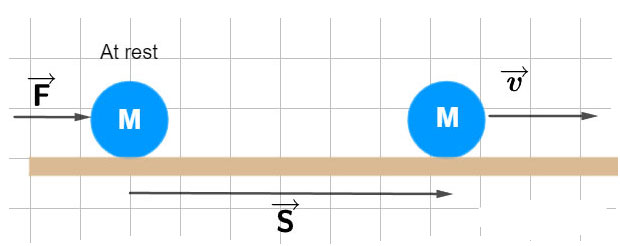
To derive the formula for kinetic energy, consider a body of mass [m] initially at rest.
A constant force [F] is applied, producing an acceleration [a], and the body covers a displacement [s].
From the work–energy relation,
[W = F \times s]
Using Newton’s Second Law, [F = ma], and the kinematic equation [v^2 = u^2 + 2as] (with [u = 0]), we get:
[W = ma \times s = m \times \dfrac{v^2}{2}]
Hence,
[K = \dfrac{1}{2}mv^2]
👉 Mathematics Connection: (Third Equation of a Uniformly Accelerated Motion)
3. Work–Energy Theorem
The work done by the net force on a body equals the change in its kinetic energy:
[W = \Delta K = K_2 – K_1]
This theorem applies to all types of motion, whether linear, rotational, or curvilinear.
4. Relation Between Force and Kinetic Energy
Let [F = ma = m \dfrac{dv}{dt}] and [v = \dfrac{dx}{dt}].
Then, the rate of work done (power) is:
[\dfrac{dW}{dt} = Fv]
Since [dW = dK], we have:
[\dfrac{dK}{dt} = Fv]
This equation relates force, velocity, and rate of change of kinetic energy.
👉 Mathematics Connection: (Differentiation and Product Rule)
5. Relation between Kinetic Energy and Linear Momentum
If a body has a mass of $ \displaystyle m$ then,
$ \displaystyle \begin{array}{l}\text{K}\text{.E}\text{.}=\dfrac{1}{2}m{{v}^{2}}=\dfrac{1}{{2m}}{{m}^{2}}{{v}^{2}}\\\Rightarrow \text{K}\text{.E}\text{.}=\dfrac{{{{p}^{2}}}}{{2m}}\end{array}$
where $ \displaystyle p$ is the linear momentum of the body i.e. $ \displaystyle p=mv$
It shows that a body cannot have kinetic energy without having linear momentum and vice-versa.
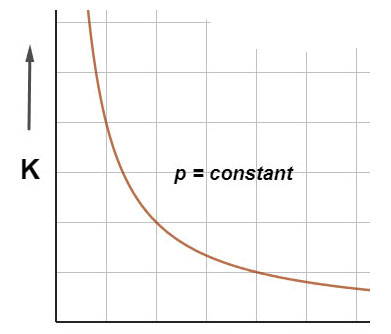
Therefore, if momentum i.e. $ \displaystyle p$ is constant the graphical representation of kinetic energy and mass is
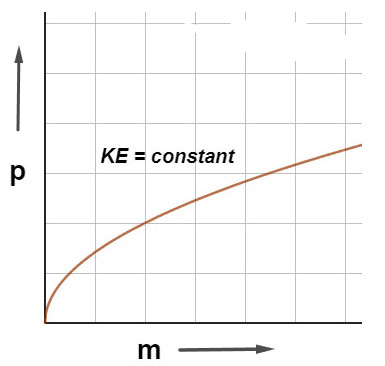
Similarly, if kinetic energy is constant, the graphical representation of kinetic momentum and mass is
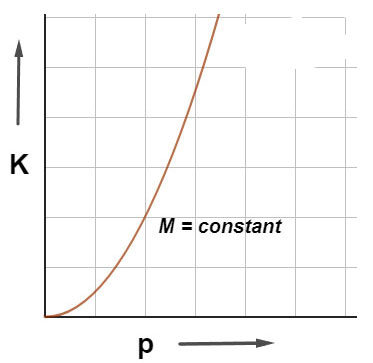
and if mass is constant, the graphical representation of kinetic energy and momentum is
5. Types of Kinetic Energy
- Translational Kinetic Energy – Energy due to linear motion: [K = \dfrac{1}{2}mv^2]
- Rotational Kinetic Energy – Energy due to rotation about an axis: [K = \dfrac{1}{2}I\omega^2]
- Vibrational Kinetic Energy – Energy due to periodic motion (as in molecules): [K = \dfrac{1}{2}kx^2]
6. Important Formulas to Remember
| Type of Kinetic Energy | Formula | Remarks |
|---|---|---|
| Linear motion | [K = \dfrac{1}{2}mv^2] | Depends on mass and square of velocity |
| Rotational motion | [K = \dfrac{1}{2}I\omega^2] | [I] is the moment of inertia |
| Change in kinetic energy | [\Delta K = K_2 – K_1] | Equal to net work done |
| Power | [P = \dfrac{dW}{dt} = Fv] | Rate of work done |
| Momentum relation | [K = \dfrac{p^2}{2m}] | Using [p = mv] |
7. Practice Questions (With Solutions)
Q1. A car of mass [1000\ \text{kg}] moves at [20\ \text{m/s}]. Find its kinetic energy.
Solution:
[
K = \dfrac{1}{2}mv^2 = \dfrac{1}{2} \times 1000 \times 20^2 = 2.0 \times 10^5\ \text{J}
]
Q2. If the velocity of a body doubles, by what factor does its kinetic energy change?
Solution:
Since [K \propto v^2], doubling [v] makes [K] increase by a factor of 4.
Q3. A bullet of mass [10\ \text{g}] moving at [400\ \text{m/s}] is stopped by a wooden block in [0.1\ \text{m}]. Find the average resistive force.
Solution:
Initial [K = \dfrac{1}{2}mv^2 = \dfrac{1}{2} \times 0.01 \times 400^2 = 800\ \text{J}]
Work done against friction = [F \times s = 800]
So, [F = \dfrac{800}{0.1} = 8000\ \text{N}]
Q4. A rotating wheel has [I = 0.5\ \text{kg·m}^2] and [\omega = 10\ \text{rad/s}]. Find its rotational kinetic energy.
Solution:
[K = \dfrac{1}{2}I\omega^2 = \dfrac{1}{2} \times 0.5 \times 10^2 = 25\ \text{J}]
Q5. A body’s kinetic energy increases from [200\ \text{J}] to [800\ \text{J}] in [2\ \text{s}]. Find the average power.
Solution:
[P = \dfrac{\Delta K}{t} = \dfrac{800 – 200}{2} = 300\ \text{W}]
8. Conceptual Questions
1. What happens to kinetic energy if the velocity is halved?
It becomes one-fourth, since [K \propto v^2].
2. Can a body have kinetic energy without momentum?
No. If velocity is zero, both momentum and kinetic energy are zero.
3. If a light and heavy body have the same kinetic energy, which has more velocity?
The lighter body, because [v = \sqrt{\dfrac{2K}{m}}].
4. Is kinetic energy a scalar or vector quantity?
Scalar, because it depends on the square of velocity.
5. Can kinetic energy be negative?
No. It is always positive or zero since [v^2] is always positive.
6. What does doubling the mass do to kinetic energy?
It doubles the kinetic energy for the same velocity.
7. If velocity is tripled, how does kinetic energy change?
It increases nine times.
8. Is kinetic energy frame dependent?
Yes, it depends on the observer’s frame of reference.
9. When is kinetic energy minimum?
When the velocity of the object is zero.
10. Does a rotating fan have kinetic energy even if its center is stationary?
Yes, due to rotational motion of the blades.
9. FAQs / Common Misconceptions
1. Does zero velocity always mean zero energy?
Translational kinetic energy is zero, but rotational or internal energy may still exist.
2. Why is kinetic energy proportional to the square of velocity?
Because work done to accelerate an object increases quadratically with speed.
3. Can kinetic energy ever be transferred?
Yes, during collisions or explosions energy transfers between objects.
4. Does direction of velocity affect kinetic energy?
No. It depends only on magnitude of velocity.
5. Is kinetic energy the same as work?
No. Work is energy in transit; kinetic energy is energy possessed due to motion.
 Sign in with Google