


Concept Overview
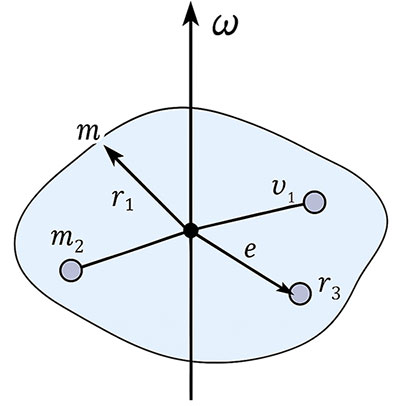
When a rigid body rotates about a fixed axis, each particle of the body moves in a circle with angular velocity [ \omega ].
Every particle has some linear velocity [ v = r\omega ], and hence possesses kinetic energy. The total kinetic energy of the rotating body is the sum of the kinetic energies of all its particles.
[\text{Kinetic Energy of Rotation: } K] [= \dfrac{1}{2} I \omega^2]
where:
- [ I = \sum m_i r_i^2 ] is the moment of inertia of the body about the axis of rotation.
- [ \omega ] is the angular velocity.
Thus, the rotational kinetic energy is analogous to the translational kinetic energy ( \frac{1}{2}mv^2 ).
Derivation
For a rigid body consisting of many particles:
[K] [= \sum \dfrac{1}{2} m_i v_i^2] [= \sum \dfrac{1}{2} m_i (r_i^2 \omega^2)]
[K] [= \dfrac{1}{2} \omega^2 \sum m_i r_i^2] [= \dfrac{1}{2} I \omega^2]
Relation Between Translational and Rotational Kinetic Energy
For a rolling object (without slipping):
[v = \omega R]
[\text{Total KE} = \dfrac{1}{2} I \omega^2 + \dfrac{1}{2} M v^2]
Practical Examples
- Rolling Ball or Cylinder: The energy of a rolling sphere is divided between rotation and translation.
- Flywheel: Stores rotational kinetic energy to smooth out the power output of engines.
- Wind Turbine: Blades rotate with angular velocity, possessing rotational kinetic energy.
- Ceiling Fan: Each blade contributes to the total kinetic energy based on its moment of inertia.
- Spinning Disk in Machinery: Used for storing or regulating kinetic energy in mechanical systems.
Key Features
- Depends on angular velocity [ \omega ] and moment of inertia [ I ].
- Independent of the direction of rotation (since it involves [ \omega^2 ]).
- Analogous to translational kinetic energy [ \dfrac{1}{2}mv^2 ].
- For rolling motion, both rotational and translational kinetic energies coexist.
- Moment of inertia plays the same role in rotation as mass does in translation.
- The energy stored can be used to perform mechanical work (e.g., in flywheels or turbines).
- Distribution of mass significantly affects rotational energy — mass farther from the axis increases [ I ] and hence [ K ].
Important Formula Table
| Quantity | Symbol | Formula / Expression | Remarks |
|---|---|---|---|
| Rotational Kinetic Energy | [ K ] | [ \dfrac{1}{2} I \omega^2 ] | [ I ]: Moment of Inertia |
| Linear Velocity | [ v ] | [ r\omega ] | Relation between linear and angular motion |
| Total Kinetic Energy (Rolling Body) | [ K_{\text{total}} ] | [ \dfrac{1}{2} I \omega^2 + \dfrac{1}{2} M v^2 ] | Combination of rotational & translational energy |
| Ratio of Rotational to Translational Energy | [ \dfrac{K_{\text{rot}}}{K_{\text{trans}}} ] | [ \dfrac{I}{MR^2} ] | Depends on shape of body |
| Moment of Inertia (Discrete System) | [ I ] | [ \sum m_i r_i^2 ] | Sum over all mass elements |
| Kinetic Energy per Unit Moment of Inertia | – | [ \dfrac{K}{I} = \dfrac{1}{2} \omega^2 ] | Useful for comparative analysis |
Conceptual Questions
1. Why is rotational kinetic energy proportional to moment of inertia?
Because \( I \) measures resistance to angular acceleration; larger \( I \) means more energy required for a given \( \omega \).
2. How is rotational kinetic energy analogous to translational kinetic energy?
Translational: \( \dfrac{1}{2}mv^2 \); Rotational: \( \dfrac{1}{2}I\omega^2 \) — both have the same form.
3. What happens if angular velocity doubles?
Energy becomes four times greater since \( K \propto \omega^2 \).
4. Does every rotating object have the same kinetic energy at a given ω?
No, because \( I \) depends on mass distribution.
5. Why does a rolling object move slower than a sliding one down an incline?
Part of the energy goes into rotation instead of pure translation.
6. Why is kinetic energy zero on the rotation axis?
Because \( r = 0 \), so \( v = 0 \).
7. Why do turbines have wide blades?
To increase moment of inertia, enabling greater energy storage.
8. If two bodies have same ω, which has more energy — ring or disc?
The ring, since \( I_{\text{ring}} > I_{\text{disc}} \).
9. How can rotational energy be converted to translational?
During rolling without slipping, rotational energy contributes to forward motion.
10. Can rotational energy exist without mass distribution?
No, without mass, there’s no inertia or stored kinetic energy.
11. Does changing the axis affect kinetic energy?
Yes, because \( I \) depends on the chosen axis of rotation.
12. Is rotational kinetic energy vectorial?
No, it’s scalar since it depends on the square of angular velocity.
13. Does the direction of rotation matter?
No, energy is independent of rotation direction.
14. What determines the energy stored in a flywheel?
Its moment of inertia and angular velocity — both influence \( \dfrac{1}{2}I\omega^2 \).
15. Why is mass distribution crucial in rotational systems?
Because energy storage capability increases when mass lies farther from the rotation axis.
FAQ / Common Misconceptions
1. Is rotational kinetic energy always the same for all rotating objects?
No, it depends on both \( I \) and \( \omega \).
2. Does higher speed always mean more energy?
Not if the moment of inertia is small; both factors matter.
3. Can a body have rotational energy without rotating?
No, angular velocity must be nonzero.
4. Does direction of rotation change the energy?
No, energy depends on \( \omega^2 \), not on the sign of \( \omega \).
5. Is moment of inertia constant for all axes?
No, it varies with axis position and orientation.
 Sign in with Google