

1. Statement of the Theorem
If a function [f(x)] satisfies:
- It is continuous on the closed interval [[a,b]], and
- It is differentiable on the open interval [(a,b)],
then there exists at least one point [c\in(a,b)] such that:
[f'(c)=\dfrac{f(b)-f(a)}{b-a}]
2. Explanation (Why It Works)
- Since [f(x)] is continuous on [[a,b]], its graph has no breaks/jumps.
- Since [f(x)] is differentiable on [(a,b)], its graph is smooth (no sharp corners).
- There must be at least one point where the tangent is parallel to the secant joining [A(a,f(a))] and [B(b,f(b))].
This connects average rate of change and instantaneous rate of change.
3. Geometrical Interpretation
- The line joining points [A(a,f(a))] and [B(b,f(b))] is the secant line with slope:
[\left(\dfrac{f(b)-f(a)}{b-a}\right)]
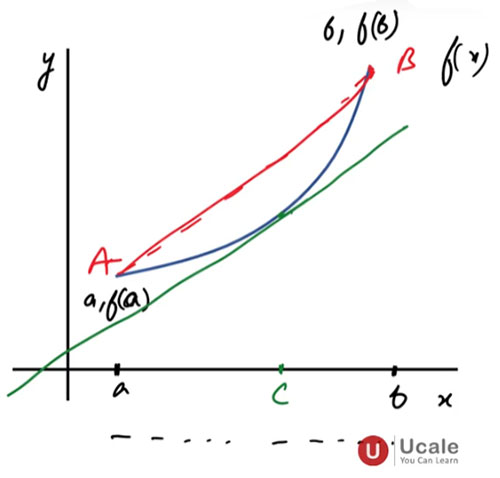
- LMVT ensures that at some point inside, the tangent line is parallel to this secant line.
4. Important Points
| Key Property | Meaning |
|---|---|
| Links differentiation + continuity | Ensures smooth behavior of function |
| Tangent parallel to secant | Same slope at some [c] |
| Extension of Rolle’s Theorem | When [f(a)=f(b)], LMVT → Rolle’s Theorem |
5. Important Formula
[f'(c)=\dfrac{f(b)-f(a)}{b-a}]
Where:
- LHS: Instantaneous rate of change
- RHS: Average rate of change
6. Examples — Step-by-Step Solutions
Example 1
Apply Lagrange`s Mean Value Theorem on [f(x)=x^{2}] on [[1,4]].
Solution:
- [x^{2}] is continuous & differentiable everywhere → LMVT applies.
- Compute RHS:
[\dfrac{f(4)-f(1)}{4-1}][=\dfrac{16-1}{3}][=\dfrac{15}{3}=5]
- LHS: [f'(x)=2x]. Set:
[2c=5][ ⇒ c=\dfrac{5}{2}]
Conclusion: Lagrange`s Mean Value Theorem is satisfied at [c=\dfrac{5}{2}].
Example 2
Apply Lagrange`s Mean Value Theorem to [f(x)=\sin x] on [[0,\pi]].
Solution:
- Continuous & differentiable everywhere.
- Compute RHS:
[\dfrac{f(\pi)-f(0)}{\pi-0}][=\dfrac{0-0}{\pi}=0]
- Derivative: [\dfrac{d}{dx}(\sin x)=\cos x].
- Solve: [\cos c=0][ ⇒ c=\dfrac{\pi}{2}]
Example 3
Apply Lagrange`s Mean Value Theorem to [f(x)=e^{x}] on [[0,1]].
Solution:
- Continuous & differentiable ⇒ okay.
- Average slope:
[\dfrac{e^{1}-e^{0}}{1-0}][=e-1]
- Derivative: [f'(x)=e^{x}].
- Solve:
[e^{c}=e-1][ ⇒ c=\ln(e-1)]
Example 4
Apply Lagrange`s Mean Value Theorem to [f(x)=\ln x] on [[1,e]].
Solution:
- Continuous on [1,e], differentiable on [(1,e)].
- RHS:
[\dfrac{\ln e-\ln 1}{e-1}][=\dfrac{1-0}{e-1}][=\dfrac{1}{e-1}]
- Derivative: [\dfrac{d}{dx}(\ln x)=\dfrac{1}{x}].
[\dfrac{1}{c}][=\dfrac{1}{e-1} ⇒ c=e-1]
Example 5
Apply Lagrange`s Mean Value Theorem on [f(x)=x^{3}-3x+1] on [[-1,2]].
Solution:
- Polynomial ⇒ continuous + differentiable.
- Average slope:
[\dfrac{f(2)-f(-1)}{2+1}][=\dfrac{(8-6+1)-((-1)+3+1)}{3}][=\dfrac{3-(3)}{3}=0]
- Derivative: [f'(x)=3x^{2}-3].
- Solve:
[3c^{2}-3=0][ ⇒ c^{2}=1 ⇒ c=±1]
- Select values inside (-1,2):
[c=1 \text{ (valid)},][\quad][ c=-1][ \text{ (endpoint, exclude)}]
Final Answer: [c=1].
7. Conceptual Questions with Solutions
1. What are the conditions required for Lagrange`s Mean Value Theorem?
A function must be **continuous** on [[a,b]] and **differentiable** on [(a,b)].
2. What does Lagrange`s Mean Value Theorem guarantee?
There exists at least one real number [c\in(a,b)] such that [f'(c)=\dfrac{f(b)-f(a)}{b-a}].
3. What does the RHS term represent?
The **average rate of change** or slope of the secant line connecting [A(a,f(a))] and [B(b,f(b))].
4. What does the LHS term represent?
The **instantaneous rate of change** (slope of tangent line).
5. Why do we need continuity on [[a,b]]?
To ensure the graph has **no breaks or jumps**.
6. Why must the function be differentiable on [(a,b)]?
To ensure the graph is **smooth** with no sharp corners.
7. What happens if the differentiability condition fails?
LMVT **does not apply**.
8. Lagrange`s Mean Value Theorem is a generalization of which theorem?
**Rolle’s Theorem**. (When [f(a)=f(b)], LMVT reduces to Rolle’s theorem)
9. Can Lagrange`s Mean Value Theorem be applied to piecewise functions?
Yes — if continuity and differentiability conditions hold.
10. What if [f(b)-f(a) = 0]?
Then [\dfrac{f(b)-f(a)}{b-a}=0] and LMVT becomes Rolle’s theorem → [f'(c)=0].
11. Does Lagrange`s Mean Value Theorem guarantee only one such ‘c’ value?
No. It guarantees **at least one**. There may be more.
12. Can Lagrange`s Mean Value Theorem be applied to [|x|] on [-1,1]?
No, because [|x|] is **not differentiable** at [x=0].
13. Can Lagrange`s Mean Value Theorem be used on [\ln x] over [(-1,2)]?
No, because [\ln x] is **not defined / not continuous** on negative x.
14. What is the value of [c] for linear functions?
Any point in (a,b), because slope is **constant** throughout.
15. What does Lagrange`s Mean Value Theorem tell us about motion?
At some point, **instantaneous velocity = average velocity** over that interval.
8. FAQ / Common Misconceptions
1. If function is continuous, Lagrange`s Mean Value Theorem always applies?
No. It must also be **differentiable** on [(a,b)].
2. A function with a sharp corner still satisfies Lagrange`s Mean Value Theorem ?
No. Sharp corner ⇒ not differentiable ⇒ LMVT fails.
3. Does Lagrange`s Mean Value Theorem find the exact maximum or minimum?
No. It finds where **slope of tangent equals slope of secant**.
4. Lagrange`s Mean Value Theorem can give values of c at endpoints?
No. [c] must lie **strictly between** [a] and [b].
5. Lagrange`s Mean Value Theorem only works for polynomials?
No. It works for **any** function satisfying the conditions.
6. Does Lagrange`s Mean Value Theorem apply to discontinuous derivatives?
Derivative must **exist** but need not be continuous everywhere.
7. If average slope is zero, does that mean flat function?
Not necessarily. Tangent is horizontal at **some point**, not everywhere.
8. Is Lagrange`s Mean Value Theorem same as Taylor theorem?
No. Taylor theorem is advanced and includes remainder terms.
9. Do we need function to be differentiable on endpoints?
No. Only inside interval [(a,b)].
10. Lagrange`s Mean Value Theorem is never used in real life?
Incorrect — used in **motion, economics, optimization**, etc.
 Sign in with Google