

1. Statement of the Law / Concept Overview
Lenz’s Law gives the direction of induced emf and induced current during electromagnetic induction.
Statement
The direction of induced emf (and current) is such that it always opposes the change in magnetic flux that produces it.
In simpler words:
- If magnetic flux increases, induced current tries to decrease it.
- If magnetic flux decreases, induced current tries to increase it.
- Nature resists the change that causes induction.
This is a direct consequence of the law of conservation of energy, because if induced current aided the change, energy could be created from nowhere.
Physical Meaning
Lenz’s law ensures that:
- A magnetic system always behaves in a self-opposing manner.
- Induced current produces its own magnetic field that opposes the flux change.
Opposition → Stability → Conservation of Energy
2. Clear Explanation and Mathematical Derivation
Consider a coil with magnetic flux [\Phi] linked to it.
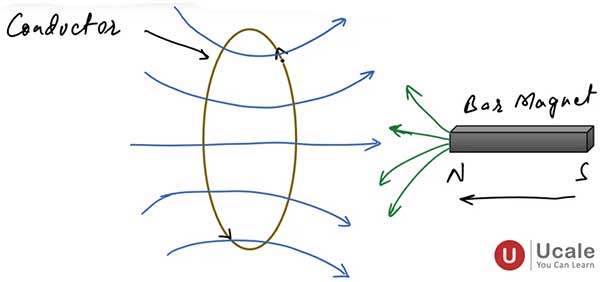
When flux changes:
- induced emf [E] appears, and
- induced current [I] flows (if circuit is closed).
Faraday’s second law gives magnitude:
[
E = -\dfrac{d\Phi}{dt}
]
But the negative sign (–) is due to Lenz’s Law.
Why is there a negative sign?
Because induced emf must oppose the change in flux.
- If flux increases ([\dfrac{d\Phi}{dt} > 0]), emf becomes negative and opposes increase.
- If flux decreases ([\dfrac{d\Phi}{dt} < 0]), emf acts to increase flux.
Thus:
[
E = -\dfrac{d\Phi}{dt}
]
is entirely due to Lenz’s law.
Energy Conservation Argument
If induced emf aided the flux change:
- then the external agent wouldn’t need to do work,
- coil would continue increasing current on its own,
- energy would be created spontaneously → impossible.
Thus Lenz’s law is essential for energy conservation.
3. Dimensions and Units
Induced emf
- SI Unit: Volt (V)
- Dimensions: [M L^{2} T^{-3} A^{-1}]
Magnetic flux
- SI Unit: Weber (Wb)
- Dimensions: [M L^{2} T^{-2} A^{-1}]
4. Key Features
- Gives only the direction, not magnitude.
- Arises from conservation of energy.
- Induced current always opposes change in flux.
- Works for:
- changing magnetic field
- changing area
- changing orientation
- Explains many phenomena like:
- eddy currents
- back emf in motors
- opposing motion in magnetic brakes
5. Important Formulas to Remember
| Concept | Formula |
|---|---|
| Faraday–Lenz law | [E = -\dfrac{d\Phi}{dt}] |
| Flux linkage | [\Phi = N\phi] |
| Magnetic flux | [\phi = BA\cos\theta] |
6. Conceptual Questions with Solutions (15)
1. Why must induced current oppose the change in flux?
To ensure conservation of energy. If it aided the change, energy would be created without input.
2. What happens if the flux through a coil increases?
Induced current produces magnetic field in the **opposite direction** to oppose the increase.
3. What happens if flux decreases?
Induced current produces magnetic field in the **same direction** to increase flux.
4. Does Lenz’s law affect magnitude of emf?
No, magnitude comes from Faraday’s law. Lenz’s law gives **direction**.
5. Why does Lenz’s law imply a negative sign?
Because the induced emf always opposes the change, hence the negative sign in [E = -\dfrac{d\Phi}{dt}].
6. Does Lenz’s law apply to motional emf?
Yes. Motion changes flux, and induced emf opposes the motion causing the flux change.
7. Why does a magnet fall slowly through a copper tube?
Eddy currents oppose the magnet’s motion due to Lenz’s law, slowing it down.
8. Why does pulling a coil out of a magnetic field require work?
Because induced current produces a magnetic field that opposes the motion.
9. If flux is constant, what is the direction of emf?
No emf is induced, so no direction exists.
10. What is the direction of induced current when magnet moves toward a coil?
It flows such that its magnetic field opposes the magnet’s approach (repulsive).
11. Why does induced current create heat?
Induced current flows through resistance → produces heat (eddy current heating).
12. Why does induced emf resist motion?
To oppose the mechanical action causing flux change, as required by energy conservation.
13. Does induced current always oppose magnetic field?
No — it opposes the **change** in the magnetic flux, not the field itself.
14. Why is Lenz’s law similar to Newton’s third law?
Both involve an opposition: Newton’s is action–reaction; Lenz’s is change–opposition.
15. Can induced emf ever support the flux change?
No, because it would violate energy conservation.
7. FAQ / Common Misconceptions (10)
1. Does Lenz’s law say flux always decreases?
No. It says induced emf opposes the **change**, not the value. If flux decreases, induced current tries to increase it.
2. Is induced current always clockwise?
No, direction depends on whether flux increases or decreases.
3. Does Lenz’s law apply only to coils?
No. It applies to any closed conducting loop.
4. Does Lenz’s law define magnitude of emf?
No — only direction. Magnitude comes from Faraday’s second law.
5. Does Lenz’s law require motion?
No. Flux can change via field strength or orientation.
6. Is opposition always magnetic?
Yes — induced current produces magnetic fields that oppose the flux change.
7. Does Lenz’s law contradict Faraday’s law?
No — Faraday gives magnitude; Lenz gives direction. They work together.
8. Is induced current always produced?
Only if the circuit is closed. In open circuits, emf exists but no current flows.
9. Does induced emf appear *after* flux changes?
It appears **at the same moment** flux begins to change.
10. Does Lenz’s law violate energy conservation?
No — it *ensures* energy conservation.
8. Practice Questions (with Step-by-Step Solutions)
Q1. A magnet is pushed into a coil. Explain the direction of induced current using Lenz’s law.
Solution:
Flux increases → induced current produces a magnetic field opposing the magnet’s motion → direction is such that the face of the coil becomes similar to the approaching pole (repelling).
Q2. A coil is pulled out of a uniform magnetic field. What is the direction of induced current?
Solution:
Flux decreases → induced current produces magnetic field trying to increase flux → direction makes the coil’s face act like the same pole as the retreating field.
Q3. A loop is rotated in a magnetic field. Why is emf induced?
Solution:
Rotation changes angle [\theta], changing flux [\phi = BA\cos\theta] → inducing emf opposing the change.
Q4. Why does a freely falling magnet inside a copper tube slow down?
Solution:
As magnet falls, flux through the tube changes → eddy currents oppose motion → slowing it (Lenz’s law).
Q5. A bar magnet is removed from a solenoid. Draw the direction of induced current.
Solution:
Flux decreases → induced current flows such that solenoid tries to keep magnet inside → direction chosen so that induced magnetic field attracts the magnet.
 Sign in with Google