

1. Statement of the Law / Concept Overview
When a charged particle moves in the presence of electric and magnetic fields, it experiences a force known as the Lorentz Force.
- If the charge is at rest, only the electric force acts on it.
- If the charge is moving, both electric and magnetic forces may act simultaneously.
- The Lorentz force determines how the charge accelerates, how its path curves, and how it behaves inside electromagnetic fields.
The Lorentz Force Law states:
A charged particle of charge ([q]), moving with velocity ([\vec{v}]) in electric field ([\vec{E}]) and magnetic field ([\vec{B}]), experiences a total force:
[\vec{F}] [= q\left( \vec{E} + \vec{v} \times \vec{B} \right)]
This force is responsible for many physical phenomena, including:
- Motion of electrons inside CRTs
- Working of cyclotrons
- Deflection of charged particles in magnetic spectrometers
- Force on current-carrying conductors
A deep understanding of Lorentz force is essential for electromagnetism, particle physics, and electrical engineering.
2. Clear Explanation and Mathematical Derivation
(A) Electric Force Component
A charge ([q]) placed in an electric field ([\vec{E}]) experiences a force:
[
\vec{F_E} = q\vec{E}
]
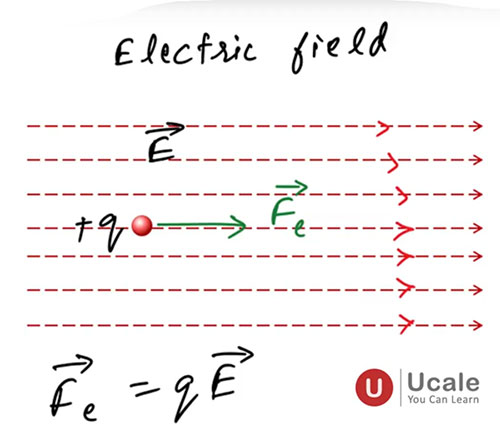
- Direction: along [\vec{E}] for positive charge, opposite for negative charge.
- Exists even if the charge is at rest.
(B) Magnetic Force Component
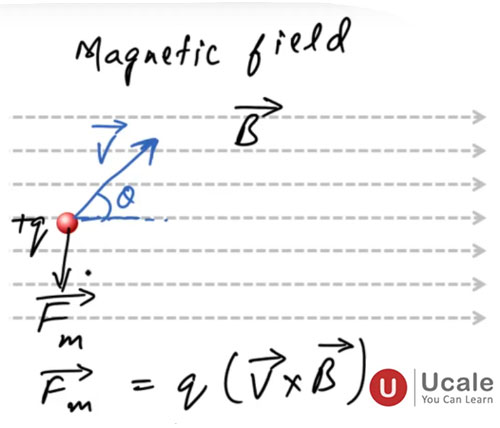
A charge moving with velocity ([\vec{v}]) in a magnetic field ([\vec{B}]) experiences:
[\vec{F_B}] [= q(\vec{v} \times \vec{B})]
Properties:
- Force is maximum when (\vec{v} \perp \vec{B}).
- Force is zero when (\vec{v} \parallel \vec{B}).
- Direction is given using right-hand rule.
Magnitude:
[
F_B = qvB\sin\theta
]
where [\theta] = angle between [\vec{v}] and [\vec{B}].
(C) Total Lorentz Force
[\vec{F}] [= \vec{F_E} + \vec{F_B}] [= q\left( \vec{E} + \vec{v} \times \vec{B} \right)]
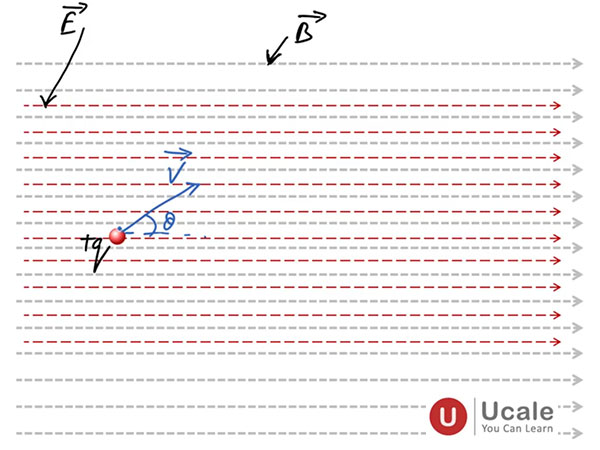
This is the fundamental relation governing charged particle dynamics.
3. Dimensions and Units
| Quantity | Dimensions | SI Unit |
|---|---|---|
| Lorentz Force ([\vec{F}]) | ([MLT^{-2}]) | Newton (N) |
| Electric Field ([\vec{E}]) | ([MLT^{-3}A^{-1}]) | Volt/m |
| Magnetic Field ([\vec{B}]) | ([MT^{-2}A^{-1}]) | Tesla (T) |
4. Key Features
- Lorentz force combines electric and magnetic effects into one equation.
- Magnetic force acts only on moving charges.
- Electric force affects both resting and moving charges.
- Magnetic force is always perpendicular to velocity → it changes direction, not speed.
- Determines circular/spiral motion of charged particles in magnetic fields.
- Helps classify regions where electric and magnetic forces balance (velocity selector concept).
5. Important Formulas to Remember
| Formula | Description |
|---|---|
| ([\vec{F}] [= q\vec{E}]) | Electric force |
| ([\vec{F_B}] [= q(\vec{v} \times \vec{B})]) | Magnetic force |
| ([F] [= qvB\sin\theta]) | Magnitude of magnetic force |
| ([\vec{F}] [= q(\vec{E} + \vec{v} \times \vec{B})]) | Lorentz force |
| ([F] [= 0 \text{ if } \vec{v} \parallel \vec{B}]) | Zero magnetic force |
| ([F = qvB]) | Maximum magnetic force (when (\theta = 90^\circ)) |
6. Conceptual Questions with Solutions
1. Why does magnetic force act only when the charge is moving?
Because magnetic fields interact with moving charges through their motion-induced magnetic effects. A stationary charge does not create a magnetic interaction.
2. Why is magnetic force always perpendicular to velocity?
Magnetic force is given by the cross product [\vec{v} \times \vec{B}], which is always perpendicular to both vectors.
3. Can magnetic force change the speed of a particle?
No. Being perpendicular to velocity, it changes only direction, not speed.
4. What happens if a charge moves parallel to magnetic field?
\(\sin\theta = 0\), so magnetic force becomes zero.
5. Why is electric force independent of velocity?
Electric fields exert force directly on charge, regardless of motion.
6. Does the sign of charge affect the direction of Lorentz force?
Yes. Negative charges experience force opposite to that predicted by the right-hand rule.
7. Can Lorentz force ever be zero?
Yes, when [\vec{E} = -\vec{v} \times \vec{B}], or when [\vec{v}\parallel\vec{B}].
8. Why does magnetic force do no work?
Because it is perpendicular to displacement → [\vec{F} \cdot \vec{v} = 0].
9. Why does a faster charge experience greater magnetic force?
Magnetic force depends on velocity: [F = qvB\sin\theta].
10. Why is the path circular when force is perpendicular?
Perpendicular force provides centripetal acceleration, causing circular motion.
11. Can Lorentz force reverse the direction of motion?
Electric field can; magnetic field cannot (it only curves the path).
12. Why are electric and magnetic fields treated together?
Because moving charges always experience combined effects; Lorentz force unifies them.
13. What happens to a negative charge in [\vec{E}] and [\vec{B}]?
Force direction reverses; motion curves opposite to that of positive charge.
14. Why is the magnetic force maximum when velocity is perpendicular?
Because [\sin 90^\circ = 1], giving maximum cross-product magnitude.
15. Does magnetic force depend on mass?
No. It depends only on charge, velocity, and magnetic field.
7. FAQ / Common Misconceptions
1. Does a magnetic field attract charges like electric field?
No. Magnetic field does not pull or push stationary charges.
2. Is Lorentz force a new type of force?
No, it is a combination of electric and magnetic forces.
3. Does increasing magnetic field always increase force?
Only if charge is moving; otherwise [F=0].
4. Do electric and magnetic forces oppose each other?
Not necessarily. Their directions depend on [\vec{v}], [\vec{E}], and[\vec{B}].
5. Does magnetic force act along the field direction?
No. It is always perpendicular to both [\vec{v}] and [\vec{B}].
6. Can magnetic force exist without electric field?
Yes, as long as the charge is moving.
7. Is Lorentz force the same for electrons and protons?
Magnitude same (if speeds same), but directions opposite.
8. Can magnetic field speed up a particle?
No, it cannot change kinetic energy.
9. Does a charge always move in a circle in magnetic field?
Only if velocity is perpendicular; otherwise helical motion occurs.
10. Why is the force zero when [\vec{v} \parallel \vec{B}]?
Because cross product becomes zero.
8. Practice Questions (with Step-by-Step Solutions)
1. A charge ([q = 2 \text{C}]) is placed in an electric field ([E = 5 \text{V/m}]). What is the force?
Solution:
[F = qE] [= 2 \times 5] [= 10 \text{N}]
2. A proton moves at ([v = 2\times10^5 \text{m/s}]) perpendicular to ([B = 0.4 \text{T}]). Find magnetic force.
[F = qvB] [= (1.6\times10^{-19})(2\times10^5)(0.4)]
[F = 1.28\times10^{-14} \text{N}]
3. A charge moves parallel to magnetic field. What is magnetic force?
Parallel → [\sin\theta = 0].
[F = qvB\sin\theta] [= 0]
4. A particle of charge ([3 \text{C}]) moves in magnetic field ([B = 2 \text{T}]) with velocity perpendicular to field ([v = 4 \text{m/s}]). Find force.
[F = qvB] [= 3 \times 4 \times 2] [= 24 \text{N}]
5. A charge ([q = -1 \text{C}]) enters a region with ([E = 10 \text{V/m}]) and ([B = 2 \text{T}]), ([v = 5 \text{m/s}]) perpendicular to [\vec{B}]. Find direction of total force.
Electric force:
- On negative charge → opposite [\vec{E}].
Magnetic force:
- [\vec{v} \times \vec{B}] direction reversed because charge is negative.
Thus, both forces reverse direction compared to positive charge.
 Sign in with Google