

1. Statement of the Concept / Concept Overview
A magnetic dipole is the simplest model of a magnetic system made up of two equal and opposite magnetic poles separated by a small distance.
Examples include:
- A bar magnet
- A current-carrying loop
- A small compass needle
- An electron, due to its orbital and spin motion
The most important quantity associated with a magnetic dipole is its magnetic dipole moment, which determines:
- How strong the dipole is
- How it interacts with external magnetic fields
- The torque it experiences
- The potential energy of its orientation
Simply speaking:
👉 A magnetic dipole moment tells us “how strong a magnet is and which direction it is pointing.”
For a bar magnet, the dipole moment depends on its pole strength and length.
For a current loop, it depends on the current and area of the loop.
2. Clear Explanation and Mathematical Derivation
A. Magnetic Dipole Moment for a Bar Magnet
For a bar magnet with pole strength [m] and pole separation (magnetic length) [2l]:
[M = m(2l)]
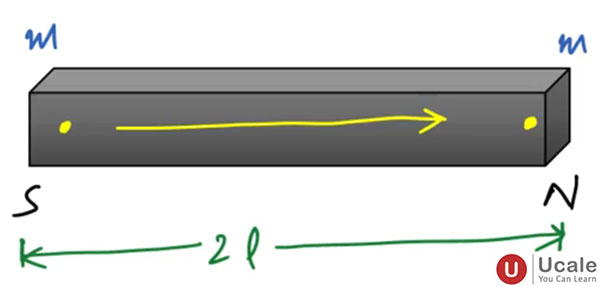
Direction of magnetic moment: from South pole → North pole inside the magnet.
B. Magnetic Dipole Moment for a Current Loop
Consider a planar current-carrying loop with:
- Current = [I]
- Area = [A]
The magnetic dipole moment is:
[\vec{M} = I \vec{A}]
where [\vec{A}] is a vector perpendicular to the plane of the loop.
Magnitude:
[M = IA]
Direction:
Given by right-hand thumb rule → thumb gives dipole moment direction.
C. Torque on a Magnetic Dipole
When placed in a uniform magnetic field [\vec{B}]:
[\vec{\tau} = \vec{M} \times \vec{B}]
Magnitude:
[\tau = MB \sin\theta]
θ = angle between dipole moment and magnetic field.
D. Potential Energy of a Magnetic Dipole
[U = -\vec{M} \cdot \vec{B}] [= -MB\cos\theta]
Minimum (most stable) when dipole aligns with field.
E. Magnetic Field due to a Dipole (Axial and Equatorial Positions)
- On axial line:
[B_{\text{axial}}] [= \dfrac{\mu_0}{4\pi} \cdot \dfrac{2M}{r^3}]
- On equatorial line:
[B_{\text{equatorial}}] [= \dfrac{\mu_0}{4\pi} \cdot \dfrac{M}{r^3}]
(But directed opposite)
3. Dimensions and Units
| Quantity | Symbol | Dimensions | SI Unit |
|---|---|---|---|
| Magnetic dipole moment | [M] | [A L^2] or [M L^2 T^{-2} A^{-1}] | A·m² |
| Torque | [\tau] | [M L^2 T^{-2}] | N·m |
| Magnetic field | [B] | [M A^{-1} T^{-2}] | Tesla (T) |
| Potential energy | [U] | [M L^2 T^{-2}] | Joule (J) |
4. Key Features
- Magnetic dipole has two poles separated by distance.
- Magnetic dipole moment defines strength and direction.
- Current loops behave like magnetic dipoles.
- Dipole moment of a current loop: [M = IA].
- A dipole in a magnetic field experiences torque: [\tau = MB \sin\theta].
- Potential energy is minimum when dipole aligns with field.
- Magnetic dipole field decreases as [1/r^3].
- Magnetic dipoles are fundamental building blocks of all magnetism.
5. Important Formulas to Remember
| Formula | Description |
|---|---|
| [M = m (2l)] | Dipole moment of a bar magnet |
| [M = IA] | Dipole moment of current loop |
| [\vec{\tau}] [= \vec{M} \times \vec{B}] | Torque on dipole |
| [U = -MB\cos\theta] | Potential energy |
| [B_{\text{axial}}] [= \dfrac{2\mu_0 M}{4\pi r^3}] | Axial field |
| [B_{\text{equatorial}}] [= \dfrac{\mu_0 M}{4\pi r^3}] | Equatorial field |
6. Conceptual Questions with Solutions
1. Why is a current loop considered a magnetic dipole?
Because it produces a magnetic field similar to a bar magnet with a definite North and South pole and has a dipole moment [M = IA].
2. Why does a dipole experience torque in a magnetic field?
Because opposite poles experience forces in opposite directions, creating a turning effect.
3. Why does torque become zero when dipole aligns with field?
Because angle [\theta = 0], so [\tau = MB\sin 0 = 0].
4. Why is potential energy minimum in aligned position?
Because [U = -MB\cos\theta] is minimum when cosθ = 1 → aligned with the field.
5. Why is magnetic dipole moment a vector?
Because it has both magnitude and direction (from S → N inside magnet).
6. Why does dipole moment increase with area?
Bigger area means more magnetic flux, so stronger dipole moment [M = IA].
7. Why do electrons behave like tiny magnetic dipoles?
Because they have intrinsic spin and orbital motion, both generating magnetic moment.
8. Why does a bar magnet always align North-South?
Because Earth’s magnetic field exerts torque on it, aligning its dipole moment with Earth’s field.
9. Why can we treat a small magnet as a dipole?
Because far away from the magnet, the field resembles that of a simple dipole.
10. Why does the axial line have stronger magnetic field?
Because axial field has factor 2 → [B_{\text{axial}}] [= \dfrac{2M}{r^3}] while equatorial has [\dfrac{1}{r^3}].
11. Why is dipole moment of a bar magnet proportional to its length?
Because greater pole separation means stronger turning effect → [M = m(2l)].
12. Why do two dipoles attract or repel?
Because their magnetic fields interact; like poles repel, unlike poles attract.
13. Why does dipole moment measure strength of a magnet?
Because higher moment means stronger ability to align and exert torque in a magnetic field.
14. Why is the unit of dipole moment A·m²?
Because it comes from current × area (I × A).
15. Why does magnetic field of dipole decrease as [1/r^3]?
Because dipole is a localized source; its field falls off rapidly with distance.
7. FAQ / Common Misconceptions
1. Is magnetic dipole moment the same as magnetization?
No. Magnetization is dipole moment per unit volume, not total moment.
2. Do magnetic poles actually exist?
No. Poles are conceptual; real magnetism arises from electron motion.
3. Can magnetic dipole moment be negative?
No. Its direction may reverse, but magnitude is always positive.
4. Does a dipole always experience a force in a uniform field?
No. It experiences torque but no net force.
5. Does increasing current always increase dipole moment?
Yes, because [M = IA], so moment is directly proportional to current.
6. Is magnetic dipole moment only for magnets?
No. Current loops, electrons, nuclei—all have dipole moments.
7. Does a larger magnet always have a larger dipole moment?
Not necessarily. It depends on pole strength and magnetic structure.
8. Does a dipole produce same field in all directions?
No. Axial and equatorial fields are different in magnitude and direction.
9. Does a magnetic dipole store potential energy?
Yes, in external fields: [U = -MB\cos\theta].
10. Is dipole moment of a magnet equal to its physical length?
No. It depends on magnetic length (slightly shorter than physical length).
8. Practice Questions (with Step-by-Step Solutions)
Q1. A circular loop of radius 5 cm carries current 2 A. Find its dipole moment.
Solution:
Area: [A = \pi r^2] [= \pi (0.05)^2]
[A = 7.85 \times 10^{-3} , \text{m}^2]
Dipole moment:
[M = IA = 2 \times 7.85 \times 10^{-3}]
[M = 1.57 \times 10^{-2} A m^2]
Q2. A bar magnet has pole strength 4 A·m and magnetic length 10 cm. Find its dipole moment.
Solution:
[2l = 0.1 \text{m}]
[M = m (2l)] [= 4 \times 0.1] [= 0.4 A m^2]
Q3. A 3 A current flows through a coil of area 0.02 m². Calculate torque in a 0.5 T field when θ = 30°.
Solution:
Dipole moment: [M = IA] [= 3 \times 0.02] [= 0.06]
Torque: [\tau = MB \sin\theta]
[\tau] [= 0.06 \times 0.5 \times \sin 30^\circ]
[\tau] [= 0.06 \times 0.5 \times 0.5 = 0.015 \text{N·m}]
Q4. A dipole of moment 0.5 A·m² lies at 60° to a field of 0.4 T. Find its potential energy.
Solution:
[U = -MB\cos\theta]
[U = – (0.5)(0.4)\cos 60^\circ]
[U = -0.2 \times 0.5] [= -0.1 \text{J}]
Q5. At what angle is torque maximum for a dipole?
Solution:
Torque: [\tau = MB \sin\theta]
Maximum when sinθ = 1 ⇒ θ = 90°.
 Sign in with Google