

1. Concept Overview
Magnetic Field Induction (also called Magnetic Flux Density) is a vector quantity that tells us how strong a magnetic field is and in which direction it acts.
It is denoted by B and represents the force a magnetic field exerts on a moving charge or a current-carrying conductor.
A beginner-friendly understanding:
- Just like electric fields describe how electric charges influence each other,
magnetic field induction describes how magnets, currents, and moving charges influence each other. - A magnetic field is not something we see directly, but its effect becomes visible when it pushes charges or a current-carrying wire.
- The stronger the magnetic field, the greater the force it produces.
- Magnetic field induction is defined through the force experienced by a moving charge.
Mathematical definition
The magnetic field induction B at any point is defined as:
“The magnetic force per unit charge per unit velocity when the charge moves perpendicular to the field.”
Mathematically,
[B = \dfrac{F}{qv}]
when [v ⟂ B].
More generally (vector form):
[\vec{F}] [= q(\vec{v} \times \vec{B})]
This definition ensures that B captures both magnitude and direction of the effect of the magnetic field.
2. Clear Explanation and Mathematical Derivation
Magnetic force on a moving charge
If a charge [q] moves with velocity [\vec{v}] in a magnetic field [\vec{B}], it experiences the magnetic force:
[\vec{F}] [= q(\vec{v} \times \vec{B})]
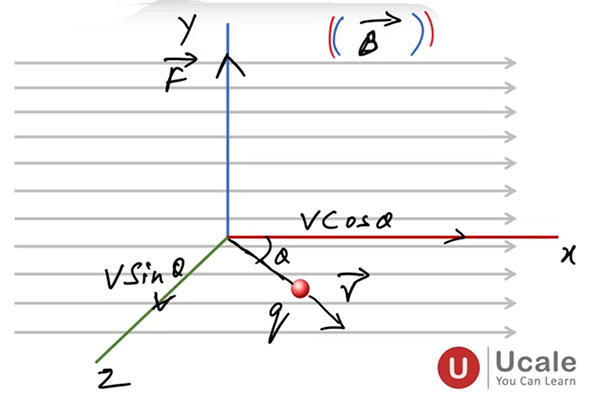
Magnitude of this force (when angle between [\vec{v}] and [\vec{B}] is [\theta]):
[F = qvB\sin\theta]
If the charge moves perpendicular to the field ([\theta = 90^\circ]):
[F = qvB]
Rewriting for [B]:
[B = \dfrac{F}{qv}]
This expression shows that a magnetic field tells us how much force it produces on a moving charge.
3. Dimensions and Units
Dimensions
[B] = [M A^{-1} T^{-2}]
SI Unit
- Tesla (T)
1 Tesla = 1 Newton per (Coulomb × m/s)
[1T = 1 \dfrac{N}{A\cdot m}]
CGS Unit
- Gauss (G)
[1T = 10^{4} G]
4. Key Features
- Magnetic field induction B represents the strength and direction of a magnetic field.
- It is a vector quantity.
- Magnetic fields exert force only on moving charges.
- Magnetic field does no work, because the force is always perpendicular to velocity.
- Direction of force is given by the right-hand rule.
- A magnetic field is produced by current, moving charges, and magnets.
- If velocity and field are parallel or antiparallel, force = 0.
- The stronger the field, the larger the force on charges and currents.
5. Important Formulas to Remember
| Quantity | Formula |
|---|---|
| Magnetic force on a moving charge | [\vec{F}] [= q(\vec{v} \times \vec{B})] |
| Magnitude of magnetic force | [F = qvB\sin\theta] |
| Definition of magnetic induction | [B] [= \dfrac{F}{qv\sin\theta}] |
| Force on a charge moving perpendicular to B | [F = qvB] |
| SI unit | Tesla (T) |
| Conversion | [1T = 10^4 G] |
6. Conceptual Questions with Solutions (15+)
1. Why does a stationary charge experience no magnetic force?
Because magnetic force depends on motion: [F = qvB\sin\theta]. If [v = 0], then [F = 0], so a stationary charge is unaffected by magnetic fields.
2. Why is magnetic force always perpendicular to velocity?
Because magnetic force arises from the cross product [\vec{v} \times \vec{B}], which is always perpendicular to both vectors. Hence, it cannot change speed, only direction.
3. What happens when velocity is parallel to the magnetic field?
When [\theta = 0^\circ], [\sin\theta = 0], so [F = 0]. Thus, the charge moves unaffected in a straight line.
4. Why does magnetic field do no work?
The force is perpendicular to displacement, and work = [\vec{F} \cdot \vec{d} = 0], so magnetic field only changes direction, not speed.
5. Why is B strongest near the poles of a magnet?
Because magnetic field lines crowd near poles, representing higher flux density.
6. Can magnetic field induction be negative?
No. Magnitude of B is always positive. The direction is represented by the vector arrow, not a negative sign.
7. Why do iron filings align in a particular way in a magnetic field?
Because each filing becomes a tiny induced magnet aligning along the direction of B.
8. Why is Earth’s magnetic field so weak compared to magnets?
Earth’s core produces a magnetic field through large-scale geodynamo processes, but its strength (~[5\times10^{-5}] T) is small compared to man-made magnets.
9. Why does a charge move in a circular path inside a uniform magnetic field?
Because force is always perpendicular to velocity, acting as a centripetal force: [qvB = \dfrac{mv^2}{r}].
10. What determines the direction of magnetic force?
The **right-hand rule**: Thumb → velocity, Fingers → magnetic field, Palm → force for positive charge.
11. Why do magnetic fields affect only moving charges?
Because magnetic interaction arises due to the relative motion between charges; stationary charges do not generate magnetic effects.
12. Does magnetic field induction depend on the charge of the particle?
No. B is a property of the field itself. Force depends on charge, but B does not.
13. Why do electrons curve more than protons in a magnetic field?
Electrons have smaller mass, so radius [r = \dfrac{mv}{qB}] becomes smaller, leading to more curvature.
14. Why is Tesla a large unit of magnetic field?
Because it is defined using Newton, Coulomb, meter, and second — all large units. Even strong magnets are only ~1 Tesla.
15. Why is magnetic field induction considered a vector field?
Because at every point in space, B has both magnitude and direction, determining how it affects moving charges.
16. Why do field lines never intersect?
Because that would imply two directions of B at a single point, which is impossible.
7. FAQ / Common Misconceptions (at least 10)
1. Is magnetic field the same as magnetic force?
No. Magnetic field (B) describes the region; force is the effect on moving charges.
2. Does magnetic field act on all objects?
No. Only moving charges or magnetic materials feel the magnetic force.
3. Can we “see” a magnetic field?
No, but we can visualize it using iron filings or compass needles.
4. Does a magnetic field change kinetic energy of a particle?
No. It only changes direction, not speed.
5. Is B always perpendicular to the force?
No. Force is perpendicular to velocity, not B. The angle between v and B determines the magnitude.
6. If B increases, does velocity always increase?
No. Magnetic force cannot increase or decrease speed.
7. Do magnetic fields require a magnet?
No. Electric current and moving charges also produce magnetic fields.
8. Are magnetic lines actual physical lines?
No. They are a visual model to represent direction and strength.
9. Does reversing the field reverse the force?
Yes. Since force depends on [\vec{v} \times \vec{B}], reversing B reverses the direction of force.
10. Is magnetic field induction the same everywhere?
No. B varies with location, source strength, and medium.
8. Practice Questions (with step-by-step solutions)
1. A charge [q = 2,C] moves at [v = 3,m/s] perpendicular to a magnetic field and experiences a force of [F = 12,N]. Find B.
Solution:
[B = \dfrac{F}{qv}]
[B] [= \dfrac{12}{2 \times 3}] [= 2T]
2. A proton moves in a uniform magnetic field of [0.5,T] with speed [2\times10^6,m/s] perpendicular to B. Find force.
[F = qvB]
[F] [= (1.6\times10^{-19})(2\times10^{6})(0.5)] [= 1.6\times10^{-13}N]
3. A charge moves at angle [30^\circ] to magnetic field. Find force if [q = 1,C], [v = 4,m/s], [B = 2,T].
[F] [= qvB\sin\theta]
[F] [= 1\times4\times2\times\dfrac{1}{2}] [= 4 N]
4. Velocity of electron is parallel to magnetic field. What is force?
Since [\theta = 0^\circ]:
[F = qvB\sin0 = 0]
No force.
5. Find the radius of circular path of a proton moving at [v = 3\times10^6,m/s] in [B = 0.2,T].
Formula:
[qvB = \dfrac{mv^2}{r}]
Rearranging:
[r = \dfrac{mv}{qB}]
[r] [= \dfrac{(1.67\times10^{-27})(3\times10^6)}{(1.6\times10^{-19})(0.2)}]
[r \approx 0.156,m]
 Sign in with Google