

1. Concept Overview
When an electric current flows through a circular coil, it produces a magnetic field at its center.
The magnetic field is directly proportional to the current, directly proportional to the number of turns, and inversely proportional to the radius of the coil.
The expression for the magnetic field at the center of a single-turn circular coil is:
[B] [= \left( \dfrac{\mu_{0} I}{2R} \right)]
For an N-turn coil:
[B] [= \left( \dfrac{\mu_{0} N I}{2R} \right)]
2. Clear Explanation and Mathematical Derivation
Consider a circular coil of:
- radius [R]
- current [I]
- number of turns [N]
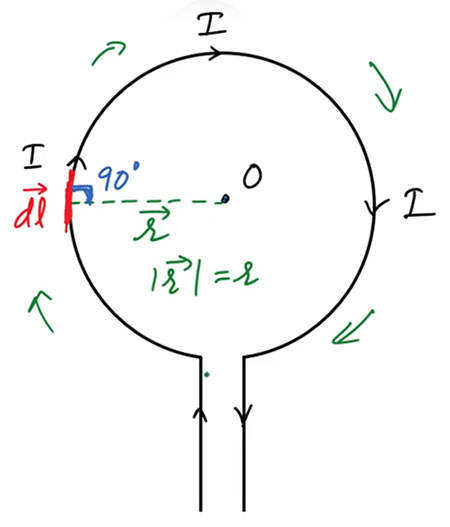
Magnetic Field Due to a Current Element (Using Biot–Savart Law)
Using Biot–Savart’s law:
[dB] [= \left( \dfrac{\mu_{0}}{4\pi} \dfrac{I dl \sin\theta}{r^{2}} \right)]
For a circular loop:
- [\theta = 90^\circ] (so [\sin\theta = 1])
- [r = R] (distance from each current element to center is same)
Thus,
[dB] [= \left( \dfrac{\mu_{0}}{4\pi} \dfrac{I , dl}{R^{2}} \right)]
To find total B at center:
[B = \displaystyle \int dB] [= \dfrac{\mu_{0} I}{4\pi R^{2}} \displaystyle \int dl]
But:
[\displaystyle \int dl = 2\pi R]
Therefore,
[B] [= \left( \dfrac{\mu_{0} I}{4\pi R^{2}} \right) (2\pi R)] [= \left( \dfrac{\mu_{0} I}{2R} \right)]
For N turns, the field becomes:
[B] [= \left( \dfrac{\mu_{0} N I}{2R} \right)]
3. Dimensions and Units
Dimension of Magnetic Field [B]:
[B] = [\left( M T^{-2} I^{-1} \right)]
SI Unit: Tesla (T)
4. Key Features
- Magnetic field is uniform near the center of the loop.
- Field is greater if:
- current increases
- number of turns increases
- radius decreases
- Field lines at center are perpendicular to plane of coil.
- Direction is found by the Right-Hand Thumb Rule:
- Curl fingers in direction of current
- Thumb gives direction of magnetic field
5. Important Formulas to Remember (Table)
| Case | Formula for Magnetic Field at Center |
|---|---|
| Single-turn circular coil | [ B] [= \left( \dfrac{\mu_{0} I}{2R} \right) ] |
| N-turn circular coil | [ B] [= \left( \dfrac{\mu_{0} N I}{2R} \right) ] |
| Coil of radius R with total wire length L | [ N] [= \left( \dfrac{L}{2\pi R} \right) ] |
| Magnetic moment | [ M] [= (N I \pi R^{2}) ] |
| Relation between B and magnetic moment | [ B] [= \left( \dfrac{\mu_{0} M}{2\pi R^{3}} \right) ] |
6. Conceptual Questions with Solutions
1. Why is the magnetic field the same at every point on the diameter?
Because all elements of the coil are symmetrically placed, giving identical contributions along the diameter.
2. What happens to B if the radius is doubled?
From [B \propto 1/R], doubling R halves the magnetic field.
3. Why does N turns multiply the field?
Each turn contributes the same field, and fields add because they all point in same direction.
4. How does direction of current affect the field?
Reversing current reverses direction of magnetic field.
5. Why is sinθ = 1 for circular coil?
Because all current elements are perpendicular to radius vectors directed toward center.
6. Is the field exactly uniform inside the coil?
Only near the center; away from center, contributions vary.
7. Why is Biot–Savart’s law used here?
It gives the magnetic field due to each small current element, allowing integration over the loop.
8. What if the coil is square instead of circular?
Field can still be computed, but formula differs since radius is not constant.
9. Why does decreasing R increase B?
Current elements get closer to center, increasing magnetic influence.
10. Why is the field perpendicular to the coil plane?
Right-hand rule: curl fingers along current → thumb gives direction of field.
11. Does coil thickness matter?
If thickness is negligible, all turns are at same radius; otherwise field calculations change slightly.
12. Is there any magnetic field outside the coil?
Yes, but it reduces rapidly and is not uniform.
13. Can a circular coil behave like a magnetic dipole?
Yes, it acts like a dipole with magnetic moment [M = N I \pi R^{2}].
14. What happens if current direction is clockwise?
Field direction becomes downward (use right-hand rule).
15. Why does length of wire not appear in formula?
Only radius and number of turns determine geometry affecting field at center.
7. FAQ / Common Misconceptions
1. Is magnetic field strongest at the center?
Yes, for a loop, the field is maximum at the center.
2. Does wire thickness affect magnetic field?
Not significantly, unless coil is thick enough that turns lie at different radii.
3. Does B depend on coil shape?
Yes. The given formula is only for circular loops.
4. Is direction affected by shape of coil?
No. Direction still follows right-hand rule for current circulation.
5. Can field at center ever be zero?
Yes, if currents in different turns flow in opposite directions and cancel out.
6. Does current distribution matter?
Only if wire has non-uniform thickness or variable current densities.
7. Is B = μ₀NI/2R valid for very large coils?
Yes, but coil must still be circular and thin compared to R.
8. Does coil orientation change magnitude?
No, only direction of field changes.
9. Do nearby magnetic materials affect field?
Yes, they modify effective permeability.
10. Is field additive from multiple coils?
Yes, superposition applies.
8. Practice Questions (with Step-by-Step Solutions)
Q1.
Find the magnetic field at the center of a single-turn coil of radius 0.2 m carrying 4 A.
Solution:
[B] [= \left( \dfrac{\mu_{0} I}{2R} \right)]
[B] [= \left( \dfrac{4\pi \times 10^{-7} \times 4}{2 \times 0.2} \right)]
[B] [= 1.26 \times 10^{-5} \text{T}]
Q2.
12 A current flows through a 20-turn coil of radius 10 cm. Find B at center.
[B] [= \left( \dfrac{\mu_{0} N I}{2R} \right)]
[B] [= \left( \dfrac{4\pi \times 10^{-7} \times 20 \times 12}{2 \times 0.1} \right)]
[B = 1.51 \times 10^{-3} \text{T}]
Q3.
A 50-turn coil produces a magnetic field of [1 \times 10^{-3} , \text{T}] at its center. Radius of coil is 0.25 m. Find current.
[B] [= \left( \dfrac{\mu_{0} N I}{2R} \right)]
[I] [= \left( \dfrac{2BR}{\mu_{0} N} \right)]
[I] [= \left( \dfrac{2 \times 10^{-3} \times 0.25}{4\pi \times 10^{-7} \times 50} \right)]
[I \approx 7.96 \text{A}]
Q4.
Two identical circular coils carry equal currents in the same direction. What is the field at the midpoint between them?
Solution:
Fields due to both add because directions are same.
Let each produce B.
Net field = [2B].
Q5.
A circular coil of radius 0.1 m has 30 turns and carries 2 A. Calculate its magnetic moment.
[
M = (N I \pi R^{2})
]
[
M = (30 \times 2 \times \pi \times 0.01)
]
[
M = 1.884 \text{A·m}^{2}
]
 Sign in with Google