

1. Statement of the Concept
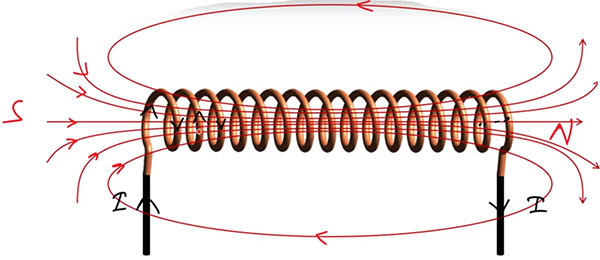
A long, tightly wound solenoid carrying electric current produces a uniform magnetic field inside it, directed along its axis, and an almost negligible magnetic field outside.
2. Clear Explanation and Mathematical Derivation
A solenoid is a helical coil of wire. When current flows through it, each circular loop produces a magnetic field. By superposition, the fields add up to produce:
- Strong and uniform field inside
- Very weak field outside (cancels due to symmetry)
Derivation of Magnetic Field Inside a Solenoid
Consider a solenoid of:
- Length = [L]
- Total number of turns = [N]
- Turns per unit length = [n = \dfrac{N}{L}]
- Current = [I]
Use Ampere’s Circuital Law:
[\displaystyle \oint \vec{B} \cdot d\vec{\ell}] [= \mu_{0} I_{\text{enclosed}}]
Choose an Amperian rectangular loop:
- Inside the solenoid: magnetic field = [B]
- Outside the solenoid: field ≈ 0
Thus, the line integral becomes:
[
B \ell = \mu_0 (n \ell) I
]
(where [n \ell] gives number of turns enclosed)
Hence:
[
B = \mu_0 n I
]
Magnetic Field Outside a Long Solenoid
For an ideal long solenoid:
[B_{\text{outside}}] [\approx 0]
Because the external field lines cancel due to symmetry.
3. Dimensions and Units
| Quantity | Expression | Dimensions | SI Unit |
|---|---|---|---|
| Magnetic field inside solenoid | [B = \mu_0 n I] | [M A^{-1} T^{-2}] | Tesla (T) |
| Permeability of free space | [\mu_0] | [M L T^{-2} A^{-2}] | [4\pi \times 10^{-7}] H/m |
4. Key Features
- Magnetic field inside is uniform and parallel to the axis.
- Field strength depends on:
- Number of turns per unit length [n]
- Current [I]
- Medium (via permeability [\mu])
- Long solenoid behaves like a bar magnet:
- One end → north pole
- Other end → south pole
- Outside field is negligible, making solenoids useful for creating controlled magnetic fields.
- Increasing number of turns increases magnetic field without increasing current.
5. Important Formulas to Remember
| Concept | Formula |
|---|---|
| Magnetic field inside solenoid | [B = \mu_0 n I] |
| Magnetic field with core | [B = \mu n I] |
| Turns per unit length | [n = \dfrac{N}{L}] |
6. Conceptual Questions with Solutions
1. Why is the magnetic field inside a solenoid uniform?
Because the turns are closely wound and each loop contributes equally at all interior points. The field lines are parallel, equally spaced, and superpose to give a uniform magnetic field.
2. Why is the magnetic field outside a long solenoid nearly zero?
Fields from opposite sides of the solenoid cancel due to symmetry, causing very weak net magnetic field outside.
3.What will happen to the magnetic field if the current is doubled?
Since [B \propto I], magnetic field doubles.
4. What happens if the number of turns per unit length is increased?
[B = \mu_0 n I]. Increasing [n] increases magnetic field proportionally.
5. Does the radius of the solenoid affect the magnetic field inside?
No. For an ideal long solenoid, magnetic field is independent of its radius.
6. Why is a solenoid used instead of a straight current-carrying wire when a uniform field is needed?
A straight wire produces a non-uniform field, whereas a solenoid produces a uniform field inside.
7. What determines the polarity of a solenoid?
The direction of current flow (use right-hand grip rule).
8. Does the magnetic field depend on the length of the solenoid?
Not directly; it depends on the **turns per unit length** [n = N/L].
9. Why does magnetic field increase when an iron core is inserted?
Iron has high permeability, so [B = \mu n I] becomes much larger.
10. Is the magnetic field exactly zero outside?
Ideal case: yes. Real solenoid: small leakage field remains.
11. What rule gives the direction of the magnetic field in a solenoid?
Right-hand grip rule.
12. If number of turns is doubled while keeping length same, what happens to B?
[n = \dfrac{N}{L}] doubles → [B] doubles.
13. Why do solenoids mimic bar magnets?
Because field lines form closed loops similar to a bar magnet — entering at one end and exiting at the other.
14. What is the nature of magnetic field lines inside a solenoid?
Straight, parallel, equally spaced.
15. Why is superposition principle important in explaining solenoid fields?
Each loop produces its own field; the total field is the vector sum of fields due to all loops.
7. FAQ / Common Misconceptions
1. Is a solenoid’s magnetic field only inside the coil?
Most of it — yes. Outside field is extremely weak but not exactly zero in real solenoids.
2. Does increasing solenoid radius increase magnetic field?
No, for a long solenoid radius does not affect [B].
3. Is magnetic field uniform in a short solenoid?
No, uniformity is only guaranteed in long solenoids.
4. Does wire thickness affect the magnetic field?
No. Field depends only on [n] and [I].
5. Is magnetic field in a solenoid similar to that of a toroid?
No. Toroids trap field inside a ring, solenoids radiate outside weakly.
6. Does solenoid need a core to work?
No. Air-core solenoids also work, though weaker.
7. Does decreasing length increase magnetic field?
Only if [N] remains same, because [n = \dfrac{N}{L}] increases.
8. Can solenoids store energy?
Yes, in their magnetic field: [U = \dfrac{1}{2} L I^2].
9. Is the solenoid field stronger at the ends?
No. It is strongest in the middle; slightly weaker near ends.
10. Does magnetic field exist outside an infinitely long solenoid?
No. It is theoretically zero.
8. Practice Questions (with step-by-step solutions)
Q1. A solenoid has 1000 turns and length 0.5 m. If it carries 2 A current, find magnetic field inside.
Solution:
[n] [= \dfrac{N}{L}] [= \dfrac{1000}{0.5}] [= 2000 \text{turns/m}]
[B] [= \mu_0 n I] [= (4\pi \times 10^{-7})(2000)(2)]
[B] [= 5.026 \times 10^{-3} \text{T}]
Q2. What current is needed to produce 0.01 T field in a solenoid having 1500 turns/m?
Solution:
[B = \mu_0 n I]
[I = \dfrac{B}{\mu_0 n}]
[I] [= \dfrac{0.01}{(4\pi \times 10^{-7})(1500)}]
[I \approx 5.3 \text{A}]
Q3. A solenoid produces field 0.5 mT with 3 A current. What is turns per meter?
[n] [= \dfrac{B}{\mu_0 I}] [= \dfrac{5 \times 10^{-4}}{(4\pi \times 10^{-7}) \times 3}]
[n \approx 132]
Q4. How many turns must a 0.2 m solenoid have to produce 0.04 T using 5 A?
[B = \mu_0 \dfrac{N}{L} I]
[N = \dfrac{B L}{\mu_0 I}]
[N] [= \dfrac{0.04 \times 0.2}{(4\pi \times 10^{-7}) 5}]
[N \approx 1274]
Q5. If the number of turns is doubled while length and current remain same, what happens to magnetic field?
[B \propto n = \dfrac{N}{L}]
If [N] doubles → [n] doubles → [B] doubles.
 Sign in with Google