

1. Statement of the Concept
A very long solid cylindrical conductor carrying a steady current produces a magnetic field whose value depends on the distance from the axis:
- Inside the cylinder (r < R): Magnetic field increases linearly with distance from the axis.
- Outside the cylinder (r ≥ R): Magnetic field decreases inversely with distance.
Here, [R] is the radius of the cylinder and [r] is the distance from its axis.
2. Clear Explanation and Mathematical Derivation
Consider a long solid cylinder of radius [R] carrying total current [I], uniformly distributed across its cross-section.
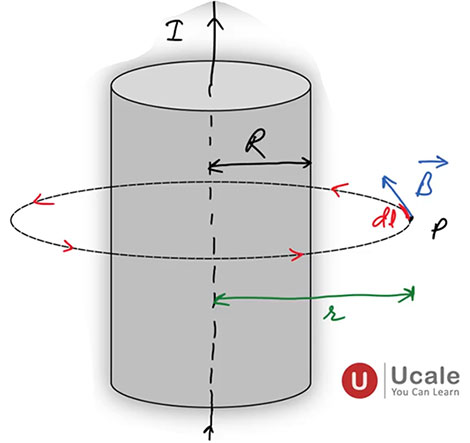
Let current density:
[
J = \dfrac{I}{\pi R^2}
]
We find magnetic field at a point located at distance [r] from the axis.
Case 1: Magnetic Field Inside the Cylinder (r < R)
Current enclosed by Amperian loop of radius [r]:
[
I_{\text{enc}} = J \cdot \pi r^2
]
Apply Ampere’s Circuital Law:
[\displaystyle \oint \vec{B} \cdot d\vec{\ell} = \mu_0 I_{\text{enc}}]
Magnetic field is tangential and constant on circular Amperian loop:
[B(2\pi r)] [= \mu_0 \left( J \pi r^2 \right)]
Substitute [J]:
[B(2\pi r)] [= \mu_0 \left( \dfrac{I}{\pi R^2} \right) \pi r^2]
[B] [= \dfrac{\mu_0 I r}{2\pi R^2}]
Thus, inside the cylinder:
[
\boxed{B_{\text{inside}}(r) = \dfrac{\mu_0 I r}{2\pi R^2}}
]
This increases linearly with distance from the axis.
Case 2: Magnetic Field Outside the Cylinder (r ≥ R)
Current enclosed = total current [I].
Apply Ampere’s Law:
[
B(2\pi r) = \mu_0 I
]
[
\Rightarrow B = \dfrac{\mu_0 I}{2\pi r}
]
Thus, outside the cylinder:
[\boxed{B_{\text{outside}}(r) = \dfrac{\mu_0 I}{2\pi r}}]
This decreases as [\dfrac{1}{r}].
3. Dimensions and Units
| Quantity | Expression | Dimensions | SI Unit |
|---|---|---|---|
| Magnetic field inside | [B] [= \dfrac{\mu_0 I r}{2\pi R^2}] | [M A^{-1} T^{-2}] | Tesla (T) |
| Magnetic field outside | [B] [= \dfrac{\mu_0 I}{2\pi r}] | [M A^{-1} T^{-2}] | Tesla (T) |
| Permeability of free space | [\mu_0] | [M L T^{-2} A^{-2}] | [4\pi \times 10^{-7}] H/m |
4. Key Features
- Magnetic field lines are concentric circles around the axis.
- Inside the cylinder, the field increases linearly with [r].
- Outside, the field varies inversely with [r].
- At the surface ([r = R]):
[
B_{\text{surface}} = \dfrac{\mu_0 I}{2\pi R}
] - Results obtained using Ampere’s Law.
- Current is assumed uniformly distributed across cross-section.
5. Important Formulas to Remember
| Region | Magnetic Field |
|---|---|
| Inside cylinder (r < R) | [B = \dfrac{\mu_0 I r}{2\pi R^2}] |
| Outside cylinder (r ≥ R) | [B = \dfrac{\mu_0 I}{2\pi r}] |
| Current density | [J = \dfrac{I}{\pi R^2}] |
6. Conceptual Questions with Solutions
1. Why does magnetic field inside the cylinder increase with r?
Because the current enclosed by the Amperian loop increases with [r^2], so magnetic field becomes proportional to [r].
2. Why is magnetic field zero at the axis of the cylinder?
At the axis ([r = 0]), the circular path shrinks to a point, so there is no loop for circulation of magnetic field, giving [B = 0].
3. Why does magnetic field outside the cylinder decrease with distance?
Outside the cylinder, enclosed current is constant but the radius of Amperian loop increases, making [B \propto \dfrac{1}{r}].
4. Why is Ampere’s Circuital Law applicable here?
Because the geometry is perfectly symmetrical (cylindrical symmetry), making the magnetic field constant along a circular Amperian loop.
5. Why do we assume current density is uniform?
For steady DC currents in a good conductor, charge carriers distribute evenly, making current density uniform across the cross-section.
6. What happens if current density is not uniform?
The enclosed current would no longer be proportional to [r^2], and the inside-field formula would require integration of actual current distribution.
7. Why does magnetic field not remain constant inside the conductor?
Because enclosed current changes with radius; hence magnetic field increases as we move outward inside.
8. Is magnetic field continuous at r = R?
Yes. Using either inside formula or outside formula gives the same value at [r = R], ensuring continuity of magnetic field.
9. Why does magnetic field depend on distance even though current is constant?
Because the magnetic field is determined not only by total current but also by the geometry (distance from the axis).
10. Why are magnetic field lines circular around the cylinder?
According to the right-hand thumb rule, magnetic field produced by a straight current element forms circular concentric loops around the conductor.
11. What determines the direction of magnetic field around the cylinder?
The right-hand thumb rule: thumb points in the direction of current, fingers curl in the direction of magnetic field.
12. Why does the outside magnetic field behave like that of a long straight wire?
Outside the cylinder, the conductor behaves like a line current because the entire current is enclosed irrespective of further radius.
13. Why does magnetic field increase linearly inside but decrease outside?
Inside: [I_{\text{enc}} \propto r^2 \Rightarrow B \propto r] Outside: [I_{\text{enc}} = I \Rightarrow B \propto \dfrac{1}{r}]
14. What happens to magnetic field if radius R is increased while keeping current same?
Increasing R decreases current density, making inside magnetic field weaker.
15. Why is magnetic field strongest at the surface of the cylinder (r = R)?
Inside, field increases with r; outside it decreases with r. Thus, the maximum value occurs at the surface.
7. FAQ / Common Misconceptions
1. Is magnetic field inside the cylinder constant?
No. It increases linearly from the axis to the surface.
2. Does a zero magnetic field at r = 0 mean no current?
No. It is due to symmetry, not absence of current.
3. Is current confined to the surface of the cylinder?
For DC currents, no. Current flows uniformly through the entire cross-section.
4. Does magnetic field vanish outside the cylinder?
No. It decreases but never becomes zero at finite distances.
5. Does the magnetic field depend on the material of the cylinder?
Not unless the material has high magnetic permeability; for ordinary conductors, μ₀ dominates.
6. Does the direction of current matter?
Yes. Reversing current reverses the direction of magnetic field.
7. Is magnetic field infinite at the axis?
No. It is exactly zero at the axis.
8. Is Ampere’s Law always valid?
Ampere’s Law is always valid, but solving it easily requires high symmetry, which this problem has.
9. Does magnetic field inside depend only on total current?
No. It depends on current density, which depends on radius as well.
10. Does the cylinder behave like a solenoid?
No. A solenoid produces nearly uniform internal field, whereas a solid conductor produces a linearly increasing one.
8. Practice Questions (with Step-by-Step Solutions)
Q1. A cylinder of radius 2 cm carries 10 A current. Find magnetic field at r = 1 cm.
Solution:
[R = 0.02, r = 0.01]
[
B = \dfrac{\mu_0 I r}{2\pi R^2}
]
[B] [= \dfrac{(4\pi \times 10^{-7})(10)(0.01)}{2\pi (0.02)^2}]
[
B = 5 \times 10^{-4} \text{ T}
]
Q2. Find magnetic field at the surface of the cylinder.
[
B = \dfrac{\mu_0 I}{2\pi R}
]
Q3. A 5 A current flows through a cylinder of radius 0.01 m. Find [B] at r = 0.02 m.
Since r > R:
[
B = \dfrac{\mu_0 I}{2\pi r}
]
[B] [= \dfrac{(4\pi \times 10^{-7})(5)}{2\pi (0.02)}] [= 5 \times 10^{-5} \text{ T}]
Q4. If current is doubled, what happens to magnetic field?
Both inside and outside, [B \propto I], so field doubles.
Q5. Find current density for 20 A current and radius 0.5 cm.
[J] [= \dfrac{I}{\pi R^2}] [= \dfrac{20}{\pi (0.005)^2}] [= 2.55 \times 10^5 \text{ A/m}^2]
 Sign in with Google