

1. Concept Overview
A bar magnet behaves like a magnetic dipole with two opposite magnetic poles (north and south) separated by a small distance.
A point lying on the axial line is one that lies along the extended line passing through both poles.
At any such point, the magnetic field is the vector sum of the fields produced by both poles. Because these fields act along the same line, their magnitudes simply add (with appropriate sign).
The magnetic field on the axial line is stronger than at other locations because the magnetic poles produce fields in the same direction along this line.
For a dipole with magnetic moment M, at a distance r from its center:
- The magnetic field decreases as [\dfrac{1}{r^3}], showing strong spatial dependence.
- Direction of the field is along the axis of the magnet, pointing from the north pole to the south pole outside the magnet.
2. Clear Explanation and Mathematical Derivation
Consider a bar magnet with pole strength m and magnetic length 2l, so that:
- North pole is at A
- South pole is at B
- Magnetic moment is [M = m(2l)]
Let point P lie on the axial line, at a distance r from the center O of the magnet.
So distances:
- From north pole: [AP = r – l]
- From south pole: [BP = r + l]
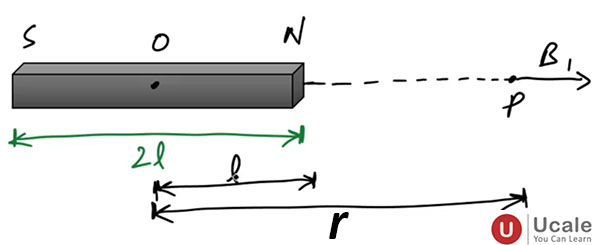
Magnetic field due to a single pole
Magnetic field due to a pole of strength m at distance d is:
[B] [= \dfrac{\mu_0}{4\pi} \dfrac{m}{d^2}]
Total Magnetic Field at P
Because both fields act along the same line, we add them:
[B_P] [= \dfrac{\mu_0}{4\pi} \left( \dfrac{m}{(r-l)^2} – \dfrac{m}{(r+l)^2} \right)]
The subtraction comes because one pole attracts and the other repels, giving opposite directions depending on the orientation.
Simplification under the dipole approximation ([r \gg l])
Using binomial expansion:
[\dfrac{1}{(r-l)^2} – \dfrac{1}{(r+l)^2}] [= \dfrac{4rl}{(r^2 – l^2)^2}]
Substituting [M = 2ml]:
[B_{\text{axial}}] [= \dfrac{\mu_0}{4\pi} \dfrac{2M}{r^3}]
This is the magnetic field of a dipole on its axial line.
Direction
- On the axial line: away from the north pole
- Outside the magnet: from N → S
3. Dimensions and Units
Magnetic field B
- SI unit: tesla (T)
- Dimensions: [M^1 L^0 T^{-2} A^{-1}]
Magnetic moment M
- SI unit: A·m²
- Dimensions: [M^0 L^2 T^0 A^1]
4. Key Features
- Magnetic field on the axial line is stronger compared to equatorial line.
- Field decreases sharply with distance as [\dfrac{1}{r^3}].
- Field direction is along the axis of the magnet.
- More accurate when the magnet is small compared to the distance (dipole approximation).
- Depends directly on magnetic moment M.
5. Important Formulas to Remember
| Quantity | Formula |
|---|---|
| Field due to North pole at distance (r − l) | [B_N] [= \dfrac{\mu_0}{4\pi} \dfrac{m}{(r-l)^2}] |
| Field due to South pole at distance (r + l) | [B_S] [= \dfrac{\mu_0}{4\pi} \dfrac{m}{(r+l)^2}] |
| Exact result on axial line | [B] [= \dfrac{\mu_0}{4\pi}\left(\dfrac{m}{(r-l)^2} – \dfrac{m}{(r+l)^2}\right)] |
| Magnetic moment | [M = m(2l)] |
| Dipole-approximation field | [B_{\text{axial}}] [= \dfrac{\mu_0}{4\pi}\dfrac{2M}{r^3}] |
6. Conceptual Questions with Solutions (15)
1. Why is the magnetic field strongest on the axial line?
The fields due to both poles act in the same direction on the axial line, so they add directly, giving a stronger net field.
2. What happens to magnetic field on axial line as distance increases?
It decreases as [\dfrac{1}{r^3}], meaning it falls very rapidly with distance.
3. Why do we use the dipole approximation?
When [r \gg l], the magnet appears like a point dipole, simplifying expressions without significant error.
4. Why do we subtract the fields of poles in exact formula?
The north and south poles produce fields in opposite directions along certain regions, so vector subtraction applies.
5. What is the direction of magnetic field outside a bar magnet?
It moves from the north pole to the south pole outside the magnet.
6. Why does magnetic field depend on magnetic moment?
Magnetic moment represents the strength of the magnet; stronger magnets produce stronger fields.
7. Why is the field not proportional to [\dfrac{1}{r^2}] like electric field?
Magnetic dipoles are made of two opposite poles separated by distance, creating a stronger spatial dependence.
8. Does reversing the magnet reverse the field direction?
Yes. North and south poles interchange roles, reversing the direction of the axial field.
9. Does magnetic field depend on medium?
Yes. Replace [\mu_0] with [\mu], which depends on the magnetic permeability of medium.
10. Why is the pole strength assumed to be point-like?
To simplify calculations based on Coulomb’s law of magnetic poles.
11. Why does the formula use absolute distances (r ± l)?
Because the magnetic field from each pole depends directly on its distance from point P.
12. Why do we consider the algebraic sign of pole fields?
Because one pole attracts and the other repels, producing opposite field directions along the same line.
13. Can the axial magnetic field be zero?
No, unless the pole strengths cancel—which is impossible for a single isolated magnet.
14. Why is magnetic field symmetrical about the axial line?
Because a bar magnet has uniform pole strength at both ends and linear geometry.
15. What happens very close to the pole?
The inverse-square term dominates, and the field becomes very large theoretically.
7. FAQ / Common Misconceptions (10)
1. Is magnetic field uniform on the axial line?
No. It varies strongly with distance as [\dfrac{1}{r^3}].
2. Are magnetic poles real physical charges?
No. They are conceptual; magnetism fundamentally arises from electron motion and spin.
3. Is the field stronger at the poles than at the center?
Yes. Field concentration is maximum near poles.
4. Does magnetic field travel from south to north inside the magnet?
Yes. Magnetic field is continuous: N → S outside, S → N inside.
5. Can magnetic poles exist independently?
No. Isolated monopoles have not been observed.
6. Is the dipole formula exact?
No. It is an approximation valid when [r \gg l].
7. Does increasing the size of magnet increase axial field?
Not necessarily. Field depends on magnetic moment M, not simply size.
8. Does steel or iron around the magnet change the field?
Yes. Materials with high permeability distort magnetic field lines.
9. Does axial field depend on angle?
No. Axial line has no angular dependence—only radial distance matters.
10. Does magnetic field reverse if we flip the magnet?
Yes. North and south poles swap, so field direction reverses.
8. Practice Questions (with Step-by-Step Solutions)
1. A bar magnet has magnetic moment [M = 0.5\ \text{A·m}^2]. Find the magnetic field on its axial line at [r = 10\ \text{cm}].
Solution:
Convert: [r = 0.1\ \text{m}]
Use dipole formula:
[B] [= \dfrac{\mu_0}{4\pi} \dfrac{2M}{r^3}]
[B] [= 10^{-7} \cdot \dfrac{2 \times 0.5}{(0.1)^3}]
[B] [= 10^{-7} \cdot 1000]
[B] [= 10^{-4}\ \text{T}]
2. A magnet has two poles separated by [2l = 4\ \text{cm}] and pole strength [m = 2\ \text{A·m}]. Find field at point P, 20 cm away on axial line.
Distances:
[AP] [= 0.2 – 0.02 = 0.18\ \text{m}]
[BP] [= 0.2 + 0.02 = 0.22\ \text{m}]
[B] [= 10^{-7}\left(\dfrac{2}{0.18^2} – \dfrac{2}{0.22^2}\right)]
Compute:
[\dfrac{2}{0.18^2} = 61.7]
[\dfrac{2}{0.22^2} = 41.3]
Difference = 20.4
So,
[B = 2.04 \times 10^{-6}\ \text{T}]
3. Doubling distance on axial line decreases field by what factor?
Dependence: [B \propto \dfrac{1}{r^3}]
So doubling r → field reduces by 8.
Answer: field becomes one-eighth.
4. If a magnet has magnetic moment [M = 1\ \text{A·m}^2], at what distance is axial field [10^{-5}\ \text{T}]?
Use:
[10^{-5}] [= 10^{-7} \dfrac{2}{r^3}]
So:
[\dfrac{2}{r^3} = 100]
[r^3 = 0.02]
[r = 0.27\ \text{m}]
5. A magnet produces field [5 \times 10^{-5}\ \text{T}] at 5 cm. What is its magnetic moment?
Convert: [r = 0.05\ \text{m}]
[B = 10^{-7} \dfrac{2M}{r^3}]
Therefore:
[5 \times 10^{-5}] [= 10^{-7} \dfrac{2M}{(0.05)^3}]
[(0.05)^3] [= 1.25 \times 10^{-4}]
So:
[5 \times 10^{-5}] [= 10^{-7} \dfrac{2M}{1.25 \times 10^{-4}}]
Rearrange:
[M] [= \dfrac{5 \times 10^{-5} \cdot 1.25 \times 10^{-4}}{2 \times 10^{-7}}]
Compute numerator:
[6.25 \times 10^{-9}]
So:
[M = 31.25 \times 10^{-3}]
[M = 0.031\ \text{A·m}^2]
 Sign in with Google