

1. Concept Overview
A bar magnet behaves like a magnetic dipole, with north and south poles separated by a small distance.
The equatorial line (also called the broadside-on position) is the line perpendicular to the magnetic axis and passing through the magnet’s center.
A point on the equatorial line lies at equal distances from both poles, but the magnetic fields due to the two poles act in opposite directions, resulting in partial cancellation.
This makes the magnetic field on the equatorial line weaker than that on the axial line.
For a magnetic dipole with moment M, at a perpendicular distance r from its center, the magnetic field is:
[B_{\text{equatorial}}] [= \dfrac{\mu_0}{4\pi}\dfrac{M}{r^3}]
This field is opposite in direction to the magnetic moment of the bar magnet.
Key ideas:
- Magnetic field decreases as [\dfrac{1}{r^3}].
- Direction is from south to north externally on the equatorial plane (i.e., opposite to dipole moment).
- Field is weaker because of partial cancellation from the two poles.
2. Clear Explanation and Mathematical Derivation
Consider a bar magnet with pole strength m and magnetic length 2l.
Point P lies on the equatorial line at distance r from the center O of the magnet.
Distances:
- From north pole A: [NP = \sqrt{r^2 + l^2}]
- From south pole B: [SP = \sqrt{r^2 + l^2}]
Thus both poles are at equal distance from P.
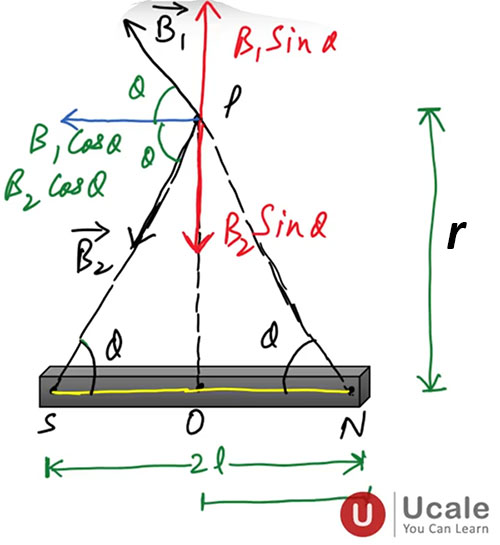
Field due to a single pole
Magnetic field due to a pole of strength m:
[B] [= \dfrac{\mu_0}{4\pi} \dfrac{m}{d^2}]
At P:
[B_1 = B_2] [= \dfrac{\mu_0}{4\pi}\dfrac{m}{(r^2 + l^2)}]
But the directions of the two fields are not along the same line.
Each field makes an angle θ with the line OP, where:
[\cos\theta = \dfrac{l}{\sqrt{r^2 + l^2}}]
Horizontal components
The horizontal components of the two fields cancel.
Vertical components add
Vertical component of each field:
[B_v = B \sin\theta]
Total magnetic field:
[B_{\text{eq}} = 2B \sin\theta]
Substitute:
[B_{\text{eq}}] [= 2\left(\dfrac{\mu_0}{4\pi}\dfrac{m}{r^2 + l^2}\right)\left(\dfrac{r}{\sqrt{r^2 + l^2}}\right)]
Simplify:
[B_{\text{eq}}] [= \dfrac{\mu_0}{4\pi} \dfrac{2mr}{(r^2 + l^2)^{3/2}}]
Using magnetic moment:
[M = 2ml]
Final exact form:
[B_{\text{eq}}] [= \dfrac{\mu_0}{4\pi}\dfrac{M}{(r^2 + l^2)^{3/2}}]
Dipole approximation (r ≫ l)
[(r^2 + l^2)^{3/2} \approx r^3]
So:
[B_{\text{eq}} = \dfrac{\mu_0}{4\pi}\dfrac{M}{r^3}]
Direction
On the equatorial line, the field is opposite to the magnetic moment of the magnet.
3. Dimensions and Units
Magnetic field B
- SI unit: tesla (T)
- Dimensions: [M^1 L^0 T^{-2} A^{-1}]
Magnetic moment M
- SI unit: A·m²
- Dimensions: [M^0 L^2 T^0 A^1]
4. Key Features
- Magnetic field exists perpendicular to the line joining the poles.
- Field on equatorial line is weaker than on axial line (half as strong in dipole form).
- Fields from both poles partially cancel.
- Decreases rapidly as [\dfrac{1}{r^3}].
- Direction is opposite to magnetic moment.
- Symmetrical geometry makes calculations simpler.
5. Important Formulas to Remember
| Concept | Formula |
|---|---|
| Distance of P from each pole | [\sqrt{r^2 + l^2}] |
| Magnetic field due to one pole | [B] [= \dfrac{\mu_0}{4\pi}\dfrac{m}{r^2 + l^2}] |
| Exact equatorial field | [B] [= \dfrac{\mu_0}{4\pi}\dfrac{M}{(r^2 + l^2)^{3/2}}] |
| Dipole form | [B] [= \dfrac{\mu_0}{4\pi}\dfrac{M}{r^3}] |
| Ratio axial : equatorial | [B_{\text{axial}}] [= 2B_{\text{equatorial}}] |
6. Conceptual Questions with Solutions (15)
1. Why is magnetic field weaker on the equatorial line?
Because the fields due to the two poles partially cancel each other.
2. Why are distances from both poles equal?
Because the equatorial line is perpendicular to the magnetic axis and passes through the magnet’s center.
3. Why do horizontal components of fields cancel?
They act in opposite directions due to the symmetrical placement of poles.
4. Why do vertical components add?
Both vertical components point in the same direction (toward south pole), so they add.
5. Why is the field direction opposite to magnetic moment?
Because the resultant field arises from vertical components that act opposite to the dipole moment direction.
6. Does the exact formula work for all distances?
Yes, but dipole form works only for [r \gg l].
7. Does equatorial field ever become zero?
No, unless the magnetic moment is zero.
8. What happens to the field if magnet strength increases?
The field increases proportionally because [B \propto M].
9. Does the sign of pole strength matter?
Yes, it determines the direction of field components.
10. Why do we use \sinθ in resolving components?
Because the vertical component of field is perpendicular to the magnet’s axis.
11. Why do we use (r² + l²) instead of r²?
Because actual distance to P includes both horizontal and vertical separation from each pole.
12. Why is the field proportional to \dfrac{1}{(r^2 + l^2)^{3/2}}?
This arises from combining inverse-square law with geometric resolution of components.
13. Is field direction outward or inward?
On equatorial line, the field points inward (toward magnet), opposite to dipole moment.
14. How does permeability affect the field?
Replace [\mu_0] with [\mu]; field increases in highly permeable materials.
15. Why is equatorial field exactly half of axial field (dipole case)?
This comes from the mathematical ratio [\dfrac{2M}{r^3}] vs [\dfrac{M}{r^3}] obtained after resolving components.
7. FAQ / Common Misconceptions (10)
1. Is equatorial field always less than axial field?
Yes. In dipole form, it is exactly half.
2. Does equatorial field point away from the magnet?
No. It points toward the magnet (opposite to M).
3. Are distances from both poles always equal?
Only on the equatorial line.
4. Are horizontal components always zero?
They cancel due to symmetry, not because they are zero individually.
5. Does increasing r by 2 decrease field by 4?
No. Magnetic field decreases by 8 because it varies as [\dfrac{1}{r^3}].
6. Is the dipole formula exact for long magnets?
No, only accurate for short magnets observed from far away.
7. Can equatorial field ever be equal to axial field?
No. Axial field is always stronger.
8. Does reversing magnet reverse equatorial field direction?
Yes. Magnetic moment reverses, so field direction also reverses.
9. Do both poles contribute equally?
Yes, because distances are equal on the equatorial line.
10. Does medium around magnet matter?
Yes. Field depends on permeability μ of the medium.
8. Practice Questions (with Step-by-Step Solutions)
1. A bar magnet has magnetic moment [M = 0.2\ \text{A·m}^2]. Find its equatorial field at [r = 20\ \text{cm}].
Convert: [r = 0.2\ \text{m}]
Use dipole formula:
[B] [= \dfrac{\mu_0}{4\pi}\dfrac{M}{r^3}]
[B] [= 10^{-7} \cdot \dfrac{0.2}{(0.2)^3}]
[B = 10^{-7} \cdot 25]
[B = 2.5 \times 10^{-6}\ \text{T}]
2. A magnet has m = 2 A·m and 2l = 6 cm. Find equatorial field at r = 10 cm.
Calculate:
[l = 0.03\ \text{m}]
[r = 0.1\ \text{m}]
Distance: [d = \sqrt{r^2 + l^2}] [= \sqrt{0.01 + 0.0009}] [= 0.104\ \text{m}]
Field due to each pole:
[B = 10^{-7}\dfrac{2}{0.104^2}] = [1.85 \times 10^{-5}]
Vertical component:
[\sin\theta] [= \dfrac{r}{d} = \dfrac{0.1}{0.104}]
Total:
[B_{\text{eq}}] [= 2B\sin\theta = 2(1.85\times10^{-5})(0.96)]
[B_{\text{eq}}] [= 3.55 \times 10^{-5}\ \text{T}]
3. If distance r is doubled, what happens to equatorial field?
[B \propto \dfrac{1}{r^3}]
Doubling r → field becomes [\dfrac{1}{8}].
4. A magnet produces equatorial field [4 \times 10^{-6}\ \text{T}] at 5 cm. Find M.
Convert: [r = 0.05\ \text{m}]
[4 \times 10^{-6}] [= 10^{-7}\dfrac{M}{(0.05)^3}]
[(0.05)^3 = 1.25 \times 10^{-4}]
Thus:
[M] [= (4 \times 10^{-6})(1.25 \times 10^{-4}) \times 10^{7}]
[M] [= 5 \times 10^{-3}\ \text{A·m}^2]
5. For a magnet, axial field at r is [2 \times 10^{-6}\ \text{T}]. What is equatorial field at same distance?
Using:
[B_{\text{axial}}] [= 2 B_{\text{equatorial}}]
So:
[B_{\text{equatorial}}] [= 1 \times 10^{-6}\ \text{T}]
 Sign in with Google