

1. Concept Overview / Statement of the Concept
Magnetic flux is a measure of the number of magnetic field lines passing through a given surface.
It tells how strongly a magnetic field “cuts through” or “links with” a surface.
If a magnetic field is perpendicular to a surface, it penetrates the surface most effectively, giving maximum flux.
If the field is parallel to the surface, no field lines pass through, giving zero flux.
Thus, magnetic flux depends on:
- the strength of magnetic field,
- the area of the surface,
- the orientation (angle) between the field and the surface.
It is a fundamental quantity in electromagnetic induction because a changing magnetic flux induces an EMF (Faraday’s Law).
2. Clear Explanation and Mathematical Derivation
Consider a flat surface of area A placed in a uniform magnetic field B.
Let θ be the angle between:
- the area vector (normal to the surface), and
- the magnetic field.
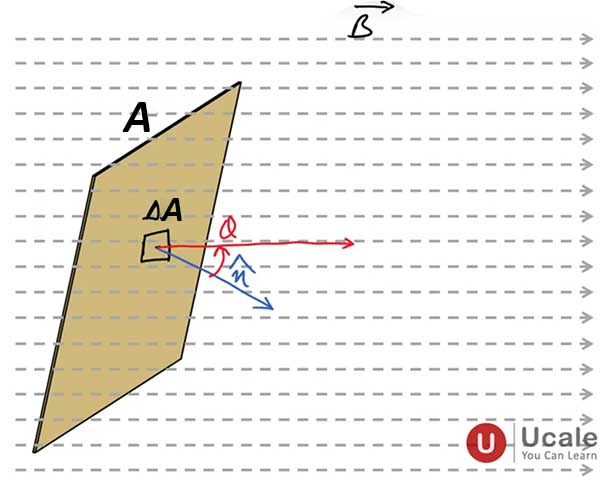
Magnetic flux Φ through the surface is defined as:
[ \Phi = \vec{B} \cdot \vec{A} ]
Using dot product:
[ \Phi = BA\cos\theta ]
Thus:
- If [\theta = 0^\circ] → area is perpendicular to field → [\Phi = BA] (maximum)
- If [\theta = 90^\circ] → area is parallel to field → [\Phi = 0]
General definition for any curved surface
Magnetic flux is the surface integral:
[ \Phi = \displaystyle \int \vec{B} \cdot d\vec{A} ]
This is essential when the field is non-uniform or the surface is curved.
3. Dimensions and Units
SI Unit: Weber (Wb)
Dimensions:
[\Phi = ML^2T^{-2}A^{-1} ]
Other Units:
- 1 Wb = 1 Tesla·m²
4. Key Features
- Magnetic flux measures magnetic field linkage with a surface.
- Depends on B, A, and angle θ.
- Flux is maximum when the surface is perpendicular to the field.
- Flux is zero when the surface is parallel to the field.
- Changing magnetic flux produces induced emf (basis of Faraday’s Law).
- Flux can be positive or negative depending on direction of [\vec{A}].
- For closed surfaces, net magnetic flux is always zero due to absence of magnetic monopoles.
5. Important Formulas to Remember
| Situation | Formula |
|---|---|
| Uniform field and flat surface | [\Phi = BA\cos\theta] |
| Perpendicular surface ([\theta = 0^\circ]) | [\Phi = BA] |
| Parallel surface ([\theta = 90^\circ]) | [\Phi = 0] |
| General formula | [\Phi = \displaystyle \int \vec{B} \cdot d\vec{A}] |
| Closed surface | [\Phi_{\text{closed}} = 0] |
6. Conceptual Questions with Solutions
1. Why does magnetic flux depend on angle?
Because flux is the dot product of magnetic field and area vector. Only the component of magnetic field perpendicular to the surface contributes to flux.
2. Why is flux maximum when θ = 0°?
At θ = 0°, magnetic field is fully perpendicular to the surface, so all field lines pass through it, giving maximum linkage.
3. Why is flux zero when θ = 90°?
At θ = 90°, the field is parallel to the surface, so no field lines pass through it; hence flux becomes zero.
4. Why do we use the area vector instead of the surface itself?
The area vector gives a clear orientation of the surface, allowing us to calculate how the magnetic field intersects the surface.
5. Why does flux increase if area is increased?
A larger surface allows more magnetic field lines to pass through, increasing total flux.
6. Can magnetic flux be negative?
Yes. If the angle between magnetic field and area vector is more than 90°, cosine becomes negative, giving negative flux.
7. Does flux change if the magnetic field is unchanged?
Yes, if the surface rotates or area changes, the flux changes even if the magnetic field remains constant.
8. Why is magnetic flux important in induction?
Because changing magnetic flux induces an emf, as stated in Faraday’s Law, forming the basis of generators and transformers.
9. Why is flux through a closed surface always zero?
Because magnetic field lines form closed loops. Every line that enters also leaves, making net flux zero.
10. Can flux be non-zero through a closed surface if the field is non-uniform?
No. Even a non-uniform field produces zero net flux because magnetic monopoles do not exist.
11. Does flux depend on the material of the surface?
No. Flux depends only on magnetic field, surface area, and orientation—not on the material.
12. Can flux exist without a magnetic field?
No. Flux is defined as linkage with magnetic field lines; without B, flux must be zero.
13. Why do we use cosine instead of sine in the formula?
Because the definition uses the component of magnetic field **perpendicular** to the surface, which involves cosine of the angle.
14. Is flux a scalar or vector?
Flux is a scalar quantity, though it can take positive or negative values depending on orientation.
15. Why is flux considered a measure of magnetic “linkage”?
Because it quantifies how many magnetic field lines pass through the surface, representing the degree of linkage.
7. FAQ / Common Misconceptions
1. Is magnetic flux the same as magnetic field?
No. Magnetic field is the cause; flux is the effect of that field passing through an area.
2. Does a larger field always mean larger flux?
Not necessarily. If the surface is oriented parallel to the field, flux can still be zero.
3. Can magnetic flux be infinite?
No. Flux is limited by finite field strength and finite area.
4. Does flux produce current directly?
No. Only **changing** flux induces current (Faraday’s Law).
5. Does zero flux mean zero magnetic field?
No. Zero flux may simply mean that the surface is parallel to the magnetic field.
6. Do field lines actually pass through surfaces physically?
No. Field lines are a visualization tool; flux quantifies their density and angle.
7. Is flux always positive?
No. It can be negative depending on the angle.
8. Is flux always constant for a given field?
No. Rotation or deformation of the surface changes flux.
9. Can a curved surface have flux?
Yes. Flux is calculated by integrating over small surface elements.
10. Does flux through a closed surface depend on the shape?
No. It is always zero regardless of shape, due to Gauss’s Law in magnetism.
8. Practice Questions (With Step-by-Step Solutions)
Q1. A magnetic field of 0.5 T makes an angle of 60° with a surface of area 2 m². Find the flux.
Solution
[ \Phi = BA\cos\theta ]
[ \Phi = (0.5)(2)\cos60^\circ ]
[ \Phi = 1 \times \dfrac{1}{2} ]
[ \Phi = 0.5\ \text{Wb} ]
Q2. What should be the angle between B and A for zero flux?
Flux is zero when:
[\cos\theta = 0] → [\theta = 90^\circ]
Q3. A surface of area 0.1 m² is perpendicular to a field of 3 T. Find flux.
[ \Phi = BA\cos0^\circ ]
[ \Phi = (3)(0.1)(1) ]
[ \Phi = 0.3\ \text{Wb} ]
Q4. A magnetic flux of 0.2 Wb passes through a surface of area 0.4 m². Find the component of magnetic field perpendicular to the surface.
We use:
[ \Phi = B_{\perp}A ]
Thus:
[ B_{\perp} = \dfrac{\Phi}{A} ]
[ B_{\perp}] [= \dfrac{0.2}{0.4}] [= 0.5\ \text{T} ]
Q5. A 2 m² loop experiences a flux of 1 Wb in a uniform field of 1 T. Find the angle with the field.
Use:
[ \Phi = BA\cos\theta ]
[ 1 = 1 \times 2 \times \cos\theta ]
[ \cos\theta = \dfrac{1}{2} ]
[ \theta = 60^\circ ]
 Sign in with Google