

1. Statement of the Concept / Concept Overview
Magnetic Lines of Forces (also called magnetic field lines) are imaginary curves that help us visually represent the strength and direction of a magnetic field.
They show:
- The direction of the magnetic field (from North pole to South pole outside the magnet).
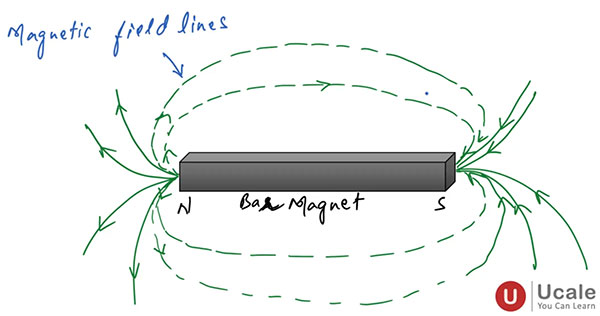
Image Credit: Ucale.org - The concentration of the field (closely spaced lines mean strong magnetic field).
- The shape and behavior of magnetic fields around magnets, current-carrying conductors, solenoids, etc.
Even though magnetic field lines are not physical entities, they allow beginners and experts to easily visualize the invisible magnetic field around a magnet.
A small compass needle placed in a magnetic field aligns tangentially to these magnetic lines of force, showing the direction of the field at that point.
2. Clear Explanation and Mathematical Derivation
Direction of Magnetic Lines
- Outside a magnet: North → South
- Inside a magnet: South → North
Thus, magnetic lines form closed continuous loops.
Properties Explained
- Tangent at any point gives field direction
If you draw a tangent to a magnetic field line at any point, it gives the direction of the magnetic field [\vec{B}] at that point. - Density of lines gives magnitude
A region with crowded lines represents a strong magnetic field:
[B \propto \text{density of lines}] - Lines never intersect
If they did, the magnetic field would have two directions at a point — impossible. - Magnetic flux
Magnetic field lines help define magnetic flux:
[\Phi_B = \displaystyle \int \vec{B} \cdot d\vec{A}]
3. Dimensions and Units
| Quantity | Symbol | Dimensions | SI Unit |
|---|---|---|---|
| Magnetic field | [B] | [M A^{-1} T^{-2}] | tesla (T) |
| Magnetic flux | [\Phi_B] | [M A^{-1} T^{-2} L^2] | weber (Wb) |
4. Key Features
- Field lines give a pictorial representation of magnetic fields.
- Always form closed loops (unlike electric field lines).
- Closely spaced lines represent strong fields.
- Lines do not intersect.
- Outside a magnet: flow from North → South.
- Inside a magnet: South → North.
- Magnetic field is vector in nature; lines help visualize both magnitude and direction.
- Used extensively in studying fields of bar magnets, solenoids, and conductors.
5. Important Formulas to Remember
| Concept | Formula |
|---|---|
| Magnetic flux | [\Phi_B = \int \vec{B} \cdot d\vec{A}] |
| Field strength from flux | [B = \dfrac{\Phi_B}{A}] (uniform field) |
| Direction of field line | Tangent to line at any point |
6. Conceptual Questions with Solutions
1. Why do magnetic lines of force form closed loops?
Because magnetic poles do not exist separately (no monopoles), so field lines must return inside the magnet, forming closed continuous loops.
2. Why do magnetic field lines never intersect?
If they intersected, the magnetic field would have two directions at one point, which is impossible.
3. Why is the field stronger where lines are closer?
Because line density is proportional to magnetic field intensity: [B \propto \text{density of lines}].
4. Why do field lines go from north to south outside a magnet?
It represents the direction a north pole would move in the field — from N to S outside the magnet.
5. What does the tangent to a field line represent?
The direction of the magnetic field [\vec{B}] at that specific point.
6. Why are magnetic lines of force imaginary?
They are man-made visual tools; they don’t physically exist but help us understand field direction and strength.
7. Why are there no magnetic lines inside a diamagnetic material?
The induced magnetic field opposes the external field, causing the net field inside to reduce.
8. Why does a compass align with magnetic lines?
Because the compass needle behaves like a tiny magnet and aligns along the direction of the field.
9. Why are magnetic field lines dense near the poles?
The magnetic field is strongest near the poles, so line density increases in these regions.
10. Why does iron filings method reveal field lines?
Iron filings become tiny temporary magnets and align along the magnetic field, tracing the lines.
11. Why do field lines contract longitudinally?
Because magnetic field lines act like stretched elastic strings, pulling poles together.
12. Why do field lines expand laterally?
They repel each other sideways due to magnetic repulsion, giving space between them.
13. Why do we draw more lines for stronger magnets?
To represent the larger magnetic flux produced by stronger magnets.
14. Why is there no field line intersection even in complex fields?
Because magnetic field is well-defined at each point; only one value and direction is possible.
15. Why does a magnet attract iron only at its poles?
Field lines are densest at poles, producing maximum magnetic force in these regions.
7. FAQ / Common Misconceptions
1. Are magnetic field lines real objects?
No, they are only visual tools to represent magnetic fields.
2. Do magnetic field lines start or end?
No. They always form closed loops. Outside the magnet: N → S. Inside: S → N.
3. Does a stronger magnet create more field lines?
Yes, we draw more lines to represent the larger magnetic flux.
4. Are magnetic field lines fixed in space?
No. They depend on the presence of magnetic materials nearby and may change shape.
5. Can field lines pass through objects?
Yes, magnetic fields can pass through most materials (except superconductors).
6. Do field lines originate from the physical pole surfaces?
No. They represent direction of force; they are drawn from N to S for visualization.
7. Is field stronger inside the magnet?
No. The field is usually strongest near the poles outside the magnet.
8. Can magnetic field lines intersect inside the magnet?
No. Intersecting lines imply multiple field directions, which is impossible.
9. Do magnetic field lines indicate the motion of particles?
No. They only show direction of magnetic force, not particle trajectories.
10. Is magnetic field same as magnetic flux?
No. Magnetic field is [B], while flux is total number of field lines passing through an area.
8. Practice Questions (with Step-by-Step Solutions)
Q1. Draw the magnetic field lines of a bar magnet and explain the pattern.
Solution:
- Outside the magnet: lines go from N → S.
- Inside: S → N forming closed loops.
- Lines are dense at poles, indicating stronger field.
- They never intersect.
Q2. At which point is the magnetic field strongest near a bar magnet? Why?
Solution:
- Strongest at poles.
- Because field line density is maximum there.
Q3. Two magnetic field lines are drawn very close to each other. What does this signify?
Solution:
- Strong magnetic field at that region because [B \propto \text{density of lines}].
Q4. A compass is placed near a magnet. Why does it point along field lines?
Solution:
- The compass needle behaves like a small magnet.
- It aligns along the direction of magnetic field, i.e., tangent to field lines.
Q5. Why do field lines curve around a bar magnet instead of moving straight?
Solution:
- Because field around a bar magnet is non-uniform.
- Lines curve to represent the correct direction of magnetic force at each point.
 Sign in with Google