


1. Introduction
In rotational dynamics, the moment of inertia (I) plays the same role as mass (m) in linear motion.
Just as mass quantifies resistance to linear acceleration under a force, moment of inertia quantifies resistance to angular acceleration under a torque.
[\text{Linear motion: } F = m a] [\quad \longleftrightarrow \quad \text{Rotational motion: } \tau = I \alpha]
Here:
- [ \tau ] = torque
- [ \alpha ] = angular acceleration
- [ I ] = moment of inertia
2. Mathematical Definition
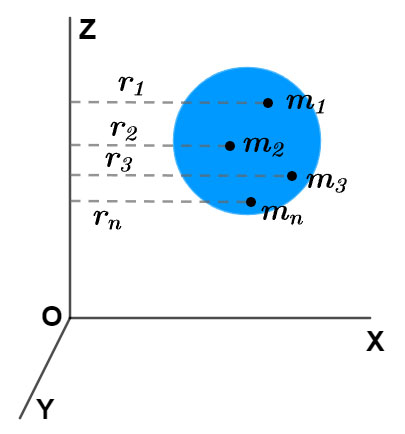
For a system of discrete particles:
[
I = \sum_i m_i r_i^2
]
For a continuous rigid body:
[
I = \int r^2 dm
]
where [ r ] is the perpendicular distance of each mass element [ dm ] from the axis of rotation.
3. Units and Dimensions
- SI Unit: [ \text{kg·m}^2 ]
- Dimensional Formula: [M L^2]
4. Dependence on Distribution of Mass
The moment of inertia depends on:
- Mass of the body [M]
- Shape and size of the body
- Position and orientation of the axis of rotation
Example:
- Solid cylinder about central axis: [ I = \dfrac{1}{2} M R^2 ]
- Hollow cylinder about central axis: [ I = M R^2 ]
Even if both have the same mass and radius, their [ I ] differs — because their mass distributions differ.
5. Theorems Related to Moment of Inertia
(a) Parallel Axis Theorem
If [ I_c ] is the moment of inertia about an axis through the center of mass and ( d ) is the distance between the two axes:
[
I = I_c + M d^2
]
(b) Perpendicular Axis Theorem
For a planar body lying in the XY-plane:
[
I_z = I_x + I_y
]
6. Physical Significance
- Moment of inertia quantifies rotational inertia — the resistance of a body to change its state of rotation.
- A larger ( I ) means it’s harder to rotate the object (requires more torque for the same angular acceleration).
- It determines how rotational kinetic energy is distributed:
[
K = \tfrac{1}{2} I \omega^2
]
Thus, moment of inertia plays the same role in rotational motion as mass does in linear motion.
7. Analogy Table: Linear vs. Rotational Motion
| Linear Motion | Rotational Motion |
|---|---|
| Force [F] | Torque [τ] |
| Mass [m] | Moment of Inertia [I] |
| Linear acceleration [a] | Angular acceleration [α] |
| Kinetic Energy: [ \dfrac{1}{2} m v^2] | [ \dfrac{1}{2} I \omega^2 ] |
8. Example Problem
Question 1:
Find the moment of inertia of a solid sphere (mass [ M ], radius [ R ]) about its diameter.
Solution:
[
I = \dfrac{2}{5} M R^2
]
Derivation (from integration):
For a sphere composed of thin disks of radius [ r ]:
[I = \int r^2 dm] [= \int_0^R r^2 (4 \pi r^2 \rho dr)] [= \dfrac{8}{15} \pi \rho R^5]
Since [ M = \dfrac{4}{3} \pi R^3 \rho ], substituting gives [ I = \dfrac{2}{5} M R^2 ].
Question 2:
Three mass points $m_1$, $m_2$, $m_3$ are located at the vertices of an equilateral triangle of length $a$ as shown in figure. What is the moment of inertia of the system about an axis along the altitude of the triangle passing through mass point $m_1$?
Solution:
Let the mass points $m_1$, $m_2$, and $m_3$ be situated at vertices $A$, $B$, and $C$ of the equilateral triangle of each side $a$. $AQ$ is the altitude of the triangle passing through mass point $m_1$.
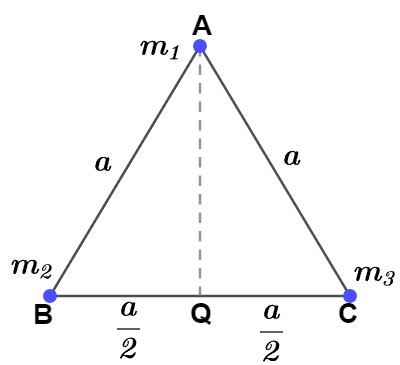
Then, the moment of inertia of the system about the altitude $AQ$,
$\displaystyle I$ $\displaystyle ={{m}_{1}}\times {{(\text{distance of }{{m}_{1}}\text{ from }AQ)}^{2}}$ $\displaystyle +{{m}_{2}}\times {{(\text{distance of }{{m}_{2}}\text{ from }AQ)}^{2}}$ $\displaystyle +{{m}_{3}}\times {{(\text{distance of }{{m}_{3}}\text{ from }AQ)}^{2}}$
$\displaystyle ={{m}_{1}}{{(0)}^{2}}+{{m}_{2}}{{\left( {\frac{a}{2}} \right)}^{2}}+{{m}_{3}}{{\left( {\frac{a}{2}} \right)}^{2}}$
$\displaystyle =\frac{1}{2}({{m}_{2}}+{{m}_{3}}){{a}^{2}}$
9. Conceptual Questions
1. Why is the moment of inertia called the rotational analogue of mass?
Because it quantifies a body’s resistance to change in angular motion, just as mass quantifies resistance to linear acceleration.
2. What does the moment of inertia depend upon?
It depends on the total mass, the shape and size of the body, and the orientation of the axis of rotation.
3. Why does the distribution of mass affect the moment of inertia?
Because the farther the mass is distributed from the axis, the larger the term \( r^2 \) becomes in \( I = \int r^2 dm \), increasing the moment of inertia.
4. Two bodies have the same mass and radius. One is solid and one is hollow. Which one has the larger moment of inertia?
The hollow one, since its mass lies farther from the axis of rotation.
5. What happens to the angular acceleration if the same torque acts on two bodies with different moments of inertia?
The body with smaller moment of inertia experiences greater angular acceleration, since \( \alpha = \tau / I \).
6. Why is it easier to spin a pencil about its long axis than about its end?
Because the moment of inertia about the long axis is smaller — mass is closer to that axis.
7. How does the moment of inertia influence rotational kinetic energy?
It determines how energy is distributed in rotational motion through \( K = \frac{1}{2} I \omega^2 \).
8. If a figure skater pulls in her arms while spinning, why does she spin faster?
Pulling the arms in reduces the moment of inertia. Since angular momentum \( L = I\omega \) is conserved, the angular velocity increases.
9. How does changing the axis of rotation affect the moment of inertia?
Changing the axis shifts the distances \( r \) of mass elements, altering \( I \). The Parallel Axis Theorem helps calculate this change.
10. Why does a solid sphere reach the bottom of an inclined plane faster than a hollow sphere of the same size?
The solid sphere has a smaller moment of inertia, so less of its potential energy is stored as rotational kinetic energy and more becomes translational kinetic energy.
11. Can the moment of inertia ever be negative?
No. Since \( I = \int r^2 dm \) and both \( r^2 \) and \( dm \) are positive, moment of inertia is always positive.
12. How does shifting the mass of a rotating system outward affect its rotational speed (assuming no external torque)?
It increases the moment of inertia, and thus decreases angular velocity to conserve angular momentum.
13. What happens to the moment of inertia if the axis passes through the center of mass versus the edge of the body?
The moment of inertia about the edge is greater because the average \( r \) values from the axis increase.
14. How does the perpendicular axis theorem simplify calculations for planar bodies?
It allows one to find the moment of inertia about a perpendicular axis by summing the moments about two perpendicular axes in the plane: \( I_z = I_x + I_y \).
15. In what way does moment of inertia influence stability in rotational motion?
A larger moment of inertia makes it harder for the rotation axis to change direction, increasing rotational stability (e.g., gyroscopes).
10. FAQ / Common Misconceptions
1. Is the moment of inertia a scalar or a vector?
For simple rotations about a fixed axis, it is a scalar quantity. In general 3D motion, it is represented by a tensor.
2. Does the moment of inertia depend on angular velocity?
No, it depends only on the mass distribution and the axis of rotation, not on how fast the object is spinning.
3. Is the moment of inertia the same for all axes through an object?
No. It varies with the position and orientation of the axis because the distances \( r \) of mass elements change.
4. Can two objects with different shapes have the same moment of inertia?
Yes, if their mass and distribution relative to the rotation axis produce the same value of \( I = \int r^2 dm \).
5. Does a larger moment of inertia always mean a heavier object?
Not necessarily — a light but extended object (like a ring) can have a larger moment of inertia than a heavier but compact object (like a solid sphere).
 Sign in with Google