


1. Key Features
- The hollow cylinder is considered to have an inner radius [R_1] and outer radius [R_2].
- The axis of rotation passes through the central axis (symmetry axis).
- The mass distribution is assumed to be uniform throughout the cylinder.
- The moment of inertia depends on both radii and the total mass.
2. Derivation
Let
- Mass of the hollow cylinder = [M]
- Inner radius = [R_1]
- Outer radius = [R_2]
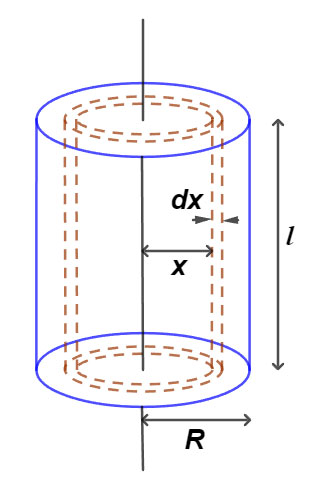
We know that the moment of inertia of a small mass element [dm] at a distance [r] from the axis is:
[
dI = r^2 dm
]
For a hollow cylinder, the mass per unit area (surface density) is:
[
\sigma = \dfrac{M}{\pi (R_2^2 – R_1^2) h}
]
Since mass is distributed over the surface, consider an elemental ring of radius [r] and thickness [dr]:
[
dm = 2 \pi r h \sigma , dr
]
Substituting in [dI]:
[
dI = r^2 (2 \pi r h \sigma dr) = 2 \pi h \sigma r^3 dr
]
Integrating from [R_1] to [R_2]:
[I = 2 \pi h \sigma \int_{R_1}^{R_2} r^3 dr] [= 2 \pi h \sigma \left( \dfrac{R_2^4 – R_1^4}{4} \right)]
Substituting [\sigma]:
[I = \dfrac{M (R_1^2 + R_2^2)}{2}]
Important Formulas to Remember
| Case | Moment of Inertia |
|---|---|
| Hollow cylinder about its own axis | [I = \dfrac{1}{2} M (R_1^2 + R_2^2)] |
| Solid cylinder (special case where [R_1 = 0]) | [I = \dfrac{1}{2} M R^2] |
| Thin cylindrical shell ([R_1 \approx R_2 = R]) | [I = M R^2] |
Conceptual Questions
1. Why does the hollow cylinder have a greater moment of inertia than a solid cylinder of the same mass and outer radius?
Because in a hollow cylinder, more mass is distributed farther from the axis, increasing [r^2] in [I = \int r^2 dm].
2. What happens to the moment of inertia if the inner radius [R_1] approaches the outer radius [R_2]?
It behaves like a thin ring, and [I \rightarrow M R^2].
3. If the inner radius is zero, what does the hollow cylinder become?
It becomes a solid cylinder.
4. Does the height of the cylinder affect its moment of inertia about the central axis?
No, because the height does not change how the mass is distributed with respect to the axis.
5. On what factors does the moment of inertia of a hollow cylinder depend?
On its total mass [M], and the inner and outer radii [R_1] and [R_2].
6. What is the physical meaning of a larger moment of inertia?
It means the object resists angular acceleration more strongly for the same applied torque.
7. Why is mass at a larger radius more significant for moment of inertia?
Because [I] depends on [r^2], so mass farther from the axis contributes more.
8. If two hollow cylinders have the same outer radius but different inner radii, which has the greater moment of inertia?
The one with a larger inner radius, since its mass is farther from the axis.
9. What is the dimensional formula of moment of inertia?
[M L^2].
10. Is moment of inertia a scalar or vector quantity?
It is a scalar quantity, though it depends on the chosen axis.
FAQ / Common Misconceptions
1. Is the moment of inertia of a hollow cylinder always greater than that of a solid one?
Yes, for the same mass and outer radius, because more mass is farther from the axis.
2. Does increasing the height of the cylinder increase its moment of inertia about the central axis?
No, the height does not affect the distribution of mass relative to the axis.
3. Can the inner radius [R_1] be greater than the outer radius [R_2]?
No, by definition, [R_1] < [R_2].
4. Why does a hollow cylinder roll down slower than a solid cylinder on an incline?
Because it has a larger moment of inertia for the same mass, so more energy goes into rotation.
5. Does the density of material affect moment of inertia?
Indirectly, since density determines mass for a given geometry, and [I] depends on mass.
 Sign in with Google