

1. Concept Overview
When a charged particle (charge [q], mass [m]) is placed in a uniform electric field [\vec{E}], it experiences a constant electric force:
[
\vec{F} = q\vec{E}
]
Since the force is constant, the particle undergoes uniformly accelerated motion.
The direction of acceleration depends on the sign of charge:
- Positive charge → accelerates in the direction of electric field
- Negative charge → accelerates opposite to the electric field
Thus, its motion in an electric field closely resembles that of an object under gravity (like projectile motion), except the direction of force depends on charge polarity.
Common situations:
- A particle projected along E → straight-line accelerated motion
- A particle projected opposite E → decelerated motion
- A particle projected perpendicular to E → parabolic path (like projectile motion)
This principle is fundamental to devices like CRT, Mass Spectrometers, Particle Accelerators, Cathode Ray Oscilloscopes, and Velocity Selectors (with magnetic fields).
2. Clear Explanation and Mathematical Derivation
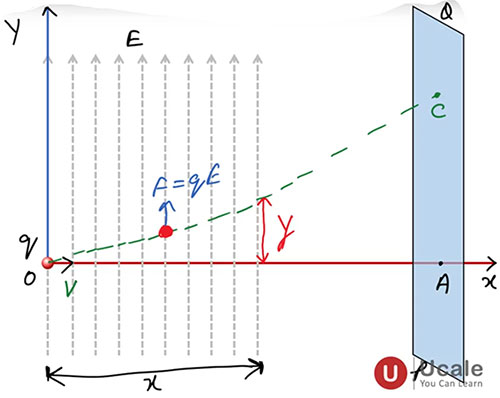
Consider a uniform electric field:
[
\vec{E} = E\hat{x}
]
The charged particle experiences:
[
\vec{F} = qE\hat{x}
]
[\Rightarrow \vec{a} = \dfrac{qE}{m}\hat{x}]
This acceleration is constant ⇒ equations of motion apply.
Case 1: Particle Released from Rest in E
If initial velocity [u = 0]:
[v = at] [= \dfrac{qE}{m}t]
[x] [= \dfrac{1}{2}\dfrac{qE}{m}t^2]
Case 2: Particle Projected Along E
If projected with initial velocity [u] along the field:
[v] [= u + \dfrac{qE}{m}t]
[x] [= ut + \dfrac{1}{2}\dfrac{qE}{m}t^2]
Case 3: Particle Projected Opposite to E
Acceleration is opposite to initial velocity → motion is uniformly retarded.
It may even come to rest momentarily.
Case 4: Particle Projected Perpendicular to E
Let electric field be along x-axis.
Particle projected along y-axis with velocity [u_y].
Components:
- Along x: accelerated motion
[
a_x = \dfrac{qE}{m}
]
[
x = \dfrac{1}{2}\dfrac{qE}{m}t^2
] - Along y: uniform motion
[
y = u_y t
]
Eliminate t:
[
t = \dfrac{y}{u_y}
]
[x] [= \dfrac{1}{2}\dfrac{qE}{m}\left(\dfrac{y}{u_y}\right)^2]
This is of form:
[
x \propto y^2
]
Hence, the path is parabolic.
3. Dimensions and Units
| Quantity | Formula | Dimensions | SI Unit |
|---|---|---|---|
| Electric force | [F = qE] | [M L T^{-2}] | Newton (N) |
| Acceleration | [a = \dfrac{qE}{m}] | [L T^{-2}] | m/s² |
| Electric field | [E = \dfrac{F}{q}] | [M L T^{-3} A^{-1}] | N/C or V/m |
| Work done | [W = qEd] | [M L^2 T^{-2}] | Joule |
4. Key Features
- Motion governed by constant force → uniformly accelerated motion.
- Sign of charge determines direction of acceleration.
- Perpendicular projection leads to parabolic trajectory.
- Similar to projectile motion under gravity, but force can be directed up or down.
- Kinetic energy increases or decreases depending on direction of field.
- Speed changes only along the field direction.
- Motion across the field is unaffected by the field.
5. Important Formulas to Remember
| Scenario | Formula |
|---|---|
| Electric force | [F = qE] |
| Acceleration | [a = \dfrac{qE}{m}] |
| Straight-line motion | [v = u + at] |
| Displacement | [x = ut + \dfrac{1}{2}at^2] |
| Perpendicular projection path | [x] [= \dfrac{1}{2}\dfrac{qE}{m}\left( \dfrac{y}{u_y} \right)^2] |
| Work done | [W = qEx] |
6. Conceptual Questions with Solutions
1. Why does a charged particle accelerate in an electric field?
Because it experiences a constant force [F = qE], producing constant acceleration [a = qE/m].
2. Why does a negative charge accelerate opposite to the field direction?
Because force is [\vec{F} = q\vec{E}]. For negative q, the direction reverses.
3. Why is motion in a uniform electric field uniformly accelerated?
Because the electric force is constant in magnitude and direction.
4. What happens to the kinetic energy of a charge moving along the field?
It increases because the electric field does positive work.
5. Why does motion perpendicular to E remain unaffected?
Because electric force acts only along the field direction, not perpendicular to it.
6. Why is the path parabolic when particle is projected perpendicular to E?
Because motion is uniform along one axis and uniformly accelerated along the other, same as projectile motion.
7. What determines whether the particle speeds up or slows down?
Whether its initial velocity is along or opposite to the electric field direction.
8. Does mass affect acceleration?
Yes. [a = qE/m], so lighter particles accelerate more.
9. Why do electrons curve more sharply than protons?
Electrons have much smaller mass ⇒ higher acceleration.
10. Can electric field change the speed without changing direction?
Yes, if motion is along the field or opposite to it.
11. Can the field change only the direction but not speed?
Not in a purely electric field. Speed always changes unless velocity is exactly perpendicular initially.
12. Why is the electric field analogous to gravity in projectile motion?
Both provide constant acceleration independent of velocity.
13. Why does a particle momentarily come to rest if projected opposite E?
Because acceleration is opposite to velocity, reducing speed to zero before reversing direction.
14. Why does electric field do work on a charged particle?
Because force and displacement have a component in the same direction.
15. Why is no magnetic force involved here?
Magnetic force requires motion and a magnetic field; here the field is purely electric.
7. FAQ / Common Misconceptions
1. Is the path always parabolic in an electric field?
Only when velocity is perpendicular to E. Otherwise, the path is straight.
2. Does a charged particle always move along E?
No. It moves according to its initial velocity and electric acceleration components.
3. Do neutral particles experience force in electric field?
No. They experience no force because q = 0.
4. Does a stationary charge gain velocity immediately?
Yes. It starts accelerating instantly because force acts instantly.
5. Is acceleration the same for positive and negative charges?
Magnitude same for same |q|, but direction opposite.
6. Does speed remain constant in an electric field?
No. Speed changes unless velocity is strictly perpendicular to the field.
7. Does electric field affect perpendicular motion?
Electric field has no component perpendicular to itself, so that motion stays uniform.
8. Do all particles follow the same path?
No. Path depends on charge, mass, and initial velocity.
9. Can electric field stop a moving charged particle?
Yes, if it opposes the motion strongly enough.
10. Is electric force the same as magnetic force?
No. Electric force acts even on stationary charges; magnetic force acts only on moving charges.
8. Practice Questions (with Step-by-Step Solutions)
Practice Q1 — Electron released from rest
An electron ([q = -1.602\times10^{-19} \text{C}], [m = 9.109\times10^{-31} \text{kg}]) is released from rest in a uniform electric field of magnitude [E = 1.0\times10^{4} \text{N/C}].
Find (a) the acceleration of the electron, and (b) the distance it travels in [1.0\times10^{-6},\text{s}].
Solution
- Acceleration: [ \vec{F}] [= q\vec{E}] [\Rightarrow a = \dfrac{|q|E}{m} ]
[a] [= \dfrac{(1.602\times10^{-19})(1.0\times10^{4})}{9.109\times10^{-31}}] [= 1.7587\times10^{15}\ \text{m/s}^2](Direction: for an electron, acceleration is opposite to the field; magnitude above.) - Distance in time [t = 1.0\times10^{-6} \text{s}]: particle starts from rest, so
[
x = \dfrac{1}{2} a t^2
]
[x] [= \dfrac{1}{2}\times 1.7587\times10^{15}\times(1.0\times10^{-6})^2] [= 8.7935\times10^{2}\ \text{m}]
Answer: (a) [a] [\approx 1.76\times10^{15}\ \text{m/s}^2] (magnitude).
(b) [x] [\approx 8.79\times10^{2}\ \text{m}].
Practice Q2 — Proton projected opposite to the field
A proton ([q = +1.602\times10^{-19} \text{C}], [m = 1.6726\times10^{-27} \text{kg}]) moves with initial speed [u = 1.0\times10^{5} \text{m/s}] toward a uniform electric field [E = 2.0\times10^{4} \text{N/C}] (i.e., its velocity is opposite to the force due to the field). Find the stopping time and stopping distance.
Solution
- Magnitude of (de)acceleration:
[a = \dfrac{qE}{m}] [= \dfrac{(1.602\times10^{-19})(2.0\times10^{4})}{1.6726\times10^{-27}}] [= 1.9156\times10^{12}\ \text{m/s}^2] - Time to stop (using [v = u – a t], v = 0):
[t_{\text{stop}}] [= \dfrac{u}{a}] [= \dfrac{1.0\times10^{5}}{1.9156\times10^{12}}] [\approx 5.22\times10^{-8}\ \text{s}] - Stopping distance (using [v^2 = u^2 – 2 a s], v = 0):
[s] [= \dfrac{u^2}{2a}] [= \dfrac{(1.0\times10^{5})^2}{2\times1.9156\times10^{12}}] [\approx 2.61\times10^{-3}\ \text{m}]
Answer: [t_{\text{stop}}] [\approx 5.22\times10^{-8}\ \text{s} [\quad] [s] [\approx 2.61\times10^{-3}\ \text{m} \ (2.61\ \text{mm}).]
Practice Q3 — Perpendicular projection: parabolic path
A proton ([q = +1.602\times10^{-19} \text{C}], [m = 1.6726\times10^{-27} \text{kg}]) is projected with velocity [u_y = 2.0\times10^{5} \text{m/s}] along the y-axis while a uniform electric field [E = 1.0\times10^{3} \text{N/C}] points along the +x direction. (Take origin at launch point.)
(a) Write the trajectory equation [x(y)].
(b) Find the x-deflection when the proton has moved [y = 0.10,\text{m}].
Solution
- Acceleration along x:
[a_x = \dfrac{qE}{m}] [= \dfrac{(1.602\times10^{-19})(1.0\times10^{3})}{1.6726\times10^{-27}}] [= 9.579\times10^{10}\ \text{m/s}^2] - Motion along y is uniform: [ y = u_y t] [\Rightarrow t = \dfrac{y}{u_y}. ]
- x as function of time: [ x = \dfrac{1}{2} a_x t^2. ] Substitute [t]:
[x(y)] [= \dfrac{1}{2} a_x \left(\dfrac{y}{u_y}\right)^2] [= \dfrac{1}{2}\dfrac{qE}{m}\left(\dfrac{y}{u_y}\right)^2] - Numeric deflection at [y = 0.10,m]:
[x] [= \dfrac{1}{2}\times 9.579\times10^{10}\times\left(\dfrac{0.10}{2.0\times10^{5}}\right)^2] [\approx 1.197\times10^{-2}\ \text{m}]
Answer: (a) [x(y)] [=\dfrac{1}{2}\dfrac{qE}{m}\left(\dfrac{y}{u_y}\right)^2.]
(b) [x(0.10\ \text{m})] [\approx 1.20\times10^{-2}\ \text{m}\ (1.20\ \text{cm}).]
Practice Q4 — Speed after acceleration through a distance
An electron (same constants as Q1) starts from rest and is accelerated by a uniform electric field [E = 1.0\times10^{5} \text{N/C}] through a distance [s = 1.0\times10^{-2} \text{m}]. Find its speed at the end of this distance.
Solution
- Acceleration magnitude (from Q1 style):
[a] [= \dfrac{|q|E}{m}] [= \dfrac{(1.602\times10^{-19})(1.0\times10^{5})}{9.109\times10^{-31}}] [= 1.7587\times10^{16}\ \text{m/s}^2] - Use energy or kinematics: [ v^2 = 2 a s] [\Rightarrow v = \sqrt{2 a s}. ]
[v] [= \sqrt{2\times 1.7587\times10^{16}\times 1.0\times10^{-2}}] [= 1.8755\times10^{7}\ \text{m/s}]
Answer: [v] [\approx 1.88\times10^{7}\ \text{m/s} \ (\approx 6.3% \text{ of } c).]
Practice Q5 — Deflection between parallel plates (will it hit the plate?)
An electron enters the space between two horizontal parallel plates of length [L = 0.10 \text{m}] with horizontal speed [u_x = 2.0\times10^{7} \text{m/s}]. The plates produce a downward uniform electric field [E = 1.0\times10^{4} \text{N/C}]. Plate separation is [d = 2.0\times10^{-2} \text{m}]. Find the vertical deflection on exit and determine whether the electron hits the lower plate while between the plates.
Solution
- Time to cross the plates:
[t = \dfrac{L}{u_x}] [= \dfrac{0.10}{2.0\times10^{7}}] [= 5.0\times10^{-9}\ \text{s}] - Vertical acceleration (electron has [q = -1.602\times10^{-19} \text{C}]):
[a_y = \dfrac{qE}{m}] [= \dfrac{(-1.602\times10^{-19})(1.0\times10^{4})}{9.109\times10^{-31}}] [= -1.7587\times10^{15}\ \text{m/s}^2]
(negative sign indicates downward acceleration) - Vertical deflection:
[y = \dfrac{1}{2} a_y t^2] [= \dfrac{1}{2}\times(-1.7587\times10^{15})\times(5.0\times10^{-9})^2] [= -2.198\times10^{-2}\ \text{m}]Magnitude: [|y|] [\approx 2.20\times10^{-2}\ \text{m}] [= 2.20\ \text{cm}. ] - Compare with plate separation: plate gap [d] [= 2.00\times10^{-2}\ \text{m}] [= 2.00\ \text{cm}]. The deflection (2.20 cm) is slightly greater than the plate separation, so the electron will hit the lower plate before emerging.
To estimate where it hits: compute time to hit plate from rest in y (starting y=0): solve [ \dfrac{1}{2}|a_y| t_h^2 = d] [\Rightarrow t_h = \sqrt{\dfrac{2d}{|a_y|}} ]
[t_h] [\approx \sqrt{\dfrac{2\times 0.02}{1.7587\times10^{15}}}] [\approx 4.78\times10^{-9}\ \text{s}]
Since [t_h < t] [4.78e-9 s < 5.0e-9 s], the electron hits the plate while still between the plates.
Answer: Vertical deflection on exit (if unobstructed) would be [2.20\times10^{-2}\ \text{m}], but since the plate gap is [2.00\times10^{-2}\ \text{m}], the electron hits the lower plate after about [4.78\times10^{-9}\ \text{s}].
 Sign in with Google