

1. Concept Overview
A charged particle experiences a magnetic force when it moves through a magnetic field.
This force is given by the Lorentz Magnetic Force Law:
[\vec{F} = q(\vec{v} \times \vec{B})]
This means:
- The force acts perpendicular to both the velocity and the magnetic field.
- The force does no work because it is always perpendicular to motion.
- Hence, the speed of the charged particle remains constant, but direction changes.
- The particle undergoes circular or helical motion depending on the angle between velocity and magnetic field.
Nature of Motion
- If [\vec{v} \perp \vec{B}], → Circular path
- If [\vec{v} \parallel \vec{B}], → Straight line
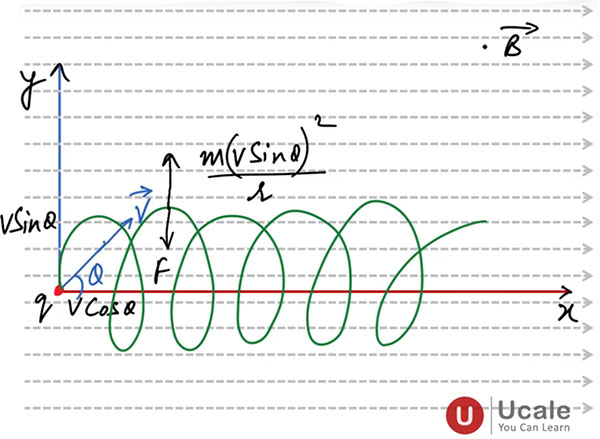
- If velocity has both parallel & perpendicular components → Helical path
The magnetic field thus acts like a “central force,” changing only the direction of the particle.
2. Clear Explanation and Mathematical Derivation
Case 1: Motion Perpendicular to Magnetic Field
If a particle of charge [q] and mass [m] enters a uniform magnetic field [B] with velocity [v] perpendicular to [B]:
Magnetic force magnitude:
[F = qvB]
This force acts as the centripetal force needed for circular motion:
[qvB = \dfrac{mv^2}{r}]
Solving for radius:
[r = \dfrac{mv}{qB}]
Time period:
[T = \dfrac{2\pi r}{v}] [= \dfrac{2\pi m}{qB}]
Frequency (cyclotron frequency):
[\nu = \dfrac{1}{T}] [= \dfrac{qB}{2\pi m}]
Angular frequency:
[\omega_c = \dfrac{qB}{m}]
Case 2: Motion at an Angle (Helical Motion)
Let velocity components be:
- Perpendicular component: [v_{\perp} = v\sin\theta]
- Parallel component: [v_{\parallel} = v\cos\theta]
Then:
- Radius:
[r = \dfrac{mv_{\perp}}{qB}] - Pitch of the helix (distance covered along field in one cycle):
[p = v_{\parallel} T] [= v_{\parallel} \dfrac{2\pi m}{qB}] - Speed remains constant; only direction changes.
3. Dimensions and Units
| Quantity | Expression | Dimensions | SI Unit |
|---|---|---|---|
| Magnetic force | [F = qvB] | ([MLT^{-2}]) | Newton (N) |
| Radius | [r=\dfrac{mv}{qB}] | ([L]) | meter (m) |
| Cyclotron frequency | [\nu=\dfrac{qB}{2\pi m}] | ([T^{-1}]) | hertz (Hz) |
| Angular frequency | [\omega=\dfrac{qB}{m}] | ([T^{-1}]) | rad/s |
4. Key Features
- Magnetic force acts perpendicular to motion → circular or helical path.
- Speed remains constant; kinetic energy does not change.
- Radius increases with momentum ([p=mv]).
- Lighter particles rotate more rapidly.
- Electrons spiral tightly; protons spiral loosely.
- Parallel component of velocity is unaffected.
- Works as the principle of the cyclotron and mass spectrometer.
- Used in particle accelerators and aurora physics.
5. Important Formulas to Remember
| Concept | Formula |
|---|---|
| Magnetic force | [F = qvB\sin\theta] |
| Radius of circular path | [r=\dfrac{mv}{qB}] |
| Time period | [T=\dfrac{2\pi m}{qB}] |
| Cyclotron frequency | [\nu=\dfrac{qB}{2\pi m}] |
| Helix radius | [r=\dfrac{mv_{\perp}}{qB}] |
| Pitch | [p = v_{\parallel}T] |
6. Conceptual Questions with Solutions (15)
1. Why does a magnetic field not change the speed of a charged particle?
Because magnetic force is perpendicular to velocity, so it does no work. Therefore, kinetic energy and speed remain constant.
2. Why is the path circular when velocity is perpendicular to magnetic field?
Because the magnetic force becomes a centripetal force producing uniform circular motion with radius [r=\dfrac{mv}{qB}].
3. Why does the radius increase if the particle is heavier?
A heavier particle has more inertia, so for the same magnetic force, the radius increases since [r=\dfrac{mv}{qB}].
4. What happens if a charged particle enters parallel to the magnetic field?
No force acts because [\sin0=0], so the particle continues in a straight line.
5. What determines whether the particle spirals clockwise or anticlockwise?
The sign of charge determines direction using Fleming’s left-hand rule.
6. Why does cyclotron frequency not depend on velocity?
Because \[\nu=\dfrac{qB}{2\pi m}\] contains no velocity term.
7. Why is pitch of the helical path proportional to parallel velocity?
Pitch = distance along magnetic field in one cycle = \[v_{\parallel}T\], so it depends directly on [v_{\parallel}].
8. Why does magnetic force vanish even if the particle is moving?
Because direction of velocity may be **parallel** to [B], making \[\sin\theta=0\].
9. Why is kinetic energy constant but momentum direction changes?
Force is perpendicular, so magnitude of momentum constant but direction rotates.
10. Why do electrons show smaller radius compared to protons?
Electrons have much smaller mass → smaller radius since [r\propto m].
11. Why is magnetic force maximum when velocity is perpendicular?
Because \[F=qvB\sin90^{\circ}=qvB\].
12. Why does motion become helical instead of circular if initial velocity is not perpendicular?
Only the perpendicular component contributes to circular motion; parallel component remains unchanged.
13. Why do charged particles in space form spirals along Earth’s magnetic field?
Because they have both perpendicular and parallel velocity components → helical motion.
14. Why does increasing magnetic field reduce radius?
Since \[r=\dfrac{mv}{qB}\], radius decreases as B increases.
15. Why is magnetic force non-zero even when acceleration appears sideways?
Magnetic force always causes centripetal acceleration, which is perpendicular to velocity.
7. FAQ / Common Misconceptions
1. Does magnetic force do work?
No. It is always perpendicular to displacement.
2. Does the magnetic field change kinetic energy?
No. Speed remains constant.
3. Is radius dependent on charge sign?
Radius depends on magnitude of charge; sign affects direction of motion.
4. Can a stationary charge be affected by a magnetic field?
No. Magnetic force requires motion.
5. Do particles speed up in magnetic fields?
No. They only change direction.
6. Is cyclotron frequency affected by speed?
No—it depends only on [q], [m], and [B].
7. Does a magnetic field attract charges?
No. It deflects them; it does not pull inward.
8. Does a larger magnetic field always mean stronger force?
Yes, for given charge and velocity, [F∝B].
9. Can motion be elliptical?
No. It is circular or helical.
10. Why can’t a cyclotron accelerate electrons to very high energies?
Relativistic mass increase disturbs resonance condition.
8. Practice Questions (with Step-by-Step Solutions)
Practice Q1 — Radius of circular motion (proton)
A proton ([m = 1.6726\times10^{-27} \text{kg}], [q = 1.602\times10^{-19} \text{C}]) moves with speed [v = 1.0\times10^{5} \text{m/s}] perpendicular to a uniform magnetic field [B = 0.20 \text{T}]. Find the radius of its circular path.
Solution
- For motion perpendicular to [\vec{B}], the magnetic force provides the centripetal force:
[qvB = \dfrac{mv^{2}}{r}] - Solve for [r]:
[\left( r = \dfrac{mv}{qB} \right)] - Substitute numbers:
[\left( r = \dfrac{(1.6726\times10^{-27})(1.0\times10^{5})}{(1.602\times10^{-19})(0.20)} \right)] - Compute (carry units):
[\boxed{r \approx 5.22\times10^{-3}\ \text{m} = 5.22\ \text{mm}}]
Practice Q2 — Cyclotron period (electron)
An electron ([m = 9.109\times10^{-31} \text{kg}], [q = 1.602\times10^{-19} \text{C}]) moves perpendicular to a uniform magnetic field [B = 0.10 \text{T}]. Find the time period [T] of its circular motion.
Solution
- Cyclotron period (from formulas):
[\left( T = \dfrac{2\pi m}{qB} \right)] - Substitute values (electron mass used):
[\left( T = \dfrac{2\pi \times 9.109\times10^{-31}}{1.602\times10^{-19} \times 0.10} \right)] - Compute:
[\boxed{T \approx 3.57\times10^{-10}\ \text{s}}]
(so the electron completes a revolution in a few tenths of a nanosecond at 0.1 T)
Practice Q3 — Pitch of a helical path (proton)
A proton with speed [v = 3.0\times10^{6} \text{m/s}] enters a uniform magnetic field [B = 0.05 \text{T}] at an angle [30^\circ] to the field. Find the pitch (distance advanced along the field in one revolution).
Solution
- Decompose velocity: parallel component
[\left( v_{\parallel} = v\cos\theta = 3.0\times10^{6}\times\cos30^\circ \right)]Numerically: [\cos30^\circ] [= \dfrac{\sqrt{3}}{2}\approx 0.8660], so
[v_{\parallel}] [\approx 2.598\times10^{6}\ \text{m/s}] - Period for one circular revolution (proton):
[\left( T = \dfrac{2\pi m}{qB} \right)]
Use proton mass [m = 1.6726\times10^{-27} \text{kg}] and [q = 1.602\times10^{-19} \text{C}]: - Substitute and compute [T]:
[\left( T \approx \dfrac{2\pi \times 1.6726\times10^{-27}}{1.602\times10^{-19}\times 0.05} \right)]
[T \approx 1.31\times10^{-6}\ \text{s}] - Pitch [[p = v_{\parallel} T]]:
[\left( p = 2.598\times10^{6} \times 1.31\times10^{-6} \right)] - Compute:
[
\boxed{p \approx 3.41\ \text{m}}
]
(so the proton advances about 3.4 m along the field in one turn — note that heavy particles and weak B give large pitch)
Practice Q4 — Direction of deflection (qualitative)
An alpha particle (charge [+2e], mass large) enters a uniform magnetic field pointing into the page with velocity pointing to the right. In which direction will the particle be deflected (as seen on the page)?
Solution
- Use the Lorentz force rule:
[\vec{F} = q(\vec{v}\times\vec{B})] - Make a quick right-hand check for a positive charge: point fingers along velocity (right), curl into the page (direction of B), thumb gives force direction.
- Right-hand: velocity → right, curling fingers into page makes thumb point up (toward top of page).
- Answer: the positively charged alpha particle is deflected upwards on the page.
(If the charge were negative, the deflection would be opposite — downward.)
Practice Q5 — Compare electron and proton radii (same speed)
An electron and a proton both move with speed [[v = 1.0\times10^{6},\text{m/s}]] perpendicular to the same magnetic field [[B = 0.50,\text{T}]]. Compute the ratio of their circular radii [[r_{e}/r_{p}]] and give numerical radii.
Solution
- Radius formula:
[\left( r = \dfrac{mv}{qB} \right)]For the electron: use [m_e = 9.109\times10^{-31} \text{kg}]; for the proton: [m_p = 1.6726\times10^{-27} \text{kg}]. - Compute each radius:Electron:
[ r_e] [= \dfrac{9.109\times10^{-31}\times 1.0\times10^{6}}{1.602\times10^{-19}\times 0.50}]
[r_e] [\approx 1.14\times10^{-5}\ \text{m}] [= 11.4\ \mu\text{m}]Proton:
[ r_p] [= \dfrac{1.6726\times10^{-27}\times 1.0\times10^{6}}{1.602\times10^{-19}\times 0.50}]
[r_p] [\approx 2.09\times10^{-2}\ \text{m}] [= 2.09\ \text{cm}] - Ratio:
[ \dfrac{r_e}{r_p}] [\approx \dfrac{1.14\times10^{-5}}{2.09\times10^{-2}} \approx 5.45\times10^{-4}] - Answer:
[r_e] [\approx 1.14\times10^{-5}\ \text{m}] [,\quad] [r_p] [\approx 2.09\times10^{-2}\ \text{m}] [,\quad] [\dfrac{r_e}{r_p}] [\approx 5.45\times10^{-4}.]
(Thus the electron circles much more tightly than the proton at the same speed.)
 Sign in with Google