

1. Statement of the Concept: Mutual Induction
Mutual induction is the phenomenon in which a changing current in one coil induces an emf in a nearby coil. The induced emf is always in a direction that opposes the change in magnetic flux.
2. Clear Explanation and Mathematical Derivation
Consider two coils placed close to each other:
- Primary coil (P): Carrying current [ I_p ]
- Secondary coil (S): Where emf is induced
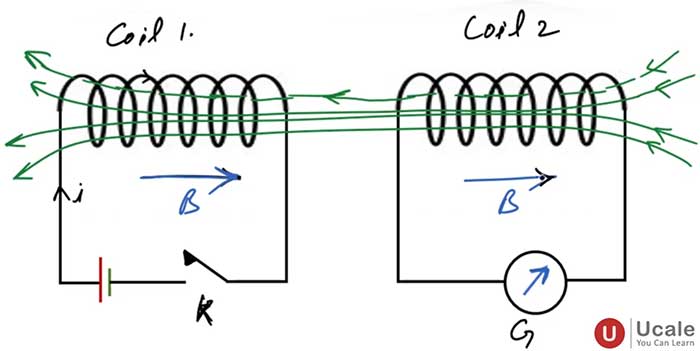
When current in the primary coil changes, the magnetic flux linked with the secondary coil changes.
If the flux linked with each turn of the secondary coil due to current [ I_p ] in the primary is:
[ \phi_s = MI_p ]
where M = mutual inductance.
Total flux linkage:
[ N_s\phi_s = MI_p ]
Differentiating with respect to time:
[ \dfrac{d(N_s\phi_s)}{dt}] [= M\dfrac{dI_p}{dt} ]
By Faraday’s law, induced emf in secondary is:
[ e_s = -\dfrac{d(N_s\phi_s)}{dt} ]
Thus,
[ e_s = -M\dfrac{dI_p}{dt} ]
This is the emf induced in one coil due to current change in another.
3. Dimensions and Units
- SI Unit of Mutual Inductance: henry (H)
- Dimensional formula:
[M] = [ML^2T^{-2}A^{-2}]
4. Key Features
- Occurs whenever coils influence each other magnetically.
- Strength of mutual induction depends on:
- Number of turns in both coils
- Distance between coils
- Orientation (coupling)
- Core material permeability
- Used in transformers, wireless chargers, inductive sensors.
- The induced emf always follows Lenz’s law.
5. Important Formulas to Remember
| Concept | Formula |
|---|---|
| Induced emf in secondary | [ e_s = -M\dfrac{dI_p}{dt} ] |
| Total flux linkage | [ N_s\phi_s = MI_p ] |
| Definition of henry | [ 1\ \text{H} = 1\ \text{V·s/A} ] |
| Energy of coupling (advanced) | [ U = MI_pI_s ] |
6. Conceptual Questions with Solutions
1. Why does an emf appear in the secondary coil?
Because the changing current in the primary changes the magnetic flux linked with the secondary, inducing emf according to Faraday’s law.
2. Why is mutual induction stronger when coils are close?
Closer coils link more magnetic flux, increasing induced emf.
3. Why is a soft iron core used between coils?
Soft iron increases magnetic flux linkage and therefore increases mutual inductance.
4. Does a steady current in the primary induce emf in the secondary?
No. Only a changing current causes changing flux and induced emf.
5. Why is mutual induction important in transformers?
Transformers rely entirely on inducing emf from one coil to another through mutual induction.
6. Why does induced emf oppose the change in the primary coil?
Because of Lenz’s law, ensuring energy conservation.
7. Why is air-core mutual inductance very small?
Air has very low permeability, so little flux links the secondary coil.
8. Why does increasing number of turns increase mutual inductance?
More turns ⇒ more flux linkage ⇒ more induced emf.
9. Can mutual induction occur between non-touching coils?
Yes, as long as part of the magnetic field of one coil links with the other.
10. Why does rotating one coil reduce mutual induction?
It reduces the effective flux passing through the other coil.
7. FAQ / Common Misconceptions
1. Does mutual induction require physical contact?
No. Coils only need magnetic coupling.
2. Is mutual inductance the same as self-inductance?
No. Self-inductance occurs within one coil; mutual inductance occurs between two coils.
3. Can induced emf be larger than the primary emf?
Yes, in transformers, depending on turn ratio.
4. Does higher current mean higher mutual inductance?
No. Mutual inductance is a property of coil geometry and core, not current.
5. Does mutual induction waste energy?
No. It only transfers energy from one coil to another.
6. Is induced emf present even when coils are far apart?
Very little. Magnetic coupling weakens rapidly with distance.
7. Does mutual inductance depend on coil resistance?
No. It depends on geometry, turns, and core.
8. Is mutual induction instantaneous?
Yes, as long as the change in primary current occurs; no mechanical delay.
9. Can mutual induction occur if coils are perpendicular?
Very weakly, because little flux links the secondary.
10. Is the induced current in secondary always in opposite direction?
It opposes the *change* in primary current—not necessarily opposite to the primary current itself.
8. Practice Questions (with Step-by-Step Solutions)
1. The current in the primary coil changes at 5 A/s. If mutual inductance is 0.2 H, find induced emf in the secondary.
Use:
[ e_s = -M\dfrac{dI_p}{dt} ]
[ e_s = -(0.2)(5)] [= -1\ \text{V} ]
Answer: 1 V (opposing the change)
2. Mutual inductance between two coils is 0.5 H. If induced emf is 10 V, find rate of change of current.
[ e_s = -M\dfrac{dI_p}{dt} ]
[ 10 = 0.5\dfrac{dI_p}{dt} ]
[ \dfrac{dI_p}{dt} = 20\ \text{A/s} ]
3. A current of 4 A in the primary produces a flux linkage of 2 Wb-turn in the secondary. Find mutual inductance.
Given:
[ N_s\phi_s = 2 ]
[ I_p = 4 ]
Use:
[ M = \dfrac{N_s\phi_s}{I_p}] [= \dfrac{2}{4}] [= 0.5\ \text{H} ]
4. If mutual inductance is 1 H and current in primary drops uniformly from 3 A to 1 A in 1 s, find induced emf.
Change in current:
[ \Delta I = 1 – 3] [= -2\ \text{A} ]
Rate:
[ \dfrac{dI_p}{dt} = -2\ \text{A/s} ]
Induced emf:
[ e_s = -1(-2)] [= 2\ \text{V} ]
5. Two coils have mutual inductance 0.1 H. Current in primary increases from 0 to 10 A in 0.5 s. Find induced emf.
Rate:
[ \dfrac{dI_p}{dt}] [= \dfrac{10}{0.5}] [= 20\ \text{A/s} ]
Induced emf:
[ e_s = -(0.1)(20)] [= -2\ \text{V} ]
 Sign in with Google