

1. Statement of the Law
Every particle in the universe attracts every other particle with a force that is directly proportional to the product of their masses and inversely proportional to the square of the distance between their centers.
This force acts along the line joining the two particles.
[
F = G \dfrac{m_1 m_2}{r^2}
]
Where:
- [ F ] = Gravitational force between two bodies
- [ m_1, m_2 ] = Masses of the two bodies
- [ r ] = Distance between their centers
- [ G ] = Universal Gravitational Constant
2. Explanation and Mathematical Derivation
Consider two point masses [ m_1 ] and [ m_2 ] separated by a distance [ r ].
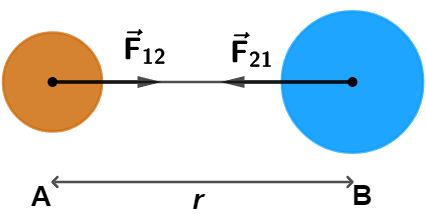
According to Newton, the gravitational attraction between them is proportional to the product of their masses:
[
F \propto m_1 m_2
]
and inversely proportional to the square of the distance between them:
[
F \propto \dfrac{1}{r^2}
]
Combining these relations:
[
F \propto \dfrac{m_1 m_2}{r^2}
]
Introducing the constant of proportionality ( G ):
[
F = G \dfrac{m_1 m_2}{r^2}
]
Where ( G ) is the Universal Gravitational Constant:
Its value is the same throughout the universe and determined experimentally by Cavendish using the torsion balance method.
[
G = 6.674 \times 10^{-11} \text{N·m}^2/\text{kg}^2
]
The negative sign (if vector form is used) indicates that the force is attractive in nature.
Vector Form:
[
\vec{F}_{12} = -G \dfrac{m_1 m_2}{r^2} \hat{r}_{12}
]
Here, [ \hat{r}_{12} ] is the unit vector from mass [ m_1 ] to [ m_2 ].
Example of Newtons Law of Gravitation
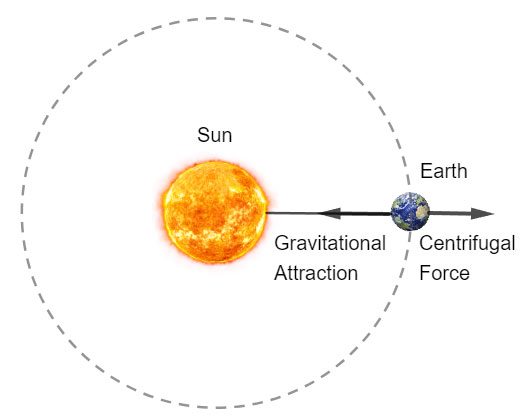
The rotation of Earth around the Sun is a great example to understand the concept of gravitational attraction. The Earth and the Sun are attracted to each other by the gravitational force of attraction. Due to this gravitational force the Earth would have gone towards the Sun, however the Earth remains in its orbit rotating around the Sun.
This is because of the centrifugal force that acts on the Earth in outward direction. Therefore, the force of gravitation attraction towards the Sun gets balanced by the centrifugal force acting outwards i.e. away from the Sun.
The formation of high tides and low tides are also due to the gravitation attraction of the Moon. The gravitational force of attraction between the Earth and the Moon results the ocean water to rise resulting to high tide. When the Moon is on the other side of the Earth there is a low tide on the ocean.
The artificial satellites in their orbit around the Earth is due to the gravitational force of attraction between Earth and satellite. The Earth’s gravity tries to pull the satellite towards its center, however the centrifugal force of satellite while rotating in a circular orbit around Earth tries to pull outwards i.e. away from the center of the Earth.
Principle of Superposition of Gravitation
It states that the resultant gravitational force $\vec{F}$ acting on a particle due to a number of masses is equal to the vector sum of the forces exerted by the individual masses on the given particle, i.e.,
[ \vec{F}={{\vec{F}}_{{01}}}+{{\vec{F}}_{{02}}}+\ldots +{{\vec{F}}_{{0n}}}] [=\sum\limits_{{i=1}}^{n}{{{{{\vec{F}}}_{{0i}}}}}]
where $\vec{F}_{01}, \vec{F}_{02}, \dots, \vec{F}_{0n}$ are the gravitational forces on a particle of mass $m_0$ due to particles of masses $m_1, m_2, m_3, \dots, m_n$, respectively.
3. Dimensions and Units
| Quantity | Symbol | SI Unit | Dimensions |
|---|---|---|---|
| Force | [ F ] | N (newton) | ([M^1 L^1 T^{-2}]) |
| Distance | [ r ] | m | ([L]) |
| Mass | [ m ] | kg | ([M]) |
| Gravitational Constant | [ G ] | N·m²/kg² | ([M^{-1} L^3 T^{-2}]) |
4. Key Features
- The gravitational force is mutual — both bodies experience equal and opposite forces.
- It is a central force, acting along the line joining the centers of the two masses.
- It is an inverse-square law — if the distance doubles, force becomes one-fourth.
- It is a long-range force — acts even at astronomical distances.
- It is an always attractive force (never repulsive).
- It depends only on mass and distance, not on the medium.
- It provides the basis for planetary motion, satellites, and orbital mechanics.
5. Important Formulas to Remember
| Concept | Formula | Description |
|---|---|---|
| Gravitational Force | [ F = G \dfrac{m_1 m_2}{r^2} ] | Force between two point masses |
| Vector Form | [ \vec{F} = -G \dfrac{m_1 m_2}{r^2} \hat{r} ] | Directional form (attractive) |
| Ratio of Forces | [ \dfrac{F_1}{F_2} = \dfrac{r_2^2}{r_1^2} ] | When distance changes |
| ( G ) Dimensional Formula | [M^{-1} L^3 T^{-2}] | Dimensional representation |
| Weight of a Body on Earth | [ W = mg = G \dfrac{M_E m}{R_E^2} ] | Derived from gravitation law |
(Refer to Differentiation for how inverse-square dependence leads to radial acceleration in orbital motion.)
6. Conceptual Questions with Solutions
1. Why is gravitational force always attractive?
Because mass is always positive, and the force acts along the line joining the masses, pulling them together. There’s no negative or repulsive mass in nature.
2. If the distance between two bodies becomes double, what happens to the force?
According to the inverse-square law: \[ F’ = \frac{F}{2^2} = \frac{F}{4} \] Hence, the force becomes one-fourth.
3. Does the gravitational force act in vacuum?
Yes, gravitational force is independent of medium and acts even in vacuum.
4. Is the gravitational force a vector or scalar quantity?
It is a **vector quantity** since it has both magnitude and direction.
5. What happens if one of the masses becomes zero?
Then \( F = 0 \). The gravitational force between a mass and a zero-mass particle is zero.
6. How is Newton’s Law related to Kepler’s Laws?
Kepler’s laws can be mathematically derived using Newton’s Law of Gravitation and the concept of centripetal force.
7. What is the nature of \( G \)?
\( G \) is a universal constant — same for all masses and locations in the universe.
8. What is the difference between gravitational force and weight?
Gravitational force acts between any two bodies; **weight** is the gravitational force of Earth on a body near its surface.
9. Can gravitational force be shielded?
No, there is no known material that can block gravitational attraction.
10. What happens if the distance between two bodies becomes half?
Force becomes \( 4 \) times larger because \( F \propto \frac{1}{r^2} \).
11. What is meant by central force?
A central force is one that always acts along the line joining the centers of two bodies. Gravitational force is an example.
12. Does gravitational force exist between two small objects?
Yes, but it’s extremely small and hence negligible compared to other forces.
13. What happens to \( G \) if medium changes?
Nothing — \( G \) is universal and does not depend on the medium.
14. Is gravitational force conservative?
Yes, it is a conservative force since the work done depends only on initial and final positions, not the path.
15. What is the dimensional formula of \( G \)?
\[ G = [M^{-1}L^3T^{-2}] \]
7. FAQ / Common Misconceptions
1. “Gravity” and “Gravitation” are the same — True or False?
**False.** Gravitation is the universal attraction between any two masses; gravity is the attraction specifically due to Earth.
2. Does gravitational force require contact between bodies?
**No.** It’s a non-contact force acting at a distance.
3. If a body is weightless, gravitational force on it is zero — True?
**False.** In weightlessness, net force appears zero due to free fall, but gravitational force still acts.
4. The gravitational constant \( G \) changes from place to place.
**False.** It’s universal — same everywhere.
5. Only Earth exerts gravitational pull.
**False.** Every mass in the universe exerts gravitational force.
6. Gravitational force becomes zero in space.
**False.** It never becomes zero; only weaker with increasing distance.
7. Heavy bodies attract light bodies more strongly.
**Partly True.** Force depends on both masses, but acceleration due to gravity is independent of mass.
8. The gravitational force depends on the medium between the masses.
**False.** It does not depend on any medium.
9. Gravitational force acts only on Earth.
**False.** It acts everywhere — on planets, stars, and galaxies.
10. Gravitational force and magnetic force are the same.
**False.** Gravitational force depends on mass; magnetic force depends on charge and motion.
8. Practice Questions (Step-by-Step Solutions)
Q1. Find the gravitational force between two bodies of masses [ 20 \text{kg} ] and [ 5 \text{kg} ] separated by [ 10 \text{m} ].
Solution:
[F = G \dfrac{m_1 m_2}{r^2}] [= (6.67 \times 10^{-11}) \dfrac{(20)(5)}{(10)^2}] [= 6.67 \times 10^{-10} \text{N}]
Q2. By what factor does the gravitational force change if distance becomes three times?
Solution:
[F’ = \dfrac{F}{3^2} = \dfrac{F}{9}]
Force becomes one-ninth of original.
Q3. The gravitational force between two masses is [ 2 \text{N} ] at a distance [ 3 \text{m} ]. What will be the force at [ 6 \text{m}] ?
Solution:
[F’ = 2 \times \left(\dfrac{3}{6}\right)^2] [= 2 \times \dfrac{1}{4} = 0.5 \text{N}]
Q4. Find the gravitational constant [ G ] if two bodies of [ 10 \text{kg} ] each attract with force [ 6.67 \times 10^{-9} \text{N} ] at [ 1 \text{m} ].
Solution:
[F = G \dfrac{m_1 m_2}{r^2} \Rightarrow G] [= \dfrac{F r^2}{m_1 m_2}] [= \dfrac{6.67 \times 10^{-9} (1)^2}{10 \times 10}] [= 6.67 \times 10^{-11} \text{N·m}^2/\text{kg}^2]
Q5. The mass of Earth is [ 6 \times 10^{24} \text{kg} ] and radius is [ 6.4 \times 10^6 \text{m} ]. Find [ g ] using Newton’s law.
Solution:
[g = G \dfrac{M_E}{R_E^2}] [= 6.67 \times 10^{-11} \times \dfrac{6 \times 10^{24}}{(6.4 \times 10^6)^2}] [= 9.8 \text{m/s}^2]
 Sign in with Google