

1. Statement of the Law / Concept Overview
What Oersted Discovered
Before 1820, electricity and magnetism were believed to be two separate, unrelated phenomena.
Hans Christian Oersted’s experiment showed for the first time that:
“An electric current produces a magnetic field around it.”
This discovery formed the foundation of electromagnetism — the unification of electric and magnetic effects.
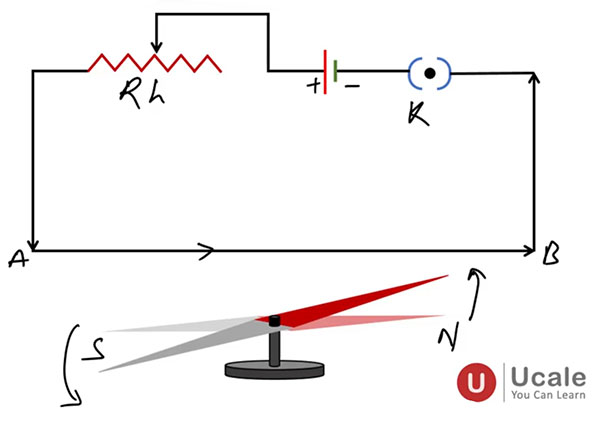
What Actually Happened in His Experiment
- Oersted placed a current-carrying wire above a magnetic compass needle.
- When no current flowed → the needle pointed north, due to Earth’s magnetic field.
- When the current was switched ON → the compass needle deflected, meaning an entirely new magnetic field was acting on it.
- When current direction was reversed, the needle deflected in the opposite direction.
This showed that:
- Electric current produces a magnetic field.
- The direction of the magnetic field depends on the direction of current.
Why This Was Revolutionary
- It proved electricity and magnetism are interconnected.
- It led to the development of:
- Magnetic field concept
- Electromagnets
- Motors, generators, transformers
- Maxwell’s equations
2. Clear Explanation and Mathematical Derivation
Oersted’s experiment gives qualitative understanding, but we can express the effect mathematically using the magnetic field around a straight conductor:
[B = \dfrac{\mu_{0} I}{2\pi r}]
Where:
- [B] = magnetic field produced
- [I] = current in the wire
- [r] = distance from the wire
- [\mu_{0}] = permeability of free space
This shows:
- B increases when current increases
- B decreases with distance from the wire
- Magnetic field forms circular loops around the wire
The deflection of the compass needle is simply the needle aligning itself with this new circular magnetic field.
3. Dimensions and Units
| Quantity | Dimensions | SI Unit |
|---|---|---|
| Magnetic Field [B] | [MT^{-2}A^{-1}] | Tesla (T) |
| Current [I] | [A] | Ampere (A) |
| Distance [r] | [L] | metre (m) |
4. Key Features
- A current-carrying conductor is surrounded by a magnetic field.
- The magnetic field lines form concentric circles around the wire.
- Reversing the current reverses the direction of the magnetic field.
- Strength of magnetic field increases with current and decreases with distance.
- Compass deflection provides observable proof of the magnetic field.
- This experiment marks the beginning of electromagnetism.
5. Important Formulas to Remember
| Formula | Description |
|---|---|
| [B = \dfrac{\mu_{0} I}{2\pi r}] | Magnetic field around a straight, long current-carrying conductor |
| Right-Hand Thumb Rule | Determines direction of magnetic field around current |
6. Conceptual Questions with Solutions
1. Why does the compass needle deflect when current flows through a nearby wire?
The wire produces a magnetic field when current flows. This field interacts with the compass needle and forces it to align along the circular magnetic field lines, causing deflection.
2. What happens when current direction is reversed?
The direction of the magnetic field reverses, so the compass needle deflects in the opposite direction.
3. What does Oersted’s experiment prove?
It proves that electricity and magnetism are related — a current produces a magnetic field.
4. Why does the needle not deflect when there is no current?
Because the only magnetic field present is Earth’s field, which the needle is already aligned with; no new magnetic field acts on it.
5. Why are magnetic field lines circular around a wire?
Because the field forms closed loops centered around the conductor, which is consistent with Maxwell’s equations and Ampere’s law.
6. What happens to the magnetic field if the current is doubled?B becomes twice as strong, since [B ∝ I].
7. Why does the compass needle align tangentially to the circular field line?
A compass needle always aligns with the magnetic field at its location; since the field is circular, the tangent shows the field direction.
8. Can a small current cause deflection?
Yes, but the deflection will be small. Higher current produces stronger magnetic field and clearer deflection.
9. What if the wire is placed vertically above the needle?
The needle still deflects, but the direction of deflection will depend on the orientation and current direction.
10. Would the needle deflect if the wire carried alternating current?
It would vibrate rapidly because the magnetic field direction reverses with current direction.
7. FAQ / Common Misconceptions
1. “The compass moves because of electric current passing through it.”
Incorrect. The compass reacts to the magnetic field created by the current, not the current itself.
2. “Electricity and magnetism are separate phenomena.”
Oersted showed they are interconnected — forming electromagnetism.
3. “Magnetic field is produced only by magnets.”
No. Any current-carrying conductor produces a magnetic field.
4. “Compass deflection means the wire became a magnet.”
The wire does not become a permanent magnet; it only produces a temporary magnetic field when current flows.
5. “Strength of magnetic field does not depend on distance.”
It decreases with distance as per [B = \dfrac{\mu_{0} I}{2\pi r}].
6. “Reversing the current does not affect the magnetic field.”
It completely reverses the magnetic field direction.
7. “A compass only points north.”
A compass aligns with the strongest magnetic field present, not necessarily north.
8. “Only straight wires produce magnetic fields.”
All current-carrying conductors (loops, solenoids, coils) produce magnetic fields.
9. “Magnetic field appears only when current reaches full value.”
The magnetic field is produced instantly when current starts flowing.
10. “Oersted discovered the right-hand rule.”
No. The right-hand rule is a logical tool derived later from his observation.
8. Practice Questions (with Step-by-Step Solutions)
Q1. A wire carries a current of 5 A. Find the magnetic field at 4 cm from the wire.
[B = \dfrac{\mu_{0} I}{2\pi r}]
[B] [= \dfrac{4\pi \times 10^{-7} \times 5}{2\pi \times 0.04}]
[B] [= \dfrac{20 \times 10^{-7}}{0.08}] [= 2.5 \times 10^{-5}\ \text{T}]
Q2. What happens to the magnetic field if distance is doubled?
[B \propto \dfrac{1}{r}]
If [r → 2r], then [B → \dfrac{B}{2}].
Q3. A compass is placed near a wire. The current increases from 1 A to 3 A. What happens to needle deflection?
Magnetic field increases three times → needle deflection becomes larger.
Q4. A wire produces a magnetic field of [6 \times 10^{-5}] T at some distance. If current is halved, what is the new magnetic field?
[B \propto I]
[B_{\text{new}}] [= 3 \times 10^{-5}\ \text{T}]
Q5. Why does switching off current make the compass return to north?
Because the artificially produced magnetic field vanishes, and only Earth’s natural magnetic field remains.
 Sign in with Google