

1. Concept Overview
A parallel plate capacitor is the simplest and most widely studied form of a capacitor.
It consists of two large, flat, parallel conducting plates separated by a small distance d, with a dielectric medium (air/vacuum or another insulating material) between them.
When a potential difference is applied across the plates:
- One plate accumulates +Q charge,
- The other accumulates –Q,
- An electric field E is established between them.
A parallel plate capacitor is used to understand the basic idea of capacitance, because its geometry is simple and allows the electric field between plates to be uniform (except at edges).
The capacitance of a parallel plate capacitor is:
[C = \dfrac{\varepsilon A}{d}]
where
- [\varepsilon] [= \varepsilon_{0} \varepsilon_{r}] is the permittivity of medium,
- [A] is plate area,
- [d] is separation.
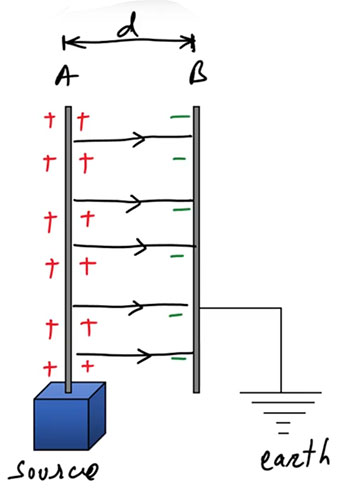
This model forms the foundation for understanding all real capacitors.
2. Clear Explanation and Derivation
Electric Field Between Plates
For two large plates with surface charge densities [+\sigma] and [-\sigma],
the electric field due to each plate is:
[E = \dfrac{\sigma}{2\varepsilon_{0}}]
Between the plates, fields add:
[E = \dfrac{\sigma}{\varepsilon_{0}}]
For vacuum or air, [\varepsilon = \varepsilon_{0}].
For dielectric medium, [\varepsilon = \varepsilon_{0}\varepsilon_{r}].
Potential Difference
[V = Ed = \dfrac{\sigma d}{\varepsilon}]
Capacitance Derivation
Charge on each plate:
[Q = \sigma A]
Capacitance:
[C = \dfrac{Q}{V} = \dfrac{\sigma A}{\dfrac{\sigma d}{\varepsilon}}]
[C = \dfrac{\varepsilon A}{d}]
3. Dimensions and Units
Dimensions of Capacitance
[C] = M^{-1}L^{-2}T^{4}A^{2}
SI Unit
- Farad (F)
- Practical units: μF, nF, pF
4. Key Features
- Electric field between plates is uniform (ignoring edge effects).
- Capacitance increases with:
- Larger plate area
- Smaller separation
- Higher dielectric constant
- Stores potential energy in the electric field:
[U = \dfrac{1}{2}CV^{2}] - Used in filters, tuning circuits, oscillators, flash circuits, DC blocking, etc.
5. Important Formulas to Remember
| Quantity | Formula |
|---|---|
| Capacitance | [C = \dfrac{\varepsilon A}{d}] |
| With dielectric constant [\varepsilon_{r}] | [C = \dfrac{\varepsilon_{0}\varepsilon_{r}A}{d}] |
| Charge | [Q = CV] |
| Electric Field | [E = \dfrac{V}{d}] |
| Energy stored | [U = \dfrac{1}{2}CV^{2}] |
| Surface charge density | [\sigma = \dfrac{Q}{A}] |
6. Conceptual Questions With Solutions
1. Why is the electric field uniform in a parallel plate capacitor?
Because the plates are large, flat, and parallel. Field lines are straight and evenly spaced across the central region, creating a uniform field.
2. Why does capacitance increase with plate area?
Larger area allows more charge to accumulate at the same voltage, leading to higher capacitance.
3. Why does capacitance decrease with separation?
Increasing separation reduces electric field strength, requiring more voltage to store the same charge.
4. Why does inserting a dielectric increase capacitance?
The dielectric reduces the effective electric field, allowing more charge to be stored at the same voltage.
5. Why can a capacitor block DC but allow AC?
DC causes charges to accumulate until current stops. AC continuously reverses, leading to periodic charging/discharging.
6. Is the charge stored inside the dielectric?
No. Charge is stored only on the plates. Dielectric only polarizes.
7. Why is capacitance independent of the amount of charge?
Capacitance depends only on geometry and dielectric, not on Q or V.
8. Why are edge effects ignored in derivation?
Because plates are assumed very large compared to separation so fringing is negligible.
9. Why does increasing separation increase potential difference?
More distance means greater work is required to move charges across the gap.
10. Why do real capacitors not behave like ideal parallel plates?
Because real plates are finite, edges cause fringing fields, and dielectrics have imperfections.
11. Does increasing voltage change capacitance?
No. Capacitance is a structural property.
12. Why is energy stored in the electric field rather than plates?
Because work is done to establish electric field between plates; energy density lies in the field.
13. Why do capacitors heat up during AC operation?
Due to dielectric losses and continuous charging/discharging cycles.
14. Why do we assume plates are infinite?
To simplify and ensure uniform electric field for mathematical analysis.
15. What happens if separation becomes zero?
The plates would touch, causing a short circuit; capacitance becomes meaningless.
7. FAQ / Common Misconceptions
1. Do capacitors store charge in the gap?
No. Charge stays on the plates; the gap only contains electric field.
2. Does a dielectric carry free charge?
No. It only polarizes by rearranging bound charges.
3. Does doubling voltage double capacitance?
No. Capacitance is independent of voltage.
4. Does increasing plate thickness increase capacitance?
No. Thickness has no effect unless it changes surface area.
5. Does current pass through dielectric?
No. Only displacement current exists; no real electrons flow across.
6. Is more capacitance always better?
No. Excess capacitance slows circuits and distorts signals.
7. Is stored energy on the plates?
No. It is stored in the electric field in the gap.
8. Do dielectrics always increase capacitance?
Yes—unless it is a conductor, which would short the capacitor.
9. Can capacitance become infinite?
No. Infinite capacitance requires zero separation, which is impossible.
10. Do capacitors lose charge instantly when disconnected?
No. Ideal capacitors hold charge indefinitely; real ones leak slowly.
8. Practice Questions (With Step-by-Step Solutions)
1. A parallel plate capacitor has area [0.5\ \text{m}^2] and separation [2 \times 10^{-3}\ \text{m}]. Find capacitance in air.
[C = \dfrac{\varepsilon_{0}A}{d}]
[C] [= \dfrac{8.85 \times 10^{-12} \times 0.5}{2 \times 10^{-3}}]
[C] [= 2.21 \times 10^{-9}\ \text{F}]
[\boxed{C = 2.21\ \text{nF}}]
2. A capacitor has capacitance 10 pF in air. A dielectric of [\varepsilon_{r} = 5] is inserted. Find new capacitance.
[C’ = \varepsilon_{r}C]
[C’ = 5 \times 10\ \text{pF}]
[\boxed{50\ \text{pF}}]
3. A capacitor with plate area [0.2\ \text{m}^2] and separation 5 mm stores charge [Q = 10\ \mu C]. Find voltage across it (air).
[C = \dfrac{\varepsilon_{0}A}{d}]
[C] [= \dfrac{8.85 \times 10^{-12} \times 0.2}{5 \times 10^{-3}}]
[C = 3.54 \times 10^{-10}\ \text{F}]
[V = \dfrac{Q}{C}]
[V] [= \dfrac{10 \times 10^{-6}}{3.54 \times 10^{-10}}]
[V] [\approx 2.82 \times 10^{4}\ \text{V}]
[\boxed{28.2\ \text{kV}}]
4. A parallel plate capacitor is charged to 100 V. If [C = 2\ \text{nF}], find energy stored.
[U = \dfrac{1}{2}CV^{2}]
[U] [= \dfrac{1}{2} \times 2 \times 10^{-9} \times (100)^{2}]
[U = 1 \times 10^{-5}\ \text{J}]
[\boxed{10\ \mu J}]
5. Doubling plate area and halving separation increases capacitance by what factor?
Initial: [C] [= \dfrac{\varepsilon A}{d}]
Final: [C’] [= \dfrac{\varepsilon (2A)}{\dfrac{d}{2}}] [= \dfrac{4\varepsilon A}{d}]
[\dfrac{C’}{C} = 4]
Capacitance increases by a factor of 4
 Sign in with Google