


1. Statement of the Concept
The parametric form of a straight line represents the equation of a line:
- passing through a fixed point [(x_1, y_1)], and
- making an angle [θ] with the positive x-axis.
This form expresses the coordinates of any point on the line in terms of a parameter [r], which measures distance along the line.
2. Explanation and Derivation
Step 1: Given Information
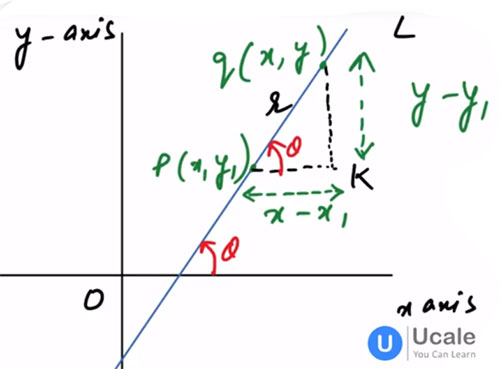
- A straight line passes through the point [(x_1, y_1)].
- The line makes an angle [θ] with the positive x-axis.
- Let [(x, y)] be any point on the line.
- Let [r] be the distance of [(x, y)] from [(x_1, y_1)] measured along the line.
Step 2: Resolve Distance Along Axes
Since the line makes an angle [θ] with x-axis:
- Horizontal component of [r] = [r \cos θ]
- Vertical component of [r] = [r\ sin θ]
Hence,
- [x − x_1 = r \cos θ]
- [y − y_1 = r \sin θ]
Step 3: Parametric Form
Dividing both equations appropriately:
[\dfrac{x – x_1}{\cos \theta} = \dfrac{y – y_1}{\sin \theta} = r]
This is called the parametric form or point–direction form of a straight line.
3. Key Features and Important Observations
- Parameter [r] can take all real values
- When [r = 0], the point is [(x_1, y_1)]
- Direction ratios of the line are:
- [\cos θ] and [\sin θ]
- This form is ideal when:
- a point and angle are given
- motion along a line is described
- It directly links geometry with trigonometry
4. Important Relations
| Concept | Relation |
|---|---|
| Direction ratios | [\cos θ, \sin θ] |
| Slope of line | [m = \tan θ] |
| Point on line | [(x, y) ][= (x_1 + r \cos θ, y_1 + r \sin θ)] |
| Symmetric form | [\dfrac{x – x_1}{\cos θ} = \dfrac{y – y_1}{\sin θ}] |
5. Conceptual Questions with Detailed Solutions
1. What is the physical meaning of the parameter [r]?
The parameter [r] represents the directed distance of a point from [(x_1, y_1)] measured along the line.
Positive [r] moves forward in the direction of the line, negative [r] moves backward.
2. Why are [cos θ] and [sin θ] used instead of slope?
Because [cos θ] and [sin θ] directly give the direction ratios of the line.
Slope [m = tan θ] fails for vertical lines, but parametric form remains valid.
3. What happens if [sin θ = 0]?
If [\sin θ = 0], then [θ = 0° or 180°].
The line becomes parallel to x-axis, and the parametric form reduces to:
[y = y_1]
4. Can parametric form represent vertical lines?
Yes.
For a vertical line, [θ = 90°]:
[\cos θ = 0]
[\sin θ = 1]
Then:
[x = x_1]
[y = y_1 + r]
5. How is this form useful in motion problems?
It naturally represents position as a function of distance, making it ideal for:
particle motion
ray tracing
vector interpretation
7. FAQ / Common Misconceptions (Deep Exam Points)
1. Students confuse parametric form with normal (distance) form.
Parametric form uses:
a point
a direction
Normal form uses:
a distance
a normal direction
They are fundamentally different.
2. Is [r] the distance from origin?
No
[r] is the distance from the given point [(x_1, y_1)], not from origin.
3. Does changing sign of [r] change the line?
No.
It only changes the direction of traversal, not the line itself.
8. Practice Questions
Question 1. Find the parametric form of the line passing through [(2, 3)] and making an angle [30°] with the x-axis.
Step-by-Step Solution:
Given point: [(x_1, y_1) = (2, 3)]
Given angle: [θ = 30°]
Compute direction ratios:
[\cos 30° = \dfrac{\sqrt{3}}{2}],
[\sin 30° = \dfrac{1}{2}]
Write parametric equations:
[x − 2 = r \dfrac{\sqrt{3}}{2}]
[y − 3 = r \dfrac{1}{2}]
Write parametric (symmetric) form:
[ \dfrac{x − 2}{\sqrt{3}/2} = \dfrac{y − 3}{1/2} = r ]
Conclusion:
Required parametric form is
[ \dfrac{x − 2}{\sqrt{3}/2} = \dfrac{y − 3}{1/2} = r ]
Question 2. Write the parametric form of the line passing through [(−1, 4)] and inclined at [45°] to the x-axis.
Step-by-Step Solution:
[(x_1, y_1) = (−1, 4)]
[θ = 45°]
Direction ratios:
[\cos 45° = \sin 45° = \dfrac{1}{\sqrt{2}}]
Parametric equations:
[x + 1 = r \dfrac{1}{\sqrt{2}}]
[y − 4 = r \dfrac{1}{\sqrt{2}}]
Parametric form:
[ \dfrac{x + 1}{1/\sqrt{2}} = \dfrac{y − 4}{1/\sqrt{2}} = r ]
Conclusion:
Required parametric form obtained.
Question 3. Find the parametric form of the line passing through [(0, −2)] and parallel to the x-axis.
Step-by-Step Solution:
A line parallel to x-axis has angle:
[θ = 0°]
Direction ratios:
[\cos 0° = 1], [\sin 0° = 0]
Given point: [(0, −2)]
Parametric equations:
[x − 0 = r · 1 ⇒ x = r]
[y + 2 = r · 0 ⇒ y = −2]
Conclusion:
Parametric form is
[ x = r, \quad y = −2 ]
Question 4. Write the parametric form of the vertical line passing through [(3, −1)].
Step-by-Step Solution:
Vertical line ⇒ angle with x-axis:
[θ = 90°]
Direction ratios:
[\cos 90° = 0], [\sin 90° = 1]
Parametric equations:
[x − 3 = r · 0 ⇒ x = 3]
[y + 1 = r · 1 ⇒ y = −1 + r]
Conclusion:
Parametric form is
[ x = 3, \quad y = −1 + r ]
Question 5. Find the parametric form of the line passing through [(1, 2)] and having slope [\sqrt{3}].
Step-by-Step Solution:
Given slope:
[m = \sqrt{3}]
Find angle [θ]:
[\tan θ = \sqrt{3} ⇒ θ = 60°]
Direction ratios:
[\cos 60° = \dfrac{1}{2}],
[\sin 60° = \dfrac{\sqrt{3}}{2}]
Parametric equations:
[x − 1 = r \dfrac{1}{2}]
[y − 2 = r \dfrac{\sqrt{3}}{2}]
Conclusion:
Parametric form is
[ \dfrac{x − 1}{1/2} = \dfrac{y − 2}{\sqrt{3}/2} = r ]
Question 6. Show that the parametric equations [x = 2 + 3r], [y = −1 + 4r] represent a straight line and find its slope.
Step-by-Step Solution:
Eliminate parameter [r]:
From [x = 2 + 3r]
⇒ [r = \dfrac{x − 2}{3}]
Substitute into [y]:
[y = −1 + 4 \dfrac{x − 2}{3}]
Simplify:
[y = −1 + \dfrac{4x − 8}{3}]
[y = \dfrac{4x − 11}{3}]
Compare with [y = mx + c]:
[m = \dfrac{4}{3}]
Conclusion:
The equations represent a straight line with slope
[ m = \dfrac{4}{3} ]
Question 7. Find the parametric form of the line joining the points [(1, 2)] and [(4, 6)].
Step-by-Step Solution:
Direction ratios of the line:
[dx = 4 − 1 = 3],
[dy = 6 − 2 = 4]
Normalize direction ratios:
[\sqrt{3^2 + 4^2} = 5]
Unit direction ratios:
[\dfrac{3}{5}, \dfrac{4}{5}]
Parametric equations:
[x − 1 = r \dfrac{3}{5}]
[y − 2 = r \dfrac{4}{5}]
Conclusion:
Parametric form is
[ \dfrac{x − 1}{3/5} = \dfrac{y − 2}{4/5} = r ]
Question 8. Find the parametric form of the line passing through the origin and making an angle [120°] with the x-axis.
Step-by-Step Solution:
[(x_1, y_1) = (0, 0)]
[θ = 120°]
Direction ratios:
[\cos 120° = −\dfrac{1}{2}],
[\sin 120° = \dfrac{\sqrt{3}}{2}]
Parametric equations:
[x = r (−\dfrac{1}{2})]
[y = r (\dfrac{\sqrt{3}}{2})]
Conclusion:
Parametric form is
[ x = −\dfrac{r}{2}, \quad y = \dfrac{\sqrt{3}r}{2} ]
Question 9. If the parametric form of a line is [\dfrac{x − 2}{2} = \dfrac{y + 1}{−3} = r], find its slope.
Step-by-Step Solution:
Direction ratios are:
[a = 2], [b = −3]
Slope formula:
[m = \dfrac{b}{a}]
Substitute values:
[m = \dfrac{−3}{2}]
Conclusion:
Slope of the line is
[ m = −\dfrac{3}{2} ]
Question 10. Find the Cartesian equation of the line given by [\dfrac{x − 1}{3} = \dfrac{y − 2}{5} = r].
Step-by-Step Solution:
Equate parameters:
[\dfrac{x − 1}{3} = \dfrac{y − 2}{5}]
Cross multiply:
[5(x − 1) = 3(y − 2)]
Expand:
[5x − 5 = 3y − 6]
Rearrange:
[5x − 3y + 1 = 0]
Conclusion:
Cartesian equation is
[ 5x − 3y + 1 = 0 ]
 Sign in with Google