

1. Concept Overview
Pascal’s Law assumes that the fluid pressure is transmitted equally in all directions only when gravity’s effect is negligible or uniform throughout the system. However, in real situations, the gravitational field of the Earth affects the pressure distribution in a fluid column.
Hence, when gravity acts, pressure is not uniform in all parts of the fluid; it increases with depth due to the weight of the fluid above.
2. Explanation and Mathematical Derivation
Let us consider a stationary fluid in a container under the influence of gravity.
Let:
- [h] = depth of the point considered below the free surface
- [ρ] = density of the liquid
- [g] = acceleration due to gravity
- [P₀] = pressure on the free surface of the liquid
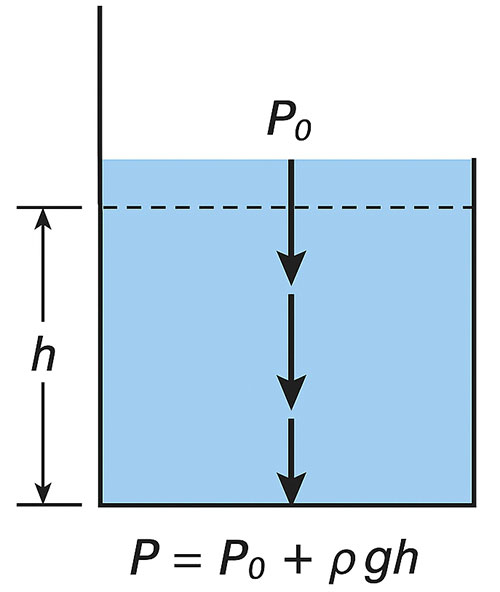
Now, the pressure at depth [h] is given by:
[
P = P₀ + ρgh
]
This equation shows that:
- The pressure increases linearly with depth,
- The rate of increase is proportional to the density and gravity,
- Pascal’s Law applies only locally, i.e., between points at the same depth.
Therefore:
If two points are at the same depth in the same fluid, the pressure is the same:
[P₁ = P₂]
even when gravity acts.
3. Dimensions and Units
| Quantity | Symbol | Dimensions | SI Unit |
|---|---|---|---|
| Pressure | P | [M¹ L⁻¹ T⁻²] | Pascal (Pa) |
| Density | ρ | [M¹ L⁻³] | kg/m³ |
| Acceleration due to gravity | g | [L¹ T⁻²] | m/s² |
| Depth | h | [L¹] | m |
4. Key Features
- In the presence of gravity, pressure increases with depth.
- Pascal’s Law remains locally valid for small regions at equal depth.
- The fluid at rest maintains equilibrium due to the balance between the pressure gradient and the weight of the fluid.
- The pressure difference between two points depends only on vertical separation, not on the horizontal distance or container shape.
5. Important Formulas to Remember
| Concept | Formula | Description |
|---|---|---|
| Pressure at depth | [P = P₀ + ρgh] | Pressure increases with depth due to gravity |
| Pressure difference | [ΔP = ρgΔh] | Difference in pressure between two points at different depths |
| Hydrostatic equilibrium | [\dfrac{dP}{dh} = ρg] | Pressure gradient in a stationary fluid |
6. Conceptual Questions with Solutions
1. Why does Pascal’s Law need modification in the presence of gravity?
Because gravity causes a variation of pressure with depth, making pressure non-uniform throughout the fluid.
2. Is Pascal’s Law completely invalid when gravity acts?
No, it still holds for small regions at the same depth where the pressure difference due to gravity is negligible.
3. What causes the increase of pressure with depth?
The weight of the liquid column above the point causes higher pressure at greater depths.
4. How can we ensure equal pressure in a fluid under gravity?
By comparing points lying on the same horizontal plane in the same liquid.
5. How does the density of the fluid affect pressure variation?
Greater density results in a steeper increase in pressure with depth.
7. FAQ / Common Misconceptions
1. Does Pascal’s Law fail under gravity?
Not entirely; it remains valid locally at constant depth.
2. Is pressure the same everywhere in a liquid under gravity?
No, it increases with depth.
3. Does pressure depend on the shape of the container?
No, it depends only on depth, density, and gravity.
4. Why does water leak more strongly from the bottom holes of a tank?
Because pressure is greatest at greater depths.
5. Can two fluids at the same depth have the same pressure?
Only if they have the same density.
8. Practice Questions (with Step-by-Step Solutions)
Q1. Find the pressure at a depth of [50 m] in the ocean where the density of seawater is [1025 kg/m³].
Solution:
[P = ρgh] [= 1025 × 9.8 × 50] [= 5.0125 × 10^5 , \text{Pa}]
Q2. If the pressure at the surface is [1.013 × 10⁵ Pa], find the total pressure at the same depth as above.
[P] [= P₀ + ρgh] [= 1.013×10^5 + 5.0125×10^5] [= 6.025×10^5 , \text{Pa}]
Q3. Why do dams have thicker bases?
Answer:
Because pressure at the bottom is greater due to greater depth, so the structure must withstand higher force.
 Sign in with Google