

1. Concept Overview
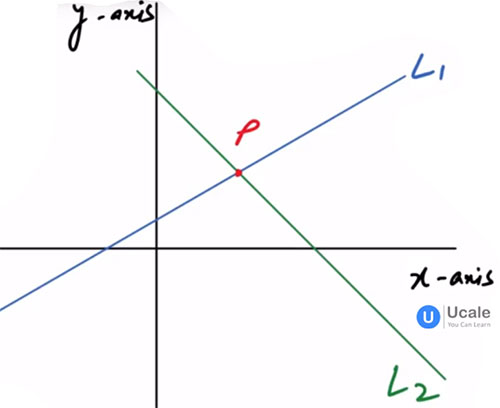
The point of intersection of two straight lines is the common point that satisfies the equations of both lines simultaneously.
Geometrically, it represents the point where the two lines meet or cross each other.
2. Mathematical Explanation and Derivation
General Form of Two Lines
Let the two lines be:
- Line 1: [a_1 x + b_1 y + c_1 = 0]
- Line 2: [a_2 x + b_2 y + c_2 = 0]
The coordinates [(x, y)] of the point of intersection must satisfy both equations.
Method: Solving Simultaneous Linear Equations
We solve:
[a_1 x + b_1 y = −c_1]
[a_2 x + b_2 y = −c_2]
Using elimination or substitution method, we obtain the unique solution [(x, y)].
Determinant Form (Most Important for Exams)
[x = \dfrac{b_1 c_2 – b_2 c_1}{a_1 b_2 – a_2 b_1},][\quad][y = \dfrac{a_2 c_1 – a_1 c_2}{a_1 b_2 – a_2 b_1}]
This formula is valid only when:
[a_1 b_2 − a_2 b_1 ≠ 0]
3. Key Features and Observations
- If two lines intersect, they have exactly one common point
- If determinant [a_1 b_2 − a_2 b_1 = 0], lines do not intersect
- Intersection point is independent of scale of equations
- Parallel lines have no point of intersection
- Coincident lines have infinitely many intersection points
4. Important Results to Remember
| Condition | Interpretation |
|---|---|
| [a_1 b_2 − a_2 b_1 ≠ 0] | Unique intersection |
| [a_1 b_2 − a_2 b_1 = 0] and ratios unequal | Parallel |
| [a_1/a_2 = b_1/b_2 = c_1/c_2] | Coincident |
5. Conceptual Questions with Detailed Solutions
1. Why does solving two line equations give their point of intersection?
A point on a line satisfies its equation.
The intersection point lies on both lines, so it must satisfy both equations simultaneously. Hence solving them together gives the intersection.
2. Why does determinant zero imply no unique intersection?
When [a_1 b_2 − a_2 b_1 = 0], the equations become dependent, meaning either:
no solution (parallel), or
infinitely many solutions (coincident)
3. Can two lines intersect at more than one point?
No.
If two distinct straight lines intersect at more than one point, they must coincide completely.
4. Does changing the form of equation affect the intersection point?
No.
Multiplying an equation by a non-zero constant does not change the geometric line, hence the intersection point remains unchanged.
5. Why do parallel lines never intersect?
Parallel lines have equal slopes but different intercepts, so their equations are inconsistent and never satisfy simultaneously.
7. FAQ / Common Misconceptions (Deep Exam Points)
1. Students assume determinant zero always means coincident lines.
Incorrect.
Determinant zero only means no unique solution. You must check ratios of coefficients.
2. Forgetting to convert equations into standard form.
Always rearrange equations to [ax + by + c = 0] before comparison.
3. Sign errors in determinant calculation.
A small sign mistake can completely change the result.
Write steps clearly.
4. Confusing intersection with shortest distance.
Intersection deals with common solution, not distance.
5. Assuming all non-parallel lines intersect inside the graph.
They always intersect mathematically, even if the point lies outside the drawn region.
8. Practice Questions with Full Step-by-Step Solutions
Question 1: Find the point of intersection of the lines [2x + 3y − 11 = 0] and [x − y + 1 = 0].
Step-by-Step Solution:
1. Rewrite equations:
[2x + 3y = 11]
[x − y = −1]
2. Multiply second equation by 3:
[3x − 3y = −3]
3. Add both equations:
[5x = 8]
4. Solve for [x]:
[x = 8/5]
5. Substitute in [x − y = −1]:
[8/5 − y = −1]
[y = 13/5]
Answer: Point of intersection is [(8/5, 13/5)].
Question 2: Find the point of intersection of [3x − 2y = 4] and [2x + y = 5].
Step-by-Step Solution:
1. Write equations:
[3x − 2y = 4]
[2x + y = 5]
2. Multiply second equation by 2:
[4x + 2y = 10]
3. Add equations:
[7x = 14]
4. Solve:
[x = 2]
5. Substitute in [2x + y = 5]:
[4 + y = 5 ⇒ y = 1]
Answer: [(2, 1)]
Question 3: Find the point of intersection of [x + y = 6] and [x − y = 2].
Step-by-Step Solution:
1. Add both equations:
[2x = 8]
2. Solve:
[x = 4]
3. Substitute in [x + y = 6]:
[4 + y = 6 ⇒ y = 2]
Answer: [(4, 2)]
Question 4: Find the point of intersection of [4x − y = 5] and [2x + y = 7].
Step-by-Step Solution:
1. Add equations:
[6x = 12]
2. Solve:
[x = 2]
3. Substitute in [2x + y = 7]:
[4 + y = 7 ⇒ y = 3]
Answer: [(2, 3)]
Question 5: Find the point of intersection of [5x + y = 1] and [3x − y = 11].
Step-by-Step Solution:
1. Add equations:
[8x = 12]
2. Solve:
[x = 3/2]
3. Substitute in [5x + y = 1]:
[15/2 + y = 1]
[y = −13/2]
Answer: [(3/2, −13/2)]
Question 6: Find the point of intersection of [2x − y = 1] and [x + y = 5].
Step-by-Step Solution:
1. Add equations:
[3x = 6]
2. Solve:
[x = 2]
3. Substitute in [x + y = 5]:
[2 + y = 5 ⇒ y = 3]
Answer: [(2, 3)]
Question 7: Find the point of intersection of [7x + y = 10] and [2x − y = 1].
Step-by-Step Solution:
1. Add equations:
[9x = 11]
2. Solve:
[x = 11/9]
3. Substitute in [2x − y = 1]:
[22/9 − y = 1]
[y = 13/9]
Answer: [(11/9, 13/9)]
Question 8: Find the point of intersection of [3x + 4y = 10] and [5x − 4y = 6].
Step-by-Step Solution:
1. Add equations:
[8x = 16]
2. Solve:
[x = 2]
3. Substitute in [3x + 4y = 10]:
[6 + 4y = 10]
[y = 1]
Answer: [(2, 1)]
Question 9: Find the point of intersection of [x − 2y = 4] and [3x + 2y = 8].
Step-by-Step Solution:
1. Add equations:
[4x = 12]
2. Solve:
[x = 3]
3. Substitute in [x − 2y = 4]:
[3 − 2y = 4]
[y = −1/2]
Answer: [(3, −1/2)]
Question 10: Find the point of intersection of [4x + 3y = 1] and [2x − 3y = 11].
Step-by-Step Solution:
1. Add equations:
[6x = 12]
2. Solve:
[x = 2]
3. Substitute in [4x + 3y = 1]:
[8 + 3y = 1]
[y = −7/3]
Answer: [(2, −7/3)]
 Sign in with Google