

1. Statement of the Concept
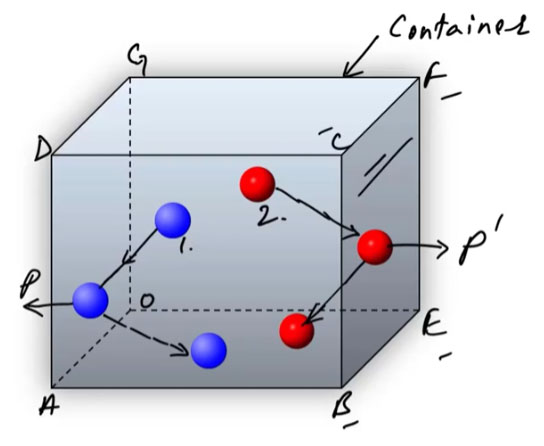
The pressure of a gas is the force exerted per unit area by the molecules of the gas when they collide elastically with the walls of the container.
Mathematically,
[
p = \dfrac{F}{A}
]
where
- [p] → pressure of the gas
- [F] → total normal force exerted by gas molecules
- [A] → area of the container’s wall
2. Clear Explanation and Mathematical Derivation
Consider a cubical container of side [l] filled with a gas having [N] molecules, each of mass [m].
Let the root mean square velocity of the molecules be [c].
Each molecule moves in random directions and collides elastically with the walls.
We derive pressure due to molecular motion as follows.
Step 1: Force by a single molecule
For a molecule moving along the x-axis with velocity [v_x]:
- Momentum before striking the wall = [m v_x]
- Momentum after rebounding = [-m v_x]
Hence, change in momentum = [2 m v_x]
Time between two successive collisions with the same wall = [\dfrac{2l}{v_x}]
[\text{Force on the wall by one molecule}] [= \dfrac{\text{Change in momentum}}{\text{Time interval}}] [= \dfrac{m v_x^2}{l}]
Step 2: Force by all molecules
If there are [N] molecules in the container, and the average of [v_x^2] over all molecules is [\overline{v_x^2}], then:
[F = \dfrac{N m \overline{v_x^2}}{l}]
Step 3: Pressure on the wall
Since [A = l^2],
[p = \dfrac{F}{A}] [= \dfrac{N m \overline{v_x^2}}{l^3}] [= \dfrac{N m \overline{v_x^2}}{V}]
But in three dimensions,
[\overline{v^2}] [= \overline{v_x^2} + \overline{v_y^2} + \overline{v_z^2}] [= 3\overline{v_x^2}]
Therefore,
[\overline{v_x^2}] [= \dfrac{1}{3}\overline{v^2}]
Substituting,
[p] [= \dfrac{1}{3}\dfrac{N m \overline{v^2}}{V}]
or,
[pV] [= \dfrac{1}{3} N m \overline{v^2}]
This is the kinetic interpretation of pressure.
3. Dimensions and Units
| Quantity | Symbol | Dimensions | SI Unit |
|---|---|---|---|
| Pressure | [p] | [M L^{-1} T^{-2}] | Pascal (Pa) |
| Volume | [V] | [L^{3}] | m³ |
| Mass of a molecule | [m] | [M] | kg |
| RMS velocity | [c] | [L T^{-1}] | m/s |
4. Key Features
- Gas pressure originates due to the continuous elastic collisions of molecules with container walls.
- Pressure is proportional to both number density (N/V) and mean square velocity of molecules.
- Pressure increases when:
- Number of molecules increases
- Temperature increases (since [\overline{v^2}] increases)
- Pressure is independent of gravity for an ideal gas.
- The expression [p = \dfrac{1}{3} \rho \overline{v^2}] connects microscopic motion with macroscopic pressure.
5. Important Formulas to Remember
| Formula | Description |
|---|---|
| [p] [= \dfrac{F}{A}] | Definition of pressure |
| [p] [= \dfrac{1}{3} \dfrac{N m \overline{v^2}}{V}] | Pressure from kinetic theory |
| [p] [= \dfrac{1}{3} \rho \overline{v^2}] | In terms of density |
| [\rho = \dfrac{N m}{V}] | Density of gas |
| [pV] [= \dfrac{1}{3} N m \overline{v^2}] | Molecular interpretation of ideal gas equation |
6. Conceptual Questions with Solutions
1. What causes pressure in a gas?
Pressure in a gas arises from the **elastic collisions** of gas molecules with the walls of the container.
2. Why does pressure increase with temperature?
As temperature increases, molecular kinetic energy and velocity increase, leading to more frequent and forceful collisions with the container walls.
3. What is the relation between pressure and mean square velocity?
They are related by [p = \dfrac{1}{3} \rho \overline{v^2}], where [\rho] is the density of the gas.
4. How does doubling the number of molecules affect pressure?
If volume and temperature remain constant, doubling the number of molecules doubles the pressure ([p \propto N]).
5. Why is molecular motion assumed random?
Because in a gas, molecules move freely in all directions with equal probability, leading to isotropic pressure.
7. FAQ / Common Misconceptions
1. Does pressure depend on the size of the container?
At constant volume and temperature, the average pressure is independent of the shape of the container—it depends only on molecular density and speed.
2. Is pressure due to the weight of gas molecules?
No, gas pressure is **not due to weight** but due to the **momentum change** from molecular collisions with the container walls.
3. Can an individual molecule exert pressure?
A single molecule exerts **force**, but measurable pressure results only from the collective impact of a very large number of molecules.
4. Why does a gas leak from a small hole?
Because of the high molecular speeds, some molecules near the hole move outward, creating an **outward flux** of gas.
5. Does the gas pressure act only upward or downward?
No, gas pressure acts **equally in all directions** due to random molecular motion (isotropic nature).
8. Practice Questions (with Step-by-Step Solutions)
Q1. The density of oxygen gas is [1.43 , kg/m^3] and the RMS velocity is [480 , m/s]. Find the pressure.
Solution:
[p] [= \dfrac{1}{3} \rho c^2] [= \dfrac{1}{3} \times 1.43 \times (480)^2] [= 1.10 \times 10^5 \,Pa]
Q2. If the average velocity of a gas is doubled, what happens to the pressure (keeping density constant)?
[p \propto \overline{v^2}] [\Rightarrow p \text{ becomes four times.}]
Q3. A gas exerts a pressure of [2 \times 10^5 \, Pa] in a 2 L container. Find the total force on one wall of area [0.02\,m^2].
[F] [= pA] [= 2 \times 10^5 \times 0.02 = 4000 \,N]
Q4. What is the relationship between the RMS velocity and temperature?
From kinetic theory: [\dfrac{1}{2} m \overline{v^2}] [= \dfrac{3}{2} kT], hence [\overline{v^2} \propto T].
Q5. Why does a football feel harder when heated?
Because heating increases molecular motion and hence internal pressure.
 Sign in with Google