


1. Concept Overview
The Principle of Conservation of Angular Momentum states that if the net external torque acting on a system is zero, the total angular momentum of the system remains constant in both magnitude and direction.
Mathematically:
[ \vec{\tau}{\text{ext}} = \dfrac{d\vec{L}}{dt} ]
If [ \vec{\tau}{\text{ext}} = 0 ], then [ \dfrac{d\vec{L}}{dt} = 0 \Rightarrow \vec{L} = \text{constant} ]
2. Key Features
- Applies to isolated systems: No external torque should act.
- Internal forces (like tensions or normal forces between system parts) cannot change total angular momentum.
- Analogous to conservation of linear momentum when no external force acts.
- Helps explain real-life phenomena like:
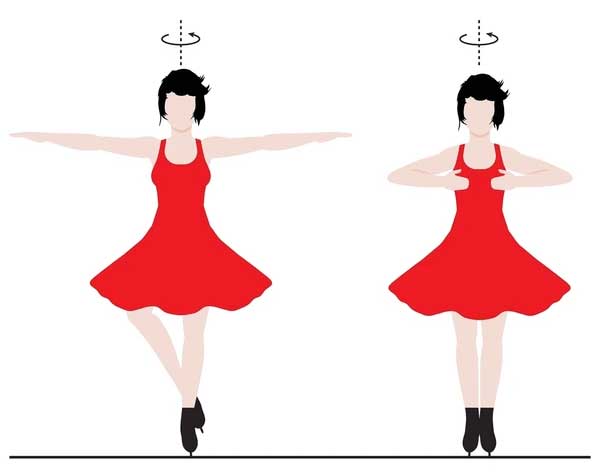
- A figure skater spinning faster when arms are pulled in.
- A collapsing star forming a rapidly spinning neutron star.
- A diver tucking in to rotate faster during a flip.
3. Derivation
From the fundamental relation:
[ \vec{\tau} = \dfrac{d\vec{L}}{dt} ]
If net external torque [ \vec{\tau}_{\text{ext}} = 0 ], then:
[ \dfrac{d\vec{L}}{dt} = 0 \Rightarrow \vec{L} = \text{constant} ]
That is, the total angular momentum before and after an event remains the same:
[ \boxed{ \vec{L}{\text{initial}} = \vec{L}{\text{final}} } ]
4. Important Formulas to Remember
| Formula | Description |
|---|---|
| [ \vec{L} = I \vec{\omega} ] | Definition of angular momentum for a rigid body. |
| [ \vec{\tau}_{\text{ext}} = \dfrac{d\vec{L}}{dt} ] | Net external torque equals rate of change of angular momentum. |
| [ \vec{\tau}_{\text{ext}} = 0 \Rightarrow \vec{L} = \text{constant} ] | Angular momentum remains conserved when external torque is zero. |
| [ I_1 \omega_1 = I_2 \omega_2 ] | Conservation relation when the moment of inertia changes but no torque acts. |
| [ \omega_2 = \dfrac{I_1}{I_2} \omega_1 ] | Relation between initial and final angular velocity for changing moment of inertia. |
5. Conceptual Questions
1. What does the conservation of angular momentum state?
It states that if the net external torque on a system is zero, its total angular momentum remains constant.
2. What is the condition for angular momentum to be conserved?
The net external torque acting on the system must be zero.
3. How does a skater spin faster when pulling in her arms?
Her moment of inertia decreases, so angular velocity increases to conserve angular momentum.
4. What happens to angular velocity when moment of inertia decreases?
Angular velocity increases to keep [ I \omega = \text{constant} ].
5. Can angular momentum change without torque?
No, only an external torque can change angular momentum.
6. What type of quantity is angular momentum?
It is a vector quantity having both magnitude and direction.
7. Why is angular momentum conserved in planetary motion?
Because the gravitational force acts through the center, so external torque is zero.
8. How is conservation of angular momentum analogous to Newton’s first law?
Both describe constant momentum (linear or angular) in absence of external influence.
9. Why does a diver spin faster when tucking in?
The moment of inertia decreases, causing an increase in angular velocity to keep [ L ] constant.
10. What happens to angular velocity if moment of inertia doubles?
It becomes half of its initial value if no external torque acts.
11. Is conservation of angular momentum applicable in non-inertial frames?
No, it strictly applies in inertial reference frames.
12. What is the role of internal torques in conservation of angular momentum?
Internal torques cancel each other and do not affect total angular momentum.
13. Why does an ice skater slow down when stretching arms outward?
Her moment of inertia increases, so angular velocity decreases to conserve [ L ].
14. What is conserved when a ballerina spins faster by pulling in arms?
Total angular momentum is conserved.
15. How does conservation of angular momentum explain neutron stars spinning fast?
The collapse reduces radius drastically, decreasing moment of inertia and increasing angular velocity.
FAQ / Common Misconceptions
1. Is angular momentum always conserved?
No, it is conserved only if the net external torque on the system is zero.
2. Can internal forces violate conservation of angular momentum?
No, internal forces cannot change total angular momentum as they occur in equal and opposite pairs.
3. Does conservation mean angular velocity is constant?
Not necessarily. Angular velocity changes if moment of inertia changes, but their product [ I\omega ] remains constant.
4. If a body changes shape, is angular momentum still conserved?
Yes, if no external torque acts, even with changing shape.
5. Does conservation depend on mass of the object?
No, it depends on the absence of external torque, not the mass of the body.
Practice Questions (with Solutions)
Q1. A skater with a moment of inertia [ 4 , \text{kg·m}^2 ] is spinning with [ \omega_1 = 2 , \text{rad/s} ]. When she pulls in her arms, her moment of inertia reduces to [ 1 , \text{kg·m}^2 ]. Find her new angular velocity.
Solution:
[ I_1 \omega_1 = I_2 \omega_2 ]
[ 4 \times 2 = 1 \times \omega_2 ]
[ \Rightarrow \omega_2 = 8 , \text{rad/s} ]
Q2. A gymnast rotating with angular momentum [ 12 , \text{kg·m}^2/\text{s} ] changes her moment of inertia from [ 3 , \text{kg·m}^2 ] to [ 2 , \text{kg·m}^2 ]. Find initial and final angular velocities.
Solution:
[ L = I \omega ]
Initially, [ \omega_1 = \dfrac{12}{3} = 4 , \text{rad/s} ]
Finally, [ \omega_2 = \dfrac{12}{2} = 6 , \text{rad/s} ]
Q3. A star collapses from radius [ 10^6 , \text{m} ] to [ 10^4 , \text{m} ] maintaining its angular momentum. If its initial period is [ 30 , \text{days} ], find its final period.
Solution:
[ I \propto R^2 ]
[ I_1 \omega_1 = I_2 \omega_2 \Rightarrow R_1^2 \omega_1 = R_2^2 \omega_2 ]
[ \Rightarrow \omega_2 = \omega_1 \left( \dfrac{R_1}{R_2} \right)^2 = \omega_1 (100)^2 = 10^4 \omega_1 ]
Hence, [ T_2 = \dfrac{T_1}{10^4} = \dfrac{30 \times 24 \times 3600}{10^4} \approx 260 , \text{s} ]
Q4. A disk of [ I = 2 , \text{kg·m}^2 ] rotating at [ 10 , \text{rad/s} ] explodes into two parts of equal mass which fly apart symmetrically. Is total angular momentum conserved?
Solution:
Yes. Since no external torque acts, total angular momentum remains conserved even though internal forces act.
Q5. A man stands on a rotating platform holding two dumbbells. When he stretches his arms out, his rotation slows. Explain why.
Solution:
Stretching arms increases the moment of inertia [ I ], and since [ L = I\omega ] is constant, [ \omega ] decreases.
 Sign in with Google