

1. Concept Overview (Beginner-Friendly)
In an alternating current (AC), the value of current keeps changing continuously — it increases, decreases, becomes zero, and even reverses direction.
So, we cannot talk about “a constant value” of AC the way we do for DC.
However, we still need one single number to tell how strong an AC is.
This is why we define the r.m.s. value.
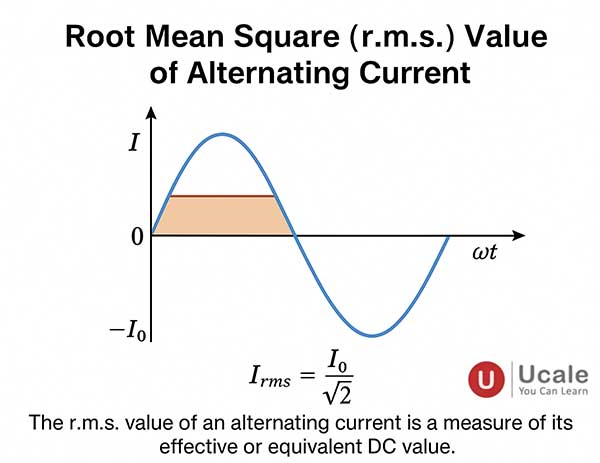
The r.m.s. current of an AC is the value of a DC current that would produce the same heating effect in a resistor as the AC produces.
For example:
If an AC current and a DC current both heat a resistor equally, they have the same r.m.s. value.
This is why r.m.s. value is also called:
- Effective value
- Heating value
- Equivalent DC value
For a sinusoidal AC, the r.m.s. value turns out to be:
[I_{\text{rms}}] [= \dfrac{I_0}{\sqrt{2}}]
where [I_0] is the peak (maximum) current.
2. Clear Explanation and Mathematical Derivation
Consider a sinusoidal alternating current:
[i(t) = I_0 \sin(\omega t)]
The definition of r.m.s. value is:
[I_{\text{rms}}] [= \sqrt{\dfrac{1}{T} \displaystyle \int_0^T i^2(t), dt}]
For one full cycle, substitute:
[i^2(t)] [= I_0^2 \sin^2(\omega t)]
So,
[I_{\text{rms}}] [= \sqrt{\dfrac{1}{T} \displaystyle \int_0^T I_0^2\sin^2(\omega t) dt}]
Take constants outside the integral:
[I_{\text{rms}}] [= I_0\sqrt{\dfrac{1}{T} \displaystyle \int_0^T \sin^2(\omega t), dt}]
We know:
[\sin^2(\omega t)] [= \dfrac{1}{2}(1 – \cos(2\omega t))]
Thus,
[I_{\text{rms}}] [= I_0 \sqrt{\dfrac{1}{T} \displaystyle \int_0^T \dfrac{1}{2}(1 – \cos(2\omega t)) dt}]
Split the integral:
[I_{\text{rms}}] [= I_0 \sqrt{\dfrac{1}{2T} \displaystyle \int_0^T (1 – \cos(2\omega t)) dt}]
Integrate:
[\displaystyle \int_0^T 1 dt = T]
[\displaystyle \int_0^T \cos(2\omega t) dt] [= 0]
Thus,
[I_{\text{rms}}] [= I_0\sqrt{\dfrac{1}{2T}(T)}] [= I_0\sqrt{\dfrac{1}{2}}]
So the final result is:
[\boxed{[I_{\text{rms}} = \dfrac{I_0}{\sqrt{2}}]}]
3. Dimensions and Units
- Dimension of Current:
[I] = [A] = [\text{Ampere}] - r.m.s. value has the same unit as current:
Ampere (A)
4. Key Features
- r.m.s. value gives the effective magnitude of AC.
- It is equal to the DC value that produces the same Joule heating.
- For sinusoidal AC:
- Peak value = [I_0]
- Average value (half-wave) = [\dfrac{2I_0}{\pi}]
- r.m.s. value = [\dfrac{I_0}{\sqrt{2}}]
- r.m.s. value is always:
[I_{\text{rms}} > I_{\text{mean}}] - Used extensively in power calculations:
[P = I_{\text{rms}}^2 R]
5. Important Formulas to Remember
| Quantity | Formula | For Sinusoidal AC |
|---|---|---|
| Instantaneous Current | [i(t) = I_0\sin\omega t] | — |
| Mean (Half Cycle) | [I_{\text{mean}}] [= \dfrac{2I_0}{\pi}] | ≈ 0.637 ([I_0]) |
| r.m.s. Value | [I_{\text{rms}}] [= \dfrac{I_0}{\sqrt{2}}] | ≈ 0.707 ([I_0]) |
| Peak to r.m.s. ratio | [I_0 : I_{\text{rms}}] [= \sqrt{2}:1] | — |
6. Conceptual Questions with Solutions
1. Why do we define r.m.s. value for AC?
Because AC keeps changing direction and magnitude, we cannot describe its strength using an average. The r.m.s. value gives the **equivalent DC value** that produces the same heating effect.
2. What physical phenomenon does r.m.s. value relate to?
R.m.s. value relates to **Joule heating**: [P = I^2R] Since heating depends on [I^2], we average the square of current.
3. Is r.m.s. value always greater than mean value?
Yes, for sinusoidal AC: [I_{\text{mean}} = 0.637I_0] [,\quad] [I_{\text{rms}} = 0.707I_0]
4. Why do we square the current before averaging?
Because heating depends on power [P = I^2R]. Taking average of [I^2] reflects true physical effect.
5. What is the root-mean-square step?
1. Square the current 2. Take its mean over one period 3. Take square root Hence “root-mean-square”.
6. Why does the cosine term vanish in the derivation?
Because the integral of cosine over one full period is zero.
7. Why is r.m.s. value also called effective value?
Because it shows the **effect** (heat produced) is same as that of a DC current.
8. Does r.m.s. depend on frequency?
No. For sinusoidal shape, r.m.s. value depends only on amplitude [I_0].
9. What is the r.m.s. value of a pure DC current?
Same as the DC value: [I_{\text{rms}} = I_{\text{DC}}]
10. What is the significance of the factor [\dfrac{1}{\sqrt{2}}]?
It shows the r.m.s. value is **0.707 times** the peak value for a pure sine wave.
11. Is r.m.s. value affected if waveform becomes distorted?
Yes, r.m.s. depends on the square of current — distortion changes the value.
12. Why do electronic devices specify current ratings in r.m.s.?
Because heating determines safety limits, and heating depends on r.m.s. current.
13. Can two AC currents have same r.m.s. value but different peaks?
Yes. Only heating effect must match; their amplitudes may differ.
14. What is r.m.s. value of half-wave AC?
[I_{\text{rms}} = \dfrac{I_0}{2}] (Useful for rectifier circuits.)
15. Does an ordinary ammeter read r.m.s. value?
Most AC meters are calibrated to read r.m.s. **assuming sine wave**. True-RMS meters calculate actual r.m.s.
7. FAQ / Common Misconceptions (10)
1. “R.m.s. is just average.” — True?
No. Average of AC over full cycle is zero, but r.m.s. ≠ 0.
2. “Peak value is more useful than r.m.s. value.”
Peak tells the maximum value, but r.m.s. tells **usable** (effective) value.
3. “R.m.s. depends on frequency.”
Not for sinusoidal AC — only amplitude matters.
4. “Average value of AC equals its r.m.s. value.”
Incorrect. [I_{\text{mean}}] [= 0.637I_0] [,\quad] [I_{\text{rms}}] [= 0.707I_0]
5. “R.m.s. is hard to measure.”
Modern meters compute it easily using electronics.
6. “R.m.s. value equals peak value for sine wave.”
Incorrect: [I_{\text{rms}} = 0.707I_0]
7. “R.m.s. formula is same for all waveforms.”
General formula same, but values differ for different shapes.
8. “More peak value means more heating.”
Not necessarily — heating depends on r.m.s., not peak.
9. “Average value tells the effective magnitude.”
Only r.m.s. value tells effective magnitude for AC.
10. “r.m.s. is different from effective value.”
They are the **same thing**.
8. Practice Questions (With Step-by-Step Solutions)
Q1. A sinusoidal AC has peak current ([I_0 = 10A]). Find its r.m.s. current.
Solution:
[I_{\text{rms}}] [= \dfrac{I_0}{\sqrt{2}}] [= \dfrac{10}{1.414}] [= 7.07 A]
Q2. If r.m.s. current is ([5A]), find the peak value.
[I_0 = \sqrt{2}I_{\text{rms}}] [= 1.414 \times 5 = 7.07A]
Q3. A resistor of ([10 \Omega]) is connected to an AC source of peak current ([4A]). Find power.
[I_{\text{rms}}] [= \dfrac{4}{\sqrt{2}}] [= 2.828A]
[P = I_{\text{rms}}^2 R] [= (2.828)^2 \times 10] [= 80W]
Q4. Two AC currents:
- ([I_{01} = 4,A])
- ([I_{02} = 6,A])
Which produces more heating?
Calculate r.m.s.:
[I_{\text{rms1}} = 2.828A] [,\quad] [I_{\text{rms2}} = 4.242A]
Higher r.m.s. → more heating → second current.
Q5. A device needs ([3A]) DC to work. What peak AC value is needed?
[3 = \dfrac{I_0}{\sqrt{2}}] [\Rightarrow I_0 = 3\sqrt{2}] [= 4.24 A]
 Sign in with Google