

1. Concept Overview
A satellite is a body that revolves around a planet in a fixed orbit under the influence of gravitational force.
Satellites are of two types:
- Natural satellites: e.g., Moon (Earth’s natural satellite).
- Artificial satellites: Man-made objects launched into orbit for communication, research, navigation, weather observation, etc.
The principle of launching a satellite is based on Newton’s Law of Gravitation and the centripetal force concept from circular motion.
2. Explanation and Mathematical Derivation
(a) Gravitational Force as the Centripetal Force
When a satellite of mass [m] revolves around the Earth (mass [M_E]) in a circular orbit of radius [r], the gravitational force provides the necessary centripetal force:
[
\dfrac{G M_E m}{r^2} = \dfrac{m v^2}{r}
]
Simplifying:
[
v = \sqrt{\dfrac{G M_E}{r}}
]
This velocity is called the orbital velocity of the satellite.
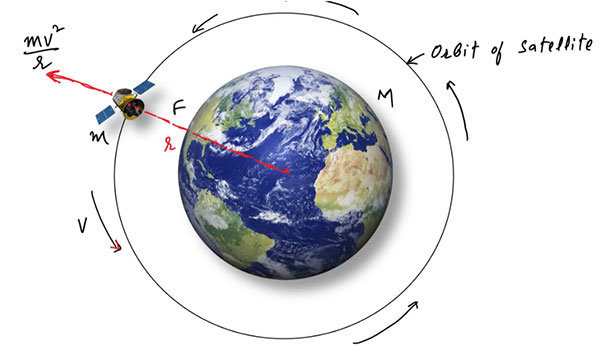
👉 (Refer to the topic Orbital Velocity for detailed derivation and applications.)
(b) Principle of Launching a Satellite
A satellite is launched so that it attains sufficient horizontal velocity to ensure that its centripetal acceleration equals gravitational acceleration at the orbit’s altitude.
Steps involved in launching:
- Launch Vehicle Preparation: A multi-stage rocket carries the satellite to the required altitude.
- Initial Vertical Motion: The rocket lifts the satellite to reduce atmospheric drag.
- Attaining Orbital Velocity: Once at the correct altitude, engines fire horizontally to give the satellite tangential velocity [v = \sqrt{\dfrac{G M_E}{r}}].
- Orbit Insertion: When the satellite’s velocity and altitude satisfy orbital conditions, engines shut down, and it remains in stable orbit.
- Centripetal-Gravitational Balance:
[\text{Centripetal Force}] [= \text{Gravitational Force}] [\Rightarrow \dfrac{m v^2}{r}] [= \dfrac{G M_E m}{r^2}]
(c) Altitude of the Satellite
Let [h] be the height of the satellite above the Earth’s surface.
[
r = R_E + h
]
Thus,
[
v = \sqrt{\dfrac{G M_E}{R_E + h}}
]
(d) Period of Revolution
The time period [T] of revolution is given by:
[T = \dfrac{2 \pi r}{v}] [= 2 \pi \sqrt{\dfrac{r^3}{G M_E}}]
👉 (Refer to Kepler’s Third Law to see how this relation connects with orbital motion.)
3. Dimensions and Units
| Quantity | Symbol | Dimensions | SI Unit |
|---|---|---|---|
| Gravitational Constant | [G] | [M^{-1} L^3 T^{-2}] | [N·m²/kg²] |
| Orbital Velocity | [v] | [L T^{-1}] | [m/s] |
| Time Period | [T] | [T] | [s] |
| Radius of Orbit | [r] | [L] | [m] |
4. Key Features
- The gravitational force acts as the centripetal force.
- The satellite’s orbital speed depends only on the mass of Earth and radius of orbit, not on the mass of the satellite.
- The higher the orbit, the lower the speed and longer the period.
- No propulsion is needed in orbit once launched — only gravity maintains motion.
- Launching angle, fuel efficiency, and escape velocity determine success.
- Satellite motion obeys Newton’s laws and Kepler’s laws.
- Satellites are launched eastward to utilize Earth’s rotation.
- Atmospheric drag is negligible beyond 200 km.
- Geostationary satellites orbit with period 24 hours (refer to Geostationary Satellite topic).
- A balance of energy and force ensures orbital stability.
5. Important Formulas to Remember
| Concept | Formula | Remark |
|---|---|---|
| Centripetal Force = Gravitational Force | [\dfrac{m v^2}{r}] [= \dfrac{G M_E m}{r^2}] | Fundamental balance |
| Orbital Velocity | [v = \sqrt{\dfrac{G M_E}{r}}] | Independent of satellite mass |
| Orbital Radius | [r = R_E + h] | Radius from Earth’s center |
| Time Period | [T = 2 \pi \sqrt{\dfrac{r^3}{G M_E}}] | Follows Kepler’s law |
| Gravitational Acceleration | [g = \dfrac{G M_E}{R_E^2}] | At Earth’s surface |
| Launch Condition | [\text{Centripetal Force}] [= \text{Gravitational Force}] | Stability criterion |
6. Conceptual Questions with Solutions
1. What is a satellite?
A satellite is a body that revolves around a planet under the influence of gravitational force.
2. What are the two types of satellites?
Natural satellites (like the Moon) and artificial satellites (like INSAT, GPS, etc.).
3. What provides the centripetal force for satellite motion?
The gravitational attraction of Earth.
4. On what factors does orbital velocity depend?
It depends on Earth’s mass [M_E] and orbital radius [r], not on satellite’s mass.
5. Why are satellites launched eastward?
To take advantage of Earth’s rotational velocity and save fuel.
6. What is the significance of orbital velocity?
It is the minimum tangential velocity required to keep a satellite in a stable orbit.
7. Why must a rocket first move vertically before tilting horizontally?
To reduce atmospheric resistance and reach the thin upper atmosphere safely.
8. What happens if a satellite’s velocity is less than orbital velocity?
It will fall back to Earth.
9. What happens if a satellite’s velocity is greater than orbital velocity?
It will move to a higher orbit or escape Earth’s gravity if it exceeds escape velocity.
10. Why doesn’t a satellite fall to Earth?
Because its tangential velocity produces centripetal acceleration equal to gravitational acceleration.
11. What is meant by orbit insertion?
It is the process of placing a satellite into its desired orbit by adjusting velocity and altitude.
12. How does altitude affect orbital period?
Higher altitude → larger orbital radius → longer period.
13. What is the relation between orbital velocity and radius?
[v \propto \dfrac{1}{\sqrt{r}}].
14. What are geostationary satellites?
Satellites with 24-hour period revolving above the equator, appearing stationary relative to Earth.
15. Why is a vacuum necessary for satellite stability?
To minimize air drag, which otherwise slows down the satellite.
7. FAQ / Common Misconceptions
1. Satellites have no gravity acting on them.
❌ Gravity is the only force acting on them — it provides centripetal force.
2. A satellite moves because engines are always running.
❌ Once in orbit, no thrust is required; gravity maintains motion.
3. Orbital velocity depends on the satellite’s mass.
❌ It depends only on Earth’s mass and orbital radius.
4. Satellites can stay still above any location.
❌ Only geostationary satellites stay fixed relative to Earth’s surface.
5. Satellites beyond the atmosphere feel no gravity.
❌ Gravity extends infinitely, though it weakens with distance.
6. If a satellite’s engine fails, it will immediately fall.
❌ No — it continues orbiting due to inertia unless air drag or perturbation acts.
7. All satellites have the same orbital period.
❌ Orbital period depends on altitude.
8. The Moon does not experience Earth’s gravity.
❌ The Moon is bound to Earth due to gravity.
9. Satellites orbit above Earth’s gravity.
❌ They orbit *within* the gravitational field.
10. Launching direction doesn’t matter.
❌ Launching eastward helps due to Earth’s rotation, reducing fuel consumption.
8. Practice Questions (With Step-by-Step Solutions)
Q1. A satellite orbits Earth at a height of [600km]. Find its orbital velocity.
[R_E = 6.4 \times 10^6m], [h = 6 \times 10^5m], [G M_E = 3.986 \times 10^{14}m^3/s^2]
[r = R_E + h = 7.0 \times 10^6,m]
[v = \sqrt{\dfrac{G M_E}{r}}] [= \sqrt{\dfrac{3.986 \times 10^{14}}{7.0 \times 10^6}}] [= 7.55 \times 10^3m/s]
Answer: [v = 7.55km/s]
Q2. Find the orbital period for the same satellite.
[T = 2 \pi \sqrt{\dfrac{r^3}{G M_E}}] [= 2 \pi \sqrt{\dfrac{(7.0 \times 10^6)^3}{3.986 \times 10^{14}}}] [= 5.8 \times 10^3s]
Answer: [T = 96.6minutes]
Q3. What should be the velocity of a satellite at an altitude equal to Earth’s radius?
[
r = 2 R_E = 1.28 \times 10^7,m
]
[v = \sqrt{\dfrac{G M_E}{r}}] [= \sqrt{\dfrac{3.986 \times 10^{14}}{1.28 \times 10^7}}] [= 5.6 \times 10^3m/s]
Answer: [v = 5.6km/s]
Q4. A satellite is launched horizontally at 7.9 km/s near Earth’s surface. What happens?
That is the orbital velocity near the surface; it will revolve around Earth in a circular orbit.
Q5. What if the velocity exceeds 11.2 km/s?
It will escape Earth’s gravity — reaching the escape velocity. (Refer to topic Escape Velocity for full explanation.)
 Sign in with Google