


1. Statement of the Concept: Self Induction
Self-induction is the phenomenon by which a changing current in a circuit induces an emf in the same circuit. This induced emf always opposes the change in current according to Lenz’s law.
2. Clear Explanation and Mathematical Derivation
Whenever electric current in a coil changes, the magnetic field linked with the coil also changes. Therefore, the magnetic flux linked with the coil changes. According to Faraday’s law, a change in flux induces an emf.
If the coil has N turns, and the flux linked with one turn is ϕ, then the total flux linkage is:
[ N\phi = LI ]
Here L is the self-inductance of the coil.
Thus,
[ \phi = \dfrac{LI}{N} ]
Differentiating with respect to time:
[ \dfrac{d(N\phi)}{dt} = L\dfrac{dI}{dt} ]
By Faraday’s law, induced emf is:
[ e = -\dfrac{d(N\phi)}{dt} ]
Thus,
[ e = -L\dfrac{dI}{dt} ]
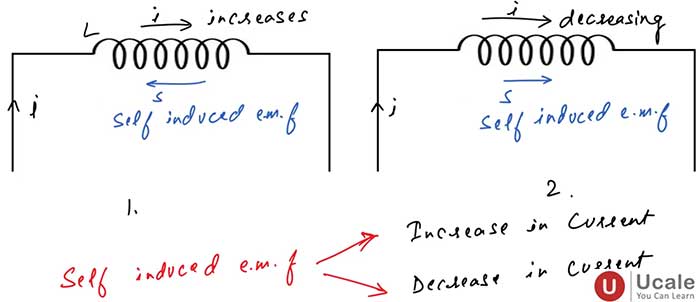
This is the emf of self-induction.
3. Dimensions and Units
Unit of Self-Inductance (L)
The SI unit is henry (H).
A coil has an inductance of 1 H if a change of current of 1 A/s induces an emf of 1 V.
Dimensional Formula
[L] = [ML^2T^{-2}A^{-2}]
4. Key Features
- A changing current creates a changing magnetic flux, inducing emf in the same circuit.
- The induced emf always opposes the change in current.
- Self-inductance depends on:
- Number of turns
- Geometry of the coil
- Permeability of the core material
- The energy stored in an inductor is:
[ U = \dfrac{1}{2}LI^2 ]
5. Important Formulas to Remember
| Concept | Formula |
|---|---|
| Induced emf due to self induction | [ e = -L\dfrac{dI}{dt} ] |
| Flux linkage | [ N\phi = LI ] |
| Energy stored in an inductor | [ U = \dfrac{1}{2}LI^2 ] |
| Definition of henry | [ 1\ \text{H} = 1\ \text{V·s/A} ] |
6. Conceptual Questions with Solutions
1. Why does self-induction oppose changes in current?
Because the induced emf follows Lenz’s law, which ensures the induced emf always opposes the change in current to conserve energy.
2. Why is self-induction stronger in coils with many turns?
More turns mean more flux linkage, so a small change in current produces a larger induced emf.
3. Why is iron used as a core in inductors?
Iron has high permeability, increasing magnetic flux and therefore increasing inductance.
4. Does self-induction occur in a straight conductor?
Yes, but it is extremely small. Coils enhance inductance by increasing flux linkage.
5. Why is the induced emf zero when current is constant?
Because [ \dfrac{dI}{dt} = 0 ], so no change in magnetic flux occurs.
6. Why does an inductor oppose AC more than DC?
AC continuously changes with time, producing large induced emf. DC becomes constant after some time.
7. Why does the energy stored depend on current squared?
Because energy depends on both the inductance and current magnitude: [ U = \dfrac{1}{2}LI^2 ].
8. Why does a coil spark when disconnected suddenly?
A sudden drop in current (large [ \dfrac{dI}{dt} ]) produces a large induced emf, causing sparking.
9. Why is self-induction called inertia of electricity?
Because it resists changes in current, similar to how mass resists changes in motion.
10. Does increasing coil resistance affect inductance?
No. Inductance depends on geometry and core material, not resistance.
7. FAQ / Common Misconceptions
1. Is induced emf present only when current increases?
No, it appears whenever current changes—whether increasing or decreasing.
2. Does larger current always mean larger induced emf?
No, emf depends on the rate of change [ \dfrac{dI}{dt} ], not the magnitude of current.
3. Does inductance produce energy?
No, it only stores energy temporarily in the magnetic field.
4. Does inductance slow down current?
Not exactly—it opposes *changes* in current, not current itself.
5. Does the induced emf act like a battery?
No, a battery produces emf due to chemical reactions; inductors produce emf due to changing flux.
6. Is inductance the same as resistance?
No. Resistance opposes current; inductance opposes changes in current.
7. Does using thicker wire increase inductance?
Not significantly. Inductance depends mainly on geometry and core material.
8. Is inductive kick always dangerous?
No, only when current changes suddenly in coils with high inductance.
9. Is the inductance of a solenoid fixed?
It can be changed by changing turns, core material, or geometry.
10. Can self-inductance be negative?
No. By definition, inductance is always positive.
8. Practice Questions (with Step-by-Step Solutions)
1. A coil has inductance 2 H. Find the emf induced when the current changes at 3 A/s.
Solution:
Use: [ e = -L\dfrac{dI}{dt} ]
[ e = -(2)(3)] [= -6\ \text{V} ]
Negative sign shows opposition.
Answer: 6 V (opposing change)
2. Current in a 0.5 H inductor drops from 4 A to 1 A in 0.2 s. Find induced emf.
Change in current:
[ \Delta I = 1 – 4] [= -3\ \text{A} ]
Rate of change:
[ \dfrac{dI}{dt} = \dfrac{-3}{0.2}] [= -15\ \text{A/s} ]
Induced emf:
[ e = -L\dfrac{dI}{dt}] [= -(0.5)(-15)] [= 7.5\ \text{V} ]
3. A coil develops an emf of 2 V when current changes at 0.4 A/s. Find its inductance.
[ L = \dfrac{e}{\dfrac{dI}{dt}}] [= \dfrac{2}{0.4}] [= 5\ \text{H} ]
4. A 1 H inductor carries 3 A current. Find energy stored.
Use:
[ U = \dfrac{1}{2}LI^2 ]
[ U = \dfrac{1}{2}(1)(3^2)] [= 4.5\ \text{J} ]
5. A 4 H inductor has current increasing uniformly from 0 A to 2 A in 1 s. Find induced emf.
Rate of change:
[ \dfrac{dI}{dt} = \dfrac{2}{1}] [= 2\ \text{A/s} ]
Induced emf:
[ e = -L\dfrac{dI}{dt}] [= -(4)(2)] [= -8\ \text{V} ]
 Sign in with Google