

1. Concept Overview
When two or more conductors are connected by a conducting wire, charges redistribute among them until they reach the same potential.
This final potential is called the common potential.
Charge flows from higher potential to lower potential until equilibrium is reached.
2. Clear Explanation and Mathematical Derivation
Consider two isolated charged conductors with:
- Charges: [Q_{1}], [Q_{2}]
- Capacitances: [C_{1}], [C_{2}]
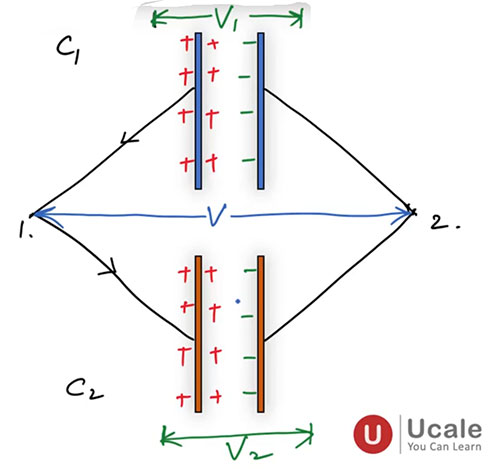
Initial potentials:
[V_{1}] [= \dfrac{Q_{1}}{C_{1}}] [, \quad V_{2}] [= \dfrac{Q_{2}}{C_{2}}]
When they are connected by a wire:
- Charges redistribute.
- But total charge is conserved:
[Q_{\text{total}}] [= Q_{1} + Q_{2}]
Let the final common potential be [V].
Each conductor finally has charge:
[Q_{1}’] [= C_{1} V] [, \quad Q_{2}’] [= C_{2} V]
Since charge is conserved:
[C_{1} V + C_{2} V] [= Q_{1} + Q_{2}]
[V] [= \dfrac{Q_{1} + Q_{2}}{C_{1} + C_{2}}]
This is the common potential.
General Case (n Conductors)
[V] [= \dfrac{Q_{1} + Q_{2} + \cdots + Q_{n}}{C_{1} + C_{2} + \cdots + C_{n}}]
Charge on the i-th conductor after sharing:
[Q_{i}’ = C_{i} V]
3. Dimensions and Units
| Quantity | Dimensions | SI Unit |
|---|---|---|
| Capacitance [C] | [M^{-1}L^{-2}T^{4}A^{2}] | Farad (F) |
| Potential [V] | [ML^{2}T^{-3}A^{-1}] | Volt (V) |
| Charge [Q] | [AT] | Coulomb (C) |
4. Key Features
- Charge flows until potentials become equal, not charges.
- Total charge remains conserved.
- Conductors with larger capacitance acquire more charge after redistribution.
- If one conductor is initially uncharged, it still acquires charge after contact.
- Some energy is always lost during charge sharing due to current flow and resistance in the connecting wire.
5. Important Formulas to Remember
| Formula | Description |
|---|---|
| [V] [= \dfrac{Q_{1} + Q_{2}}{C_{1} + C_{2}}] | Common potential of two conductors |
| [Q_{i}’ = C_{i} V] | Final charge on i-th conductor |
| [V] [= \dfrac{\sum Q_{i}}{\sum C_{i}}] | General formula for n conductors |
| [Q_{\text{total}}] [= \text{constant}] | Charge conservation |
6. Conceptual Questions with Solutions
1. Why do charges share when two conductors are connected?
Because conductors connected by a wire allow free movement of electrons. Charges move from higher potential to lower potential until both conductors reach the same potential.
2. Do two bodies reach equal charge after sharing?
No. They reach equal potential, not equal charge. Charge depends on capacitance: [Q = C V].
3. Why does a larger conductor get more charge?
Because its capacitance is larger. After sharing: [Q’ = C V]. A bigger C means more charge at the same potential.
4. Does total charge always remain the same?
Yes. Charges only redistribute; no charge is created or destroyed.
5. Why is some energy always lost during charge sharing?
Because charges flow through the wire. This current produces heat due to resistance, leading to energy loss.
6. Can a neutral conductor get charged after touching a charged one?
Yes. The charged conductor induces movement of electrons, giving the neutral conductor a non-zero charge.
7. If one conductor has negative charge and the other positive, what happens?
Charges rearrange to reach a common potential. Final charge may be positive, negative, or zero depending on values.
8. Why does potential equalize instantly?
Because electrons move extremely fast inside conductors, equilibrating potentials quickly.
9. Does the shape of conductors affect the sharing?
Yes. Shape determines capacitance, which affects how much charge a conductor finally gets.
10. What happens if conductors have infinite distance between them after connection?
Once disconnected, final charges remain fixed. Distance no longer matters.
7. FAQ / Common Misconceptions
1. “Charge divides equally between conductors.”
No. Charge divides based on capacitance, not equally.
2. “Same potential means same charge.”
False. [Q = C V]; if C differs, Q differs even if V is same.
3. “Large conductor always ends with higher potential.”
No. Both reach the same potential after sharing.
4. “Energy is conserved during charge sharing.”
Incorrect. Some energy is always lost as heat.
5. “Neutral conductor cannot be charged by contact.”
It can. Charge redistribution occurs on contact.
6. “If one conductor is very large, potential won’t change.”
True — a large conductor behaves like a reservoir; its potential changes very little.
7. “Charges stop moving when they are equal on both conductors.”
No. Charges stop moving when potentials equalize.
8. “Sign of charge always remains same after sharing.”
Not necessarily. A large opposite charge may reverse the sign of the smaller one.
9. “Sharing of charges happens only in capacitors.”
It happens with any conductors that can hold charge.
10. “Total charge becomes zero after sharing.”
Only if the sum of initial charges was zero.
8. Practice Questions (with Step-by-Step Solutions)
Q1. Two conductors have charges 6 μC and –2 μC, and capacitances 3 μF and 1 μF respectively. Find common potential.
Solution:
[V] [= \dfrac{Q_{1} + Q_{2}}{C_{1} + C_{2}}]
[V] [= \dfrac{6 – 2}{3 + 1}] [= \dfrac{4}{4}] [= 1\ \text{V}]
Q2. For the above case, find final charges.
[Q_{1}’] [= C_{1} V] [= 3 \times 1] [= 3\ \mu C]
[Q_{2}’] [= C_{2} V] [= 1 \times 1] [= 1\ \mu C]
Sum = 4 μC = total initial charge → conserved.
Q3. Two conductors have capacitances 5 μF and 10 μF, initially uncharged and 15 μC respectively. Find common potential.
[V = \dfrac{0 + 15}{5 + 10}]
[V] [= \dfrac{15}{15}] [= 1\ \text{V}]
Final charges:
[Q_{1}’] [= 5 \times 1] [= 5\ \mu C] [,\quad] [Q_{2}’ = 10 \times 1] [= 10\ \mu C]
Q4. Two spheres of capacitances 2 μF and 8 μF carry charges 10 μC and –6 μC. Find the final charge on each.
Common potential:
[V] [= \dfrac{10 – 6}{2 + 8}] [= \dfrac{4}{10}] [= 0.4\ \text{V}]
Final charges:
[Q_{1}’] [= 2 \times 0.4] [= 0.8\ \mu C]
[Q_{2}’] [= 8 \times 0.4] [= 3.2\ \mu C]
Q5. A conductor of capacitance 20 μF is connected to another conductor of 5 μF carrying 15 μC. Find final charges.
Common potential:
[V] [= \dfrac{15}{20 + 5}] [= \dfrac{15}{25}] [= 0.6\ \text{V}]
Final charges:
[Q_{1}’] [= 20 \times 0.6] [= 12\ \mu C]
[Q_{2}’] [= 5 \times 0.6] [= 3\ \mu C]
 Sign in with Google