

1. Statement / Concept Overview
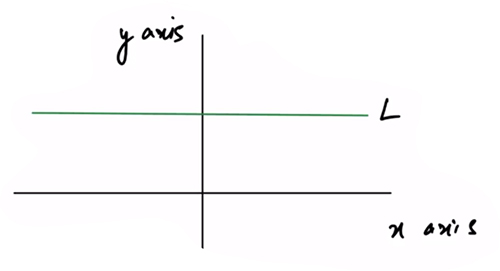
A straight line parallel to the x-axis has a constant y-coordinate for all its points.
Such a line has zero slope.
Statement:
The slope of any straight line parallel to the x-axis is zero.
2. Clear Explanation and Mathematical Derivation
Using Two-Point Formula
Let the line be parallel to the x-axis and pass through two points
[A(x₁, y)] and [B(x₂, y)], where the y-coordinate is the same.
- Change in y-coordinate:
[y₂ − y₁ = y − y = 0] - Change in x-coordinate:
[x₂ − x₁ ≠ 0] - Slope formula:
[m = \dfrac{y₂ − y₁}{x₂ − x₁}] - Substitute values:
[m = \dfrac{0}{x₂ − x₁} = 0]
Using Angle of Inclination
- A line parallel to the x-axis makes an angle
[\theta = 0°] with the positive x-axis.
Using the formula:
[m = \tan \theta]
[m = \tan 0° = 0]
Equation-Based Understanding
The general equation of a line parallel to the x-axis is:
[y = c], where [c] is a constant.
Since y does not change with x, the slope is zero.
3. Key Features
- Line is perfectly horizontal
- No rise, only run
- y-coordinate remains constant
- Graph never cuts the x-axis unless [c = 0]
- Represents equations of the form [y = c]
5. Important Formulas to Remember
| Description | Result |
|---|---|
| Line parallel to x-axis | [m = 0] |
| Angle with x-axis | [\theta = 0°] |
| Equation of line | [y = c] |
6. Conceptual Questions with Detailed Solutions
1. Why is the slope of a line parallel to the x-axis zero?
Because there is no vertical change in y as x changes. Since slope is the ratio of change in y to change in x, the numerator becomes zero.
2. What is the angle made by such a line with the x-axis?
The line coincides with the x-direction and hence makes an angle of [0°] with the x-axis.
3. Can a line parallel to the x-axis cut the x-axis?
Only when [y = 0]. Otherwise, it never intersects the x-axis.
4. Does a zero slope mean the line is flat?
Yes. A zero slope indicates a completely horizontal or flat line.
5. Can two different horizontal lines intersect?
No. If they have different y-intercepts, they are parallel and never intersect.
6. Is slope zero the same as slope not defined?
No. Zero slope corresponds to horizontal lines, whereas undefined slope corresponds to vertical lines.
7. Is the x-axis itself a special case?
Yes. The x-axis is the line [y = 0], whose slope is zero.
8. Can a constant function have a non-zero slope?
No. A constant function represents a horizontal line and always has zero slope.
9. What happens to slope if the line shifts upward or downward?
Slope remains unchanged. Only the y-intercept changes.
10. Is zero slope possible for a slanted line?
No. Any slanted line has either a positive or negative slope.
7. FAQ / Common Misconceptions
1. Zero slope means no line exists.
Incorrect. A zero slope means a horizontal line exists.
2. Horizontal line means y = 0 only.
Incorrect. Any line of the form [y = c] is horizontal.
3. Zero slope and undefined slope are the same.
Incorrect. They represent entirely different orientations.
4. Slope depends on where the line is drawn.
False. Slope depends only on inclination, not position.
5. Horizontal lines can never intersect y-axis.
False. Every horizontal line intersects the y-axis at [ (0, c) ].
6. A line parallel to x-axis always passes through origin.
False. Only [y = 0] passes through the origin.
7. Zero slope implies zero intercept.
Incorrect. Intercept can be any real number.
8. A horizontal line has no direction.
Incorrect. It has a direction but no vertical change.
9. Horizontal lines cannot represent functions.
False. They represent constant functions.
10. The x-axis is not a straight line.
False. The x-axis is a straight horizontal line.
8. Practice Questions with Step-by-Step Solutions
Question 1. Find the slope of the line y = 5.
Step-by-Step Solution:
Given equation: [y = 5]
y is constant for all x.
No vertical change.
Conclusion:
Slope [m = 0].
Question 2. Find the slope of the line passing through (2, 4) and (−3, 4).
Step-by-Step Solution:
Points: [ (2, 4), (−3, 4) ]
Apply slope formula:
[m = \dfrac{4 − 4}{−3 − 2}]
Simplify:
[m = \dfrac{0}{−5} = 0]
Conclusion:
Slope of the line is [0].
Question 3. Find the angle of inclination of a line parallel to x-axis.
Step-by-Step Solution:
Slope of such a line: [m = 0]
Use relation: [m = \tan \theta]
So, [\tan \theta = 0]
Hence, [\theta = 0°]
Conclusion:
Angle of inclination is [0°].
Question 4. Is the line y = −7 parallel to the x-axis? Justify.
Step-by-Step Solution:
Given equation: [y = −7]
y is constant for all x.
Such lines are horizontal.
Conclusion:
Yes, the line is parallel to the x-axis and has slope [0].
Question 5. Find the slope of the x-axis.
Step-by-Step Solution:
Equation of x-axis: [y = 0]
y is constant.
Hence slope is zero.
Conclusion:
Slope of x-axis is [0].
 Sign in with Google